Hajj Inspirations in Saudi Visual Art
Knowledge Affairs – Special
The Hajj pilgrimage is the fifth pillar of Islam. This divine obligation began with the construction of the Holy Kaaba by Prophet Ibrahim (Abraham) and Prophet Ismail (Ishmael), peace be upon them. It holds profound human significance throughout the history of humanity, as the Kaaba has remained a destination close to the hearts of believers around the world. Its importance grew further with the emergence of Islam and the final divine message brought by Prophet Muhammad, peace and blessings be upon him.
This historical and spiritual depth is reflected in the rituals of Hajj, including the various rites, the pilgrims’ response of Labbayk, the arrival and farewell circumambulations of the Kaaba, standing at Arafat, spending the nights of the Days of Tashreeq in Mina, offering sacrifices, and giving charity.
All these rituals have inspired Muslims around the world to embrace sacrifice and devotion. They have also inspired writers, travelers, poets, artists, calligraphers, decorative artists, painters, and visual artists, each drawing upon artistic elements with profound human significance in their respective fields. In this way, the creative culture of Hajj has become a vast source of knowledge, expressing a spiritual culture that stands among the most remarkable in human history.
Among the notable sources of artistic inspiration are the visual arts, which have drawn upon this radiant abundance of scenes and images. These works take inspiration from the movement of pilgrims toward Makkah and their Hajj journeys, following the entire course of the pilgrimage and encompassing its many religious scenes and rituals.
Saudi Visual Creativity:
Saudi visual artists have drawn inspiration from the Hajj pilgrimage in many of their paintings. Hajj represents an inspiring visual and spiritual heritage in Saudi visual art. Depicting the pilgrimage is no longer merely a traditional record of a place; it has evolved into contemporary and conceptual artworks that reflect the unity of Muslims, the majesty of the sacred sites, and the emotional depth of a journey in which differences disappear. The sight of pilgrims dressed in spiritual white garments, symbolizing purity and detachment from worldly concerns, remains an enduring image in the imagination of art and Saudi artists. Among the most prominent Saudi visual artists who have drawn inspiration from Hajj in their works are His Royal Highness Prince Khalid Al-Faisal, Abdulhalim Radwi, Taha Sabban, Dia Aziz Dia, Mohammed Al-Saleem, Abdullah Hamas, Mohammed Al-Rabاط, Samir Al-Dahham, Mohammed Al-Ajam, Mohammed Siam, Abdullah Nawawi, and others.
Because a sense of place is closely connected to artists’ identities, vision, and spirit, their visual artworks have been deeply influenced by scenes of Hajj. The circular geometry of pilgrims’ movement around the Kaaba has served as a source of visual inspiration. Materials such as fabric, including the cloth covering the Kaaba, have provided another source of inspiration, with artists incorporating fabric into the composition and structure of their paintings.
A Mural in Jeddah:
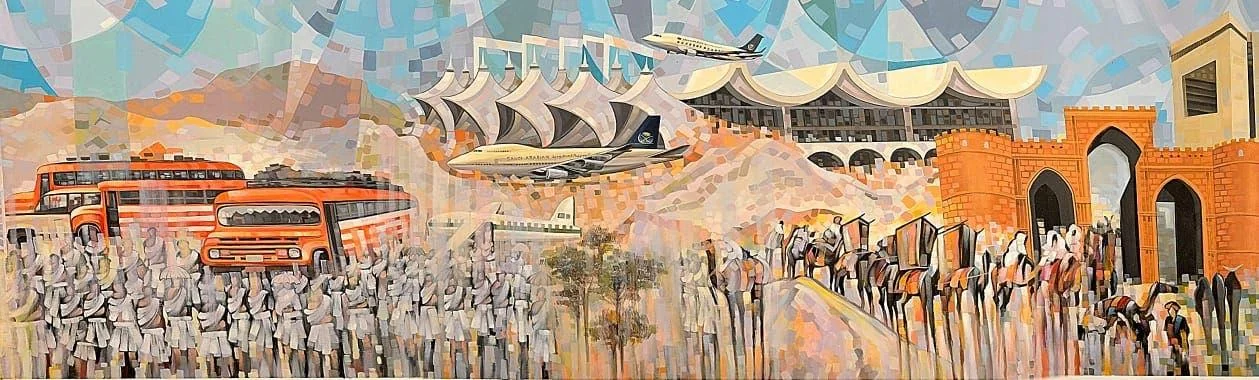
Among the notable works in this field is the creation by Saudi artist Mohammed Al-Rabاط, who depicted the Hajj journey in a mural extending 36 meters at King Abdulaziz International Airport in Jeddah. Other works by earlier visual artists have similarly focused on capturing and depicting scenes of circumambulation around the Kaaba, the Day of Tarwiyah, standing at Arafat, and the stoning of the Jamarat. They have also portrayed the minarets of the Grand Mosque in Makkah and the Prophet’s Mosque in Madinah.
Artists have also focused on the beauty of the holy sites in Makkah, visits to Madinah, and various religious landmarks, such as the Cave of Hira and Mount Uhud, among others. Using a variety of modern artistic styles, they have depicted the expansion of the Grand Mosque in Makkah, highlighting the decorative, colorful, and lighting effects introduced during its most recent expansion.
Many exhibitions featuring a large number of visual artworks inspired by the Hajj pilgrimage have also been held. These include the “Hajj Ritual Exhibition” in Jeddah and the “Art Path” exhibitions, which showcase works inspired by the spirituality, sanctity, and movement of the pilgrimage journey between the Holy Grand Mosque in Makkah and the other rituals associated with fulfilling this divine obligation. Hajj remains a major source of inspiration for Arab, Islamic, and global literature, art, and culture.