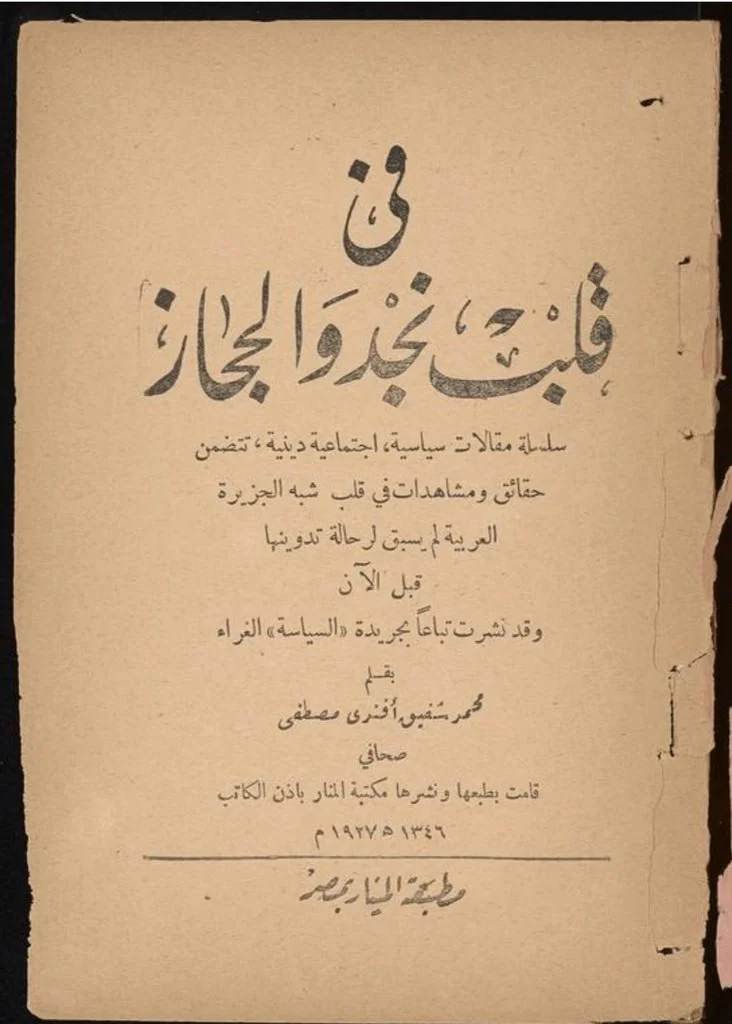
In a rare book published in Cairo 99 years ago, an Egyptian writer portrays King Abdulaziz five years before the founding of the Kingdom.
Knowledge Affairs – Special
It is a rare historical book, seldom mentioned in studies, sources, and references. It was written by the Egyptian author Muhammad Shafiq Mustafa in 1927, and recounts a journey he undertook from Cairo to the Arabian Peninsula in 1926, traveling on camelback from Al-Qurayyat in the north to Riyadh in 35 days. He recorded his observations of the countries he visited in a book entitled “In the Heart of Najd and the Hijaz.” The articles that make up the book were first published in the Egyptian weekly newspaper Al-Siyasa, whose editor-in-chief was the renowned writer, author, and poet Muhammad Hussein Heikal, and were later compiled into this book.
In the book, he discusses some of the characteristics of the people of Najd, including their patience and perceptiveness. Upon his arrival in Riyadh, he had the honor of meeting King Abdulaziz, who said to him verbatim: “My love and appreciation for the people of Egypt are beyond what you can imagine.”
Among the most beautiful passages, which perhaps have not been widely circulated in research and historical books, is his description of the founding King, Abdulaziz Al Saud. He writes:
“As for His Majesty King Abdulaziz bin Saud, he is tall, well-built, copper-colored, bright-eyed, pleasant-faced, and wears spectacles. He displays signs of exceptional intelligence, strength of will, and firmness of determination, together with graciousness of character, deliberation, and reflection in everything that comes from his mouth in the form of speech. His Majesty is approaching fifty years of age. He was shot in the thumb of his left hand during the war, leaving a visible mark that remains to this day. When he walks, he habitually lowers his head toward the ground. He wears a Najdi cloak embroidered with gold and often raises part of it beneath his armpit. He does not walk quickly. He is loved by his people and does not fear harm from anyone; therefore, he does not pay much attention to having guards constantly accompany him.”
Before Dawn Breaks:
In describing the daily life of King Abdulaziz, the author says:
“His Majesty has made it his custom to rise before dawn breaks, without requiring any of his close associates to rise at that time. After performing ablution and reciting whatever portions of the Holy Qur’an he can, and after the muezzin calls for the dawn prayer, he proceeds to the palace mosque, where a number of his servants await him. He performs the dawn prayer there, then returns to his quarters and has breakfast with whichever of his sons and family members are present.
Once he has finished, he moves to his private office in the royal court, where he reads letters, reviews and discusses various matters, and gives his written opinions. He remains there until an hour after sunrise. He then moves to one of the reception halls, where he receives some of his close associates and sends for those whose affairs with him are of importance. After that, he receives delegations of the Ikhwan, spending considerable time welcoming and conversing with them and listening to what they have to say regarding their affairs and circumstances.
It is worth mentioning that these Ikhwan would speak to their king as though they were addressing one of their fellow Bedouins in the desert. This was not, as some might immediately imagine, a matter of ‘Bedouin roughness’ or a lack of respect for their king. Rather, they did so in adherence to the tradition of the righteous predecessors and in accordance with the way Muslims conducted themselves during the era of the Rightly Guided Caliphs. For example, I once saw one of them address his master, the King, saying: ‘O Abdulaziz.’ I found this astonishing and could hardly believe my ears, given the lowly status of the speaker and the broad forbearance of His Majesty, had one of them not whispered in my ear: ‘That is the constitution this king has established for us. He accepts it wholeheartedly and will accept no substitute for it.’”
A Historical Document:
This book, which was republished electronically by the Hindawi Foundation in 2012, serves as a document chronicling the history of Najd and the Hijaz across the sands of its desert. It contains a series of political, social, religious, and geographical articles filled with facts and observations from the heart of the Arabian Peninsula. Muhammad Shafiq Mustafa chronicled Najd and the Hijaz through descriptions of the countries he visited, which in turn revealed their customs, traditions, popular and cultural heritage, and religious beliefs.
The author began his journey by visiting the town of Qurayyat Al-Milh, considering it the first town to come under the influence of King Abdulaziz Al Saud, the Saudi monarch at the time. He then visited the cities of Al-Jawf, Hail, and Buraydah, discussed the beliefs of the people of Najd, and described the mosques of Riyadh and the residents’ commitment to prayer. He also described the punishment imposed on those who were late for prayer: their keffiyeh would first be taken from them; if they returned late again, their cloak would be taken; and if they returned once more, they would be punished with imprisonment.
He also mentioned the development of Unaizah and Buraydah in comparison with other places and spoke of the skill of their inhabitants in commerce. He also referred to the currency used in Hail at the time, known as the Shushi, which some called the riyal. He also discussed the Al-Samah Water in Hail, saying that it was no less important than Vichy mineral water in France, and mentioned its medicinal benefits.
He concluded his journey with a visit to Umm Al-Qura, Makkah Al-Mukarramah, where he discussed its administrative system, the rituals of Hajj, the practices of fasting, and various acts of worship. Muhammad Shafiq Effendi observed that most shops and stores in Makkah Al-Mukarramah were closed during the blessed month of Ramadan, while pedestrian activity in the streets was light, making the city appear almost deserted. He writes:
“We investigated the reason for this and learned that the people of Makkah devote themselves entirely, in all their affairs and aspects, during the month of fasting to worship, remaining in the mosques, and forgetting the pleasures and preoccupations of worldly life.”
He concluded his observations in his documentary account of the journey by saying:
“Thus, conditions developed in the two kingdoms of Najd and the Hijaz, and their strong integration was achieved. Najd emerged from its long isolation from the rest of the civilized Muslim peoples. Its king became the possessor of the decisive word and the voice that was heard in the Holy Lands and their affairs. His name became renowned among the kings of Islam, pointed to by the fingers, and he proved through action, not words, that he was worthy of this vast kingdom, so magnificent in its stature and held in such high regard in the eyes of all believers.”