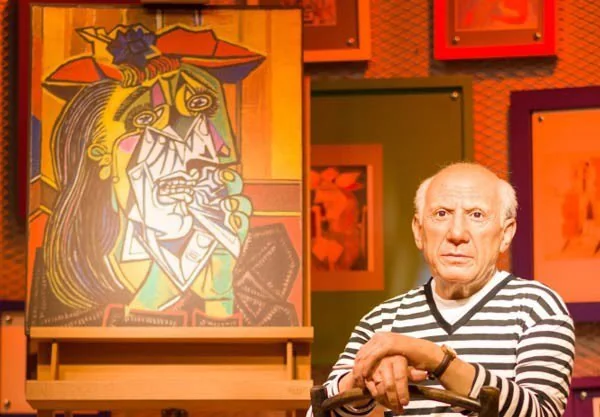
Abstract and Surrealist Visual Art: Between Genius and Madness
“There is no genius without a touch of madness.” This is how Aristotle is often said to have described the relationship between extraordinary creativity and madness. In states of madness, consciousness may become transformed and fragmented, and multiple selves and identities may emerge within the creative individual, sometimes driving them to produce the unexpected, whether through writing, in the case of an author, or through the seemingly irrational composition of a painting, in the case of a visual artist.
The creative artist possesses an exceptionally delicate sensitivity and a profound ability to contemplate things. At times, this intense contemplation may lead to a form of madness or an endless hallucination that finds its resolution only through the creation of an artistic work.
Perhaps the association between creativity and madness dates back to ancient times, when certain poets were placed within the category of the “mad” and were believed to draw their poetry from the mythical Valley of Abqar, where jinn were thought to dictate poems to them. An Arab poet once mocked another by saying:
“His demon is female, while mine is male.”
Such ideas gradually became attached to the poetic experience until the story of Majnun Layla, Qays ibn al-Mulawwah, further reinforced them through both poetry and personal experience.
The relationship between art and madness is also an extension of the ancient Greek idea that artists and poets entered states of possession or divine frenzy. In the visual arts, madness may appear in many forms: the madness of paintings, the madness of colors, and the madness of artistic designs.
Some people describe visual artists as “mad,” while others call them disturbed. Still others see them as among the purest and most refined manifestations of human creativity, particularly because some artists adopt unconventional appearances, grow their hair, mustaches, and beards in unusual ways, and sometimes behave in eccentric or unconventional manners.
Despite the advances made in psychology and medical science, many people continue to hold the mythical belief that there is a direct relationship between art and madness.
But is every great visual artist actually “mad” in one sense or another?
One of the most striking examples is the Spanish Surrealist artist Salvador Dalí, who was known for his extraordinary appearance, including his distinctive mustache, which resembled the horns of the passionate Spanish bulls in the arena, as well as his theatrical and hysterical laughter.
Salvador Dalí also enjoyed theatrical displays. At one of his exhibitions, he entered wearing a diving suit. When asked why he had chosen such an unusual outfit, he replied that he wanted to “go deeper into the human unconscious.”
His paintings were equally unconventional. In his famous painting of melting clocks, time appears to flow across objects and elements of the composition. He transformed psychological states, illusion, mythology, and the unconscious into visual imagery.
Examples include The Persistence of Memory and Dream Caused by the Flight of a Bee Around a Pomegranate a Second Before Awakening. Despite the unusual nature of his work and behavior, Dalí is regarded as one of the major figures of modern visual art and is widely recognized by historians of modern art movements for his contribution to Surrealism.
The Dutch painter Vincent van Gogh is another artist frequently associated with the relationship between creativity and psychological suffering. He experienced serious mental-health difficulties, although modern retrospective diagnoses of his condition remain debated.
Van Gogh once wrote about the tension between his ordinary state and his artistic life, describing how, when he was in what he considered his normal state, he could think in a balanced manner and produce paintings that cost him a great deal while bringing him little or no financial return. He regarded this situation as something that appeared irrational and almost like madness.
Van Gogh died in 1890 from a gunshot wound, leaving behind paintings and drawings that would eventually become enormously valuable and influential. During his lifetime, however, he received little recognition or financial reward for his work.
The Norwegian artist Edvard Munch, a major figure associated with Expressionism, provides another example of the complicated relationship between art, society, and psychological suffering. Under the Nazi regime, many works by Munch were removed from German museums and exhibitions after his art was condemned as “degenerate.” His artistic reputation, however, grew substantially after his death, and his legacy was later celebrated through institutions such as the Munch Museum in Oslo.
Among the great curiosities of the international art market is the enormous prices sometimes paid for abstract works that appear, at first glance, to contain almost nothing. An artist may place only black dots on a canvas, create a collection of wandering lines, or leave a largely blank surface with a single mark in one corner, suggesting that the empty space belongs to the viewer, who must complete it through imagination and interpretation.
Within this context, a work by the American artist and calligrapher Cy Twombly was sold for approximately $69.6 million at a Christie's auction in New York in 2014. The abstract work consisted largely of seemingly spontaneous, looping lines made with pencil. Its extraordinary sale price demonstrated the remarkable economic and cultural value that can sometimes be assigned to highly abstract forms of artistic expression.
Ultimately, the relationship between creativity and madness remains a fascinating subject. The unconventional appearance or behavior of an artist does not, by itself, establish mental illness, and creativity should not automatically be equated with psychological disorder. Yet throughout history, artists have repeatedly challenged conventional ways of seeing, thinking, and creating. In that sense, the boundary between what society considers ordinary and extraordinary has often been one of the most fertile territories in the history of art.
References
Al-Masry Al-Youm: https://lite.almasryalyoum.com/lists/69909
Sami Hassan Badr: https://www.samihassnbadr.com/2020/03/blog-post_28.htm