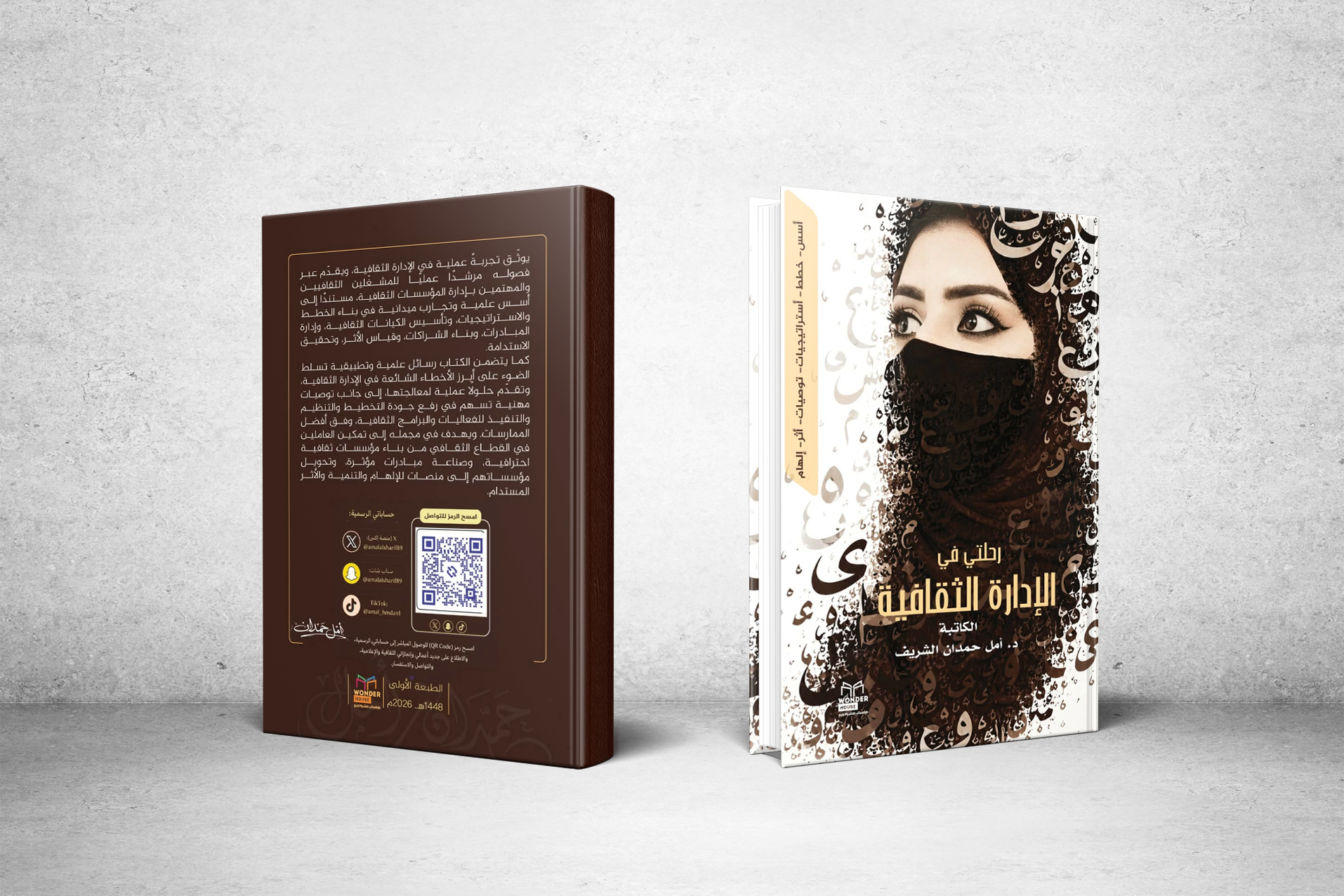
In her book My Journey in Cultural Management, Dr. Amal Al-Sharif documents her practical experience in cultural, media, and knowledge-based development.
Ahwal Al-Ma'rifa – Special
Cultural management today is no longer merely about organizing an event, preparing a program, or coordinating a passing occasion. Rather, it has become a discipline grounded in planning, vision, and the creation of sustainable impact. Culture does not flourish through individual efforts alone; it flourishes when it is managed with an institutional mindset that invests in talent, transforms ideas into projects, and turns initiatives into tangible achievements.
This is how writer and academic Dr. Amal Hamdan Al-Sharif expresses her vision of cultural management. She adds that the first principles of cultural management begin with the belief that culture is not a luxury, but a pillar of human and social development. Therefore, any cultural project should begin with a genuine need, clear objectives, defined target groups, a timetable, and measurable indicators of success, so that activities do not become seasonal efforts whose impact ends when the event is over.
Among the most important foundations of successful cultural management are a conscious reading of the cultural landscape, an understanding of community needs, effective use of available resources, and the development of partnerships with institutions and individuals. Culture is a collaborative endeavor that embraces everyone, and its impact becomes greater when efforts are integrated.
In her new book, My Journey in Cultural Management, published by Dar Al-Ajaaib for Publishing and Distribution, Dr. Amal Hamdan Al-Sharif documents her practical experience in cultural management and presents an applied vision based on years of work across the fields of culture, media, and administration. Through the book, she seeks to enrich specialized knowledge and transfer her experience to practitioners and those interested in the field.
Across more than 20 chapters, the book examines cultural management as an integrated system based on strategic planning, partnership building, initiative management, and impact measurement. It explores how ideas can be transformed into sustainable cultural projects that create added value for society, moving beyond the traditional concept of management as being limited to organizational and operational tasks. The book also addresses institutional identity-building and impact measurement, drawing on practical experiences and applied models that reflect the realities of cultural work and offer tools for developing higher-quality and more sustainable initiatives.
Throughout the book, the author presents field experiences and practical lessons acquired during her professional career. She emphasizes that the success of cultural work should not be measured by the number of events and programs, but by its ability to create sustainable impact, strengthen the role of culture in development, and consolidate its presence within society.
The book does not merely recount the author's experience; it transforms that experience into applicable knowledge through a collection of insights and recommendations aimed at practitioners, researchers, and those interested in cultural management. It emphasizes that successful cultural projects are not achieved through an abundance of events, but begin with quality planning, a clear vision, effective management, and sustainable impact.
The publication comes at a time when Saudi Arabia's cultural sector is experiencing rapid growth under the objectives of Saudi Vision 2030, which has positioned culture as one of the drivers of national development. These efforts have contributed to the development of the cultural work environment and strengthened its economic and social role.
The book represents a valuable addition to the Saudi cultural library, combining academic foundations with practical experience. This makes it a useful reference for practitioners, researchers, and those interested in cultural management, while contributing to the dissemination of professional practices and strengthening a culture of planning and impact creation within the cultural sector.
Dr. Amal Hamdan Al-Sharif summarizes her vision of cultural management by saying that its principles cannot be reduced to regulations or work templates. Rather, they begin with a thoughtful idea, a clear vision, and a belief that culture is a mission built on knowledge, managed with competence, and measured by the impact it leaves on people and society. When institutions manage culture effectively, they do not merely create successful events; they create a nation's memory, build bridges between the past and the present, and lay the foundations for a brighter future.
The author has previously published several books, including Movement and Impact and A Mark of Hope.