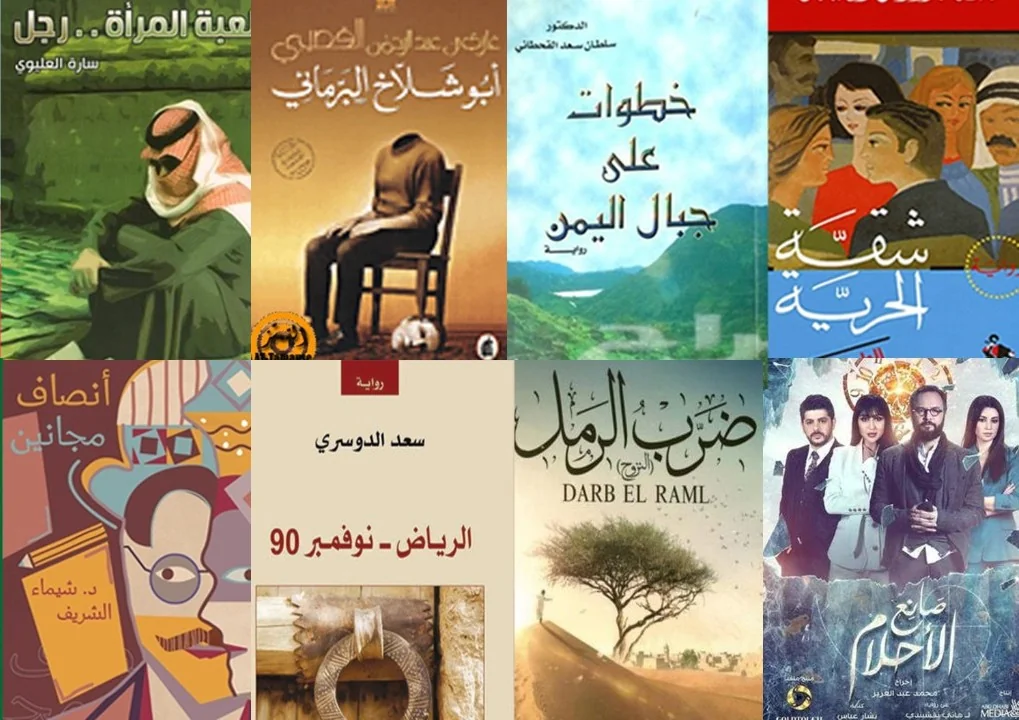
Transformations in Saudi Novel Titles: Between Drawing Inspiration from Values and Shaping Place
Knowledge Affairs – Special
Scholars concerned with fiction divide the Saudi novelistic scene into three stages. The first is the stage of beginnings and establishment, which commenced with the publication of the first Saudi novel, “The Twins” (Al-Taw’aman) by Abdulquddus Al-Ansari in 1349 AH / 1930. The second stage, which researchers refer to as the “stage of artistic maturity,” began with the publication of the first artistic novel in the Kingdom, “The Price of Sacrifice” (Thaman Al-Tadhiyah) by Hamid Damanhuri in 1959. The third stage is the “stage of renewal and modernization,” extending from 1980 to the present. This was the period during which the Saudi novel flourished and rose to prominence, particularly after the Second Gulf War in 1991, followed by a large wave of novel publications that began with “The Apartment of Freedom” (Shuqqat Al-Hurriyah) by Dr. Ghazi Al-Gosaibi, published in 1994.
The short-story writer, novelist, and researcher Khalid Al-Yousef has documented the number of Saudi novels published according to their historical stages. He and several other researchers indicate that 208 novels were published between 1930 and 1999, while 578 novels were published between 2000 and 2011, and more than 1,500 novels were published between 2012 and 2022.
Extensions of Place:
Amid this abundance of novels, place has formed a striking semantic dimension in the Kingdom’s novelistic experience. Saudi male and female novelists have searched for titles for their novels that draw upon the dimensions and aesthetics of place, pointing to it in ways that connect the novel with its setting, history, and geographical, social, and cultural extensions.
While the early novels tended to draw inspiration from values, eras, and human situations, and featured titles such as “An Idea,” “The Price of Sacrifice,” and “A Hole in the Night’s Robe,” along with other romantic titles such as those of Samira Bint Al-Jazirah’s novels: “I Bid Farewell to My Hopes,” “Tearful Memories,” “The Sparkle of Your Eyes,” and “Behind the Fog,” the titles of Saudi novels in the third Gregorian millennium became closely associated with place and the details of everyday life.
Place and Imagination:
As we browse the titles of Saudi novels, we may notice that some choose the names of places, streets, and alleyways as their titles. The integration between the narrative work and place points to a particular significance. Place may refer to a historical, heritage, or modern location, and in this reference it encompasses the life of a particular society at a particular time and place—a place with its own characters, events, incidents, circumstances, and references.
For this reason, novelists sometimes choose the names of places because they spare them a great deal of explanation and interpretation. The name of the place moves directly into the reader’s imagination, carrying with it its history, heritage, architectural characteristics, old sites, markets, traditional cafés, references, or even modern urban spaces. Place has its own meanings and aesthetics, which novelists skillfully employ. From it they draw inspiration for their fictional works, the characters who move within it, and the extent to which those characters express reality and society. They also draw upon the spirit of place and its various linguistic levels according to the characters who inhabit it, highlighting in their novels what literary criticism and critical theory refer to as the “aesthetics of place.”
From here, many novelists seek to connect their fictional creativity with the name of a particular place, perhaps for two reasons:
First: To express the place itself and draw inspiration from its buildings, architectural style, and the characters who live there.
Second: To connect the novel and its title with the name of the place itself, allowing the work to gain a degree of popularity through the prominence of the place chosen for its title. This phenomenon can be found in both international and Arab novels.
In world literature, many novels have celebrated the names of places, such as “A Tale of Two Cities,” “Wuthering Heights” by Emily Brontë (1847), and “Berlin Alexanderplatz” by Alfred Döblin (1929). In Arabic literature, there are novels by Naguib Mahfouz such as “Palace of Longing,” “Sugar Street,” and “Palace Walk,” all referring to places in Cairo; “No One Sleeps in Alexandria” by Ibrahim Abdel Meguid; “The Mills of Beirut” by Tawfiq Yusuf Awwad; “The Latin Quarter” by Suhail Idris; “Sana’a: An Open City” by Muhammad Abdulwali; and “The Granada Trilogy” by Radwa Ashour, among many other novels.
The Saudi novelist has made use of numerous places, choosing them as titles for novels. Sometimes these are heritage sites, places associated with a historical event or circumstance, or places connected to childhood and upbringing, such as villages, alleyways, old streets, and other locations that may carry personal significance for the author. They may be places of education, upbringing, travel, migration, or learning, or even places that represent the homeland of the beloved, as in the heritage places of poetry that ancient Arab poets excelled in describing.
Among the Saudi novels that bear the names of places in the Kingdom are Turki Al-Hamad’s “Al-Karadeeb,” “Al-Adamah,” and “Al-Shumaisi”; Abdullah Bakheet’s “Al-Ataif Street”; Yahya Amqasim’s “Saq Al-Ghurab”; Abdulaziz Mishri’s “Al-Wasmiyah”; Badria Al-Bishr’s “Love Affairs on Al-Asha Street”; Salah Al-Qurashi’s “The Mountain Girl”; and Yousef Al-Muhaimeed’s “The Pigeon Does Not Fly in Buraidah.”
Other novels have also carried the names of cities, places, and streets, including “Girls of Riyadh” by Raja’a Alsanea and “The Seduction of Jeddah” by Muqbil Al-Alawi, along with other novels that express a number of places across the Kingdom.
Perhaps the choice of places here does not tend toward affluent or prestigious locations, possibly because of their limited popular density or the limited diversity of social groups within them. Novelists often tend to draw inspiration from old and popular neighborhoods because of the abundance of subjects they contain and the dramatic diversity in the lives of their characters. They also provide the social movement created by the presence of different social classes and groups within a single place, enriching that place intellectually and dynamically due to the interdependence between the various social groups.
Spatial illumination through narrative fiction provides implicit aesthetic, historical, and social frameworks for place. Every place has its own traditions and identity within the broader framework of the country. It expresses, among other things, diverse cultures and evolving, changing lives, at whose depth emerges a subtle human dimension that constitutes one of the principal purposes of the world of the novel.
References:
· Dr. Sahmi Al-Hajri: The Dialectic of Text and Formation: The Novelistic Boom in Saudi Arabia, Arab Diffusion Foundation, Beirut, 1st ed. – 2009
· Dr. Hassan Hijab Al-Hazmi: The Hero in the Saudi Novel, Jazan Literary Club, 1st ed. – 2001
· Dr. Muhammad Saleh Al-Shanti: The Art of the Novel in Contemporary Saudi Literature, Dar Al-Andalus for Publishing and Distribution, Hail, 2nd ed.