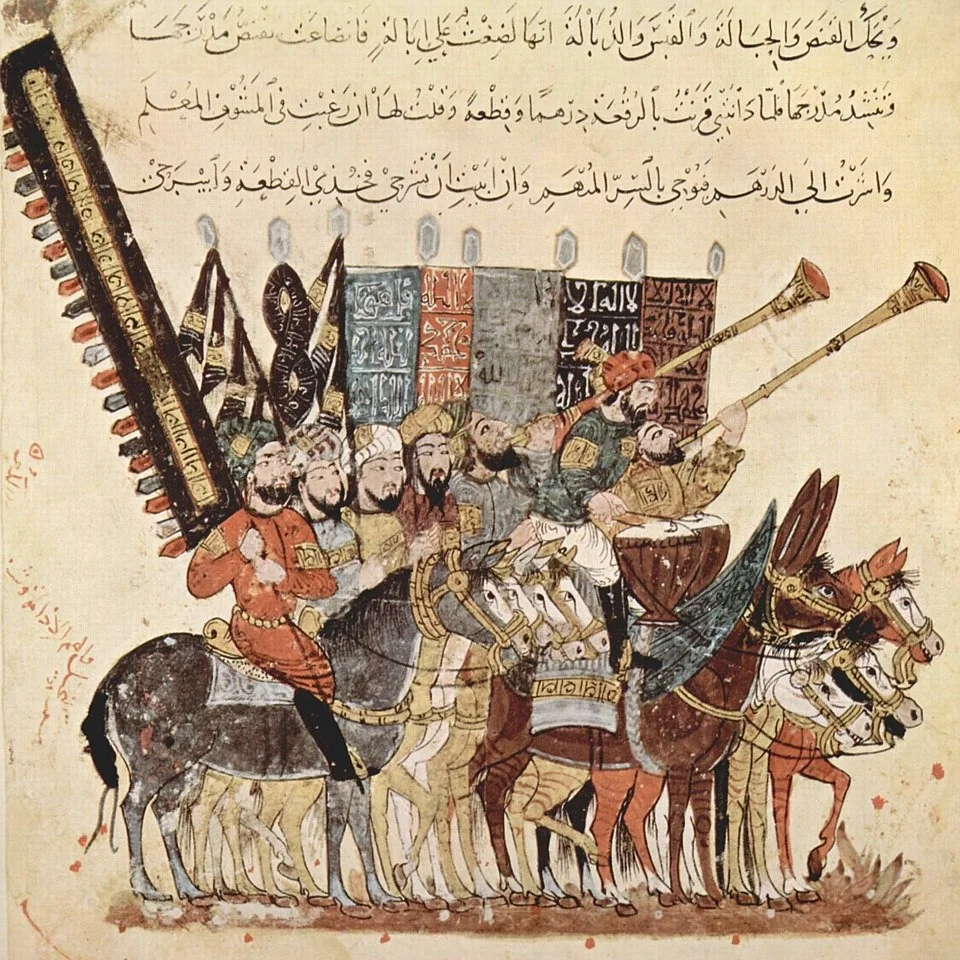
Al-Wasiti’s Miniatures in the Maqamat of Al-Hariri: The Earliest Artistic Depiction of Hajj Journeys from 800 Years Ago
Knowledge Affairs – Special
One of the most remarkable early visual arts in the Islamic world is the art of miniature painting, which first appeared in the early centuries of Islam. Among the prominent artists in this field was Yahya ibn Mahmud al-Wasiti, who excelled at producing one hundred illustrations for the book Maqamat al-Hariri, depicting 50 of the book’s themes through his paintings.
Miniature paintings are decorated with bright, clear colors. Artists focus on sandy tones, different shades of brown and green, and black, in addition to the various colors of the clothing worn by the figures depicted in these paintings. Al-Wasiti used mixtures of colors, such as mustard, which he mixed with black camphor oil when creating his miniatures and artistic paintings. He also incorporated lines, passages from stories, and sometimes lines of poetry or verses from the Holy Quran.
In his drawings, Al-Wasiti focused on drawing inspiration from the Islamic life in which he lived. He also created a number of miniatures reflecting his inspiration from the journeys of pilgrims traveling along the seven Hajj routes through the deserts of the Arabian Peninsula.
Among Al-Wasiti’s most notable paintings, or miniatures, are those depicting Hajj journeys. He painted several journeys in which camels were commonly used, along with some horses. His miniatures also showed how guards moved with the caravans and how proud they were of their efforts to protect them from highway robbers.
Al-Wasiti created more than one painting of Hajj caravans, highlighting feelings of longing and yearning through the way the heads and necks of the camels were positioned. He developed a distinctive artistic style of his own. We find that he gave great importance to figures who were listening, paying attention, or watching something. Clear expressions can be seen on their faces.
Al-Wasiti also depicted nature and everyday life without flattery or bias. His paintings reflect gatherings of entertainment and music, sessions of judges, and Hajj caravans.
Al-Wasiti’s figures are steady, stable, and balanced, standing firmly and confidently on the ground rather than floating or drifting through the space of the painting. This becomes clear through his use of the ground line and the environmental details represented along it. These include carefully and attractively drawn thorny plants, an orange tree, a camel moving its leg, or a horse stretching its head forward and looking ahead toward the journey. The horse seems to share the pilgrims’ strong desire to travel to the House of God, as shown in the image of the Hajj caravan.
It seems that Al-Wasiti had a deep appreciation for poetry. As a result, harmony, balance, and rhythm are clearly present in his works. One painting shows the movement of a camel, the bending of plant branches, the leaning of a palm tree, and a chicken picking up grains. Al-Wasiti portrayed all these details with an artistic spirit. The same applies to the image of the camel caravan, which appears like a symphony of verbal and visual rhythms. In the Hajj scene, there is a shared forward movement, while the camels appear alert and ready to move. Both the people and their mounts seem eager to reach their destination quickly, and the flags move forward as well. All these images are purely poetic in nature.
Yahya ibn Mahmud al-Wasiti lived in the thirteenth century CE. He was an Arab Muslim painter and calligrapher who became famous for Islamic miniature painting. He is considered one of the most important founders of the Baghdad School of painting and one of the best-known Arab and Muslim painters of the late Abbasid period. He was born in the city of Wasit, in central Iraq, at the beginning of the thirteenth century CE. In 1237 CE, he produced a copy of the well-known Maqamat al-Hariri, which he decorated with one hundred of his own miniature paintings. This work was the first known example of Arabic painting to identify the artist who created and illustrated it.
Al-Wasiti was a well-educated and widely knowledgeable intellectual who transformed mental images into reality. He lived during the same period as a generation of thinkers from Mesopotamia, such as the historian Ibn al-Athir al-Jazari, the scientist Ibn al-Razzaz al-Jazari, and the geographer Yaqut al-Hamawi, among others. He held exhibitions in the libraries of Al-Mustansiriya School in Baghdad. His artistic works, including manuscripts, were acquired in Andalusia and the Maghreb, particularly by the rulers of the Almohad dynasty in Marrakesh.
Yahya al-Wasiti was the leading figure of the Baghdad School of decorative painting, as visual arts were also known. The art of decorative painting became known in Arab-Islamic civilization alongside literary works and artistic traditions inherited from earlier civilizations.
Footnotes: