Released 45 years ago as a record of architectural heritage: 33 rare plates featuring Al-Ula, Riyadh, Jeddah, Abha, Najran, and various other Saudi regions.
Knowledge Affairs – Special
Among the earliest books to anticipate and document the architectural heritage of Saudi Arabia is the book by Muhammad Wahbi Al-Hariri, published in 1981. The book was produced in a large and rare format (81 × 64 cm) and consists of artistic plates in black ink drawn by the artist Al-Hariri depicting the AlUla region (Hegra), as well as a number of cities in the Kingdom, including Riyadh, Jeddah, Abha, Najran, Sarat Ubaidah, Jizan, and Bisha.
The book contains (33) plates drawn by the artist Muhammad Wahbi Al-Hariri of selected locations in several regions of the Kingdom, representing various forms and styles of architectural heritage.
The introduction to the book, which was published during the reign of King Khalid bin Abdulaziz – may he rest in peace – was written by Dr. Ghaith Rashad Pharaon. In it, he dedicated the book to everyone who contributed to its production and publication, to everyone who encouraged and supported the work, to all those who loved knowledge and pursued it, and to those who wished to learn about the history of the Kingdom and its architectural heritage throughout the ages.
The introduction was handwritten with a brush by the artist Muhammad Wahbi Al-Hariri, the author of the book and the artist who drew its plates. It begins: “To everyone who loves truth, its beauty and splendor, and seeks it in order to uncover it.” It also states: “I began traveling along the Red Sea coast, north and south, and moved among the cities of the Kingdom, large and small, near and far, to examine what had been built during different historical periods. I spent a long time traveling and exploring, until I was able to complete what I could of these studies. And I say, before God and the people, as a word of truth, that the people of the Kingdom everywhere – young and old alike – never hesitated or delayed in accompanying me to places that I would not have been able to reach.”
The book begins with its title in both Arabic and English, followed by a dedication and acknowledgment by Dr. Ghaith Rashad Pharaon, then an introduction by the author, artist, and Syrian-American researcher Muhammad Wahbi Al-Hariri, followed by a map of the Kingdom of Saudi Arabia. This is followed by a page containing a table of the plates. The book includes (33) plates distributed as follows:
Riyadh is represented by one plate depicting the inner courtyard of His Majesty King Abdulaziz Al Saud’s Palace; Makkah by one plate depicting Ajyad; Al-Hofuf by one plate depicting an old mosque; Al-Qunfudhah by one plate depicting the house of Ibrahim Omar in Wadi Maroun; and Bisha by one plate depicting the houses of the heirs of Saeed. Najran is represented by two plates depicting the old Emirate Palace and the house of Jaber bin Hussein bin Naseeb. Two plates from Dhahran Al-Janub depict two houses in the villages of Al-Qa’ah and Al-Mu’nis.
The book also includes (4) plates of houses from Jizan, from two villages: Abu Al-Qa’a’id and Al-Farshah; (5) plates from Abha depicting houses from Wadi Tayyib, the village of Al Tajer, and Al-Mallahah; and (4) plates from Sarat Ubaidah depicting houses from the villages of Al Mahdi, Al Abbas, Al-Ma’tif. The book also includes (5) plates from Hegra, depicting Al-Khuraymat and Qasr Al-Nabt, as well as Qasr Abu Lawhah.
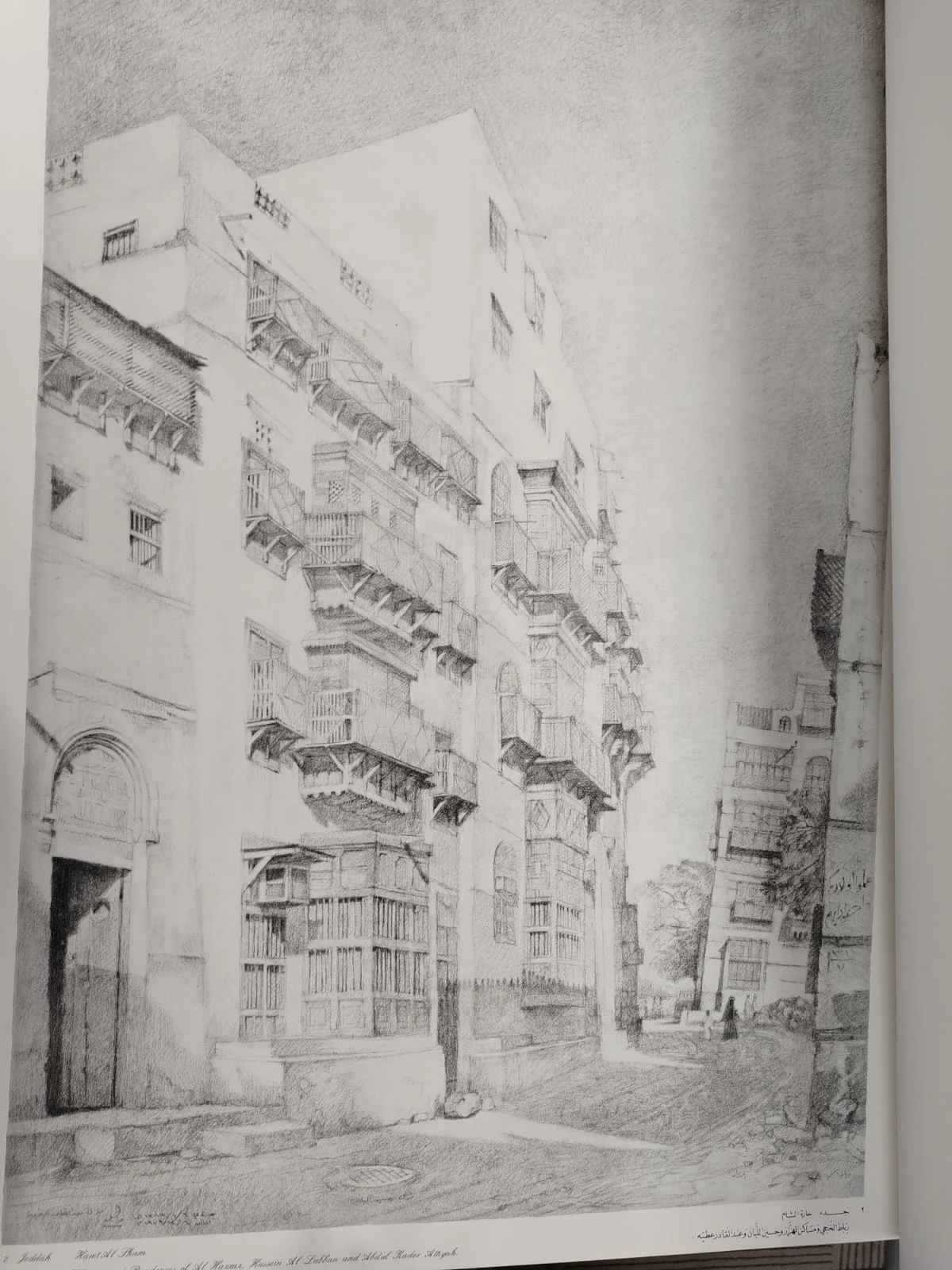
Jeddah is represented by (6) plates, featuring pencil drawings of several residences and houses located in Al-Sham neighborhood in Jeddah, including the houses of Al-Hazzaz, Hussein Al-Labban, Ahmed Al-Nazir, Abdulqader Atiyah, Muhammad Saleh bin Ali Ba’ashen, Muhammad Al-Jar, and Saleh Bashikh, as well as Al-Basha Mosque.
The plates highlight the diversity of architectural heritage across the regions of the Kingdom and the distinctive characteristics of one region compared with another, and of one village compared with another. While the old palaces were distinguished by columns, spacious balconies, and expansive courtyards, construction in Jeddah was distinguished by the presence of rawasheen, mashrabiyas, and wooden windows divided according to geometric arabesque patterns, along with intricately interwoven and ornamented woodwork. Rural houses, meanwhile, were simple mud-brick dwellings that nevertheless contained aesthetic touches reflecting their connection to the architectural environment found in each individual village.
It is worth noting that the author of the book, Muhammad Wahbi Al-Hariri (1914–1994), was a Syrian-American artist, writer, and engineer. He traveled to Paris, where he enrolled in its renowned École des Beaux-Arts to study architecture. He was the first Arab to graduate from this school. He also enrolled there in the School of Conservation of Antiquities at the Louvre Museum.
Upon returning to Syria, he contributed to the completion of several projects, including the overall design of Adnan Al-Maliki Square in Damascus, including its museum, as well as a project to preserve the historic Khalid ibn Al-Walid Mosque in the city of Homs.
His interest in Islamic art led him to travel to Saudi Arabia in the early 1960s, where he settled for several years as a researcher, explorer, and artist, alongside his official work in the Engineering Administration of Public Security. During this period, he published an important and substantial book entitled “The Architectural Heritage of the Kingdom of Saudi Arabia,” which was printed and published in 1981 in the Italian city of Florence. It contains pencil drawings representing various styles of Saudi architectural heritage. In 1987, he published another book featuring his photography entitled “Asir: Heritage and Civilization.” He later published another book in English, photographed and prepared by him in collaboration with his son Mukhlis, entitled “The Heritage of the Kingdom of Saudi Arabia.” In the final years of his life, he began preparing his new book, “The Houses of God,” for which he completed forty plates.