It Began in 1932 and Included Five Types.. The Theatre Laboratory Association for Studies and Research.. A New Addition to Saudi Theatre
Saudi theatre is a prominent landmark of Saudi culture. It began in 1932, the year the Kingdom of Saudi Arabia was established, and gradually developed until it became one of the Kingdom’s leading artistic and cultural activities.
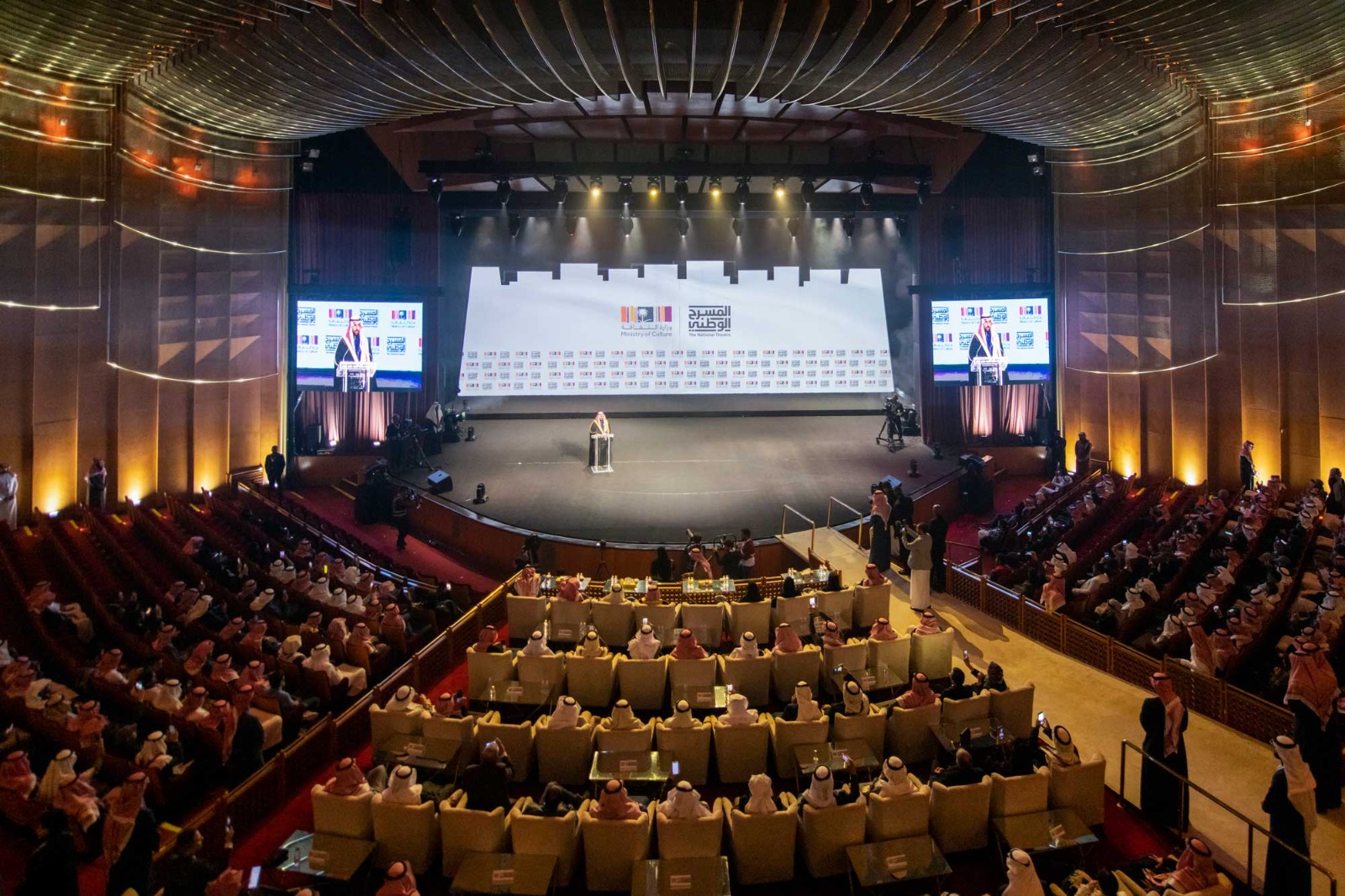
In 2019, the National Theatre and Music Troupe was established and based at the King Fahd Cultural Center. The Theatre and Performing Arts Commission was also established under the Ministry of Culture in January 2020. The first professional association for theatre and performing arts was founded in October 2021.
Continuing this cultural journey, which aims to highlight and promote one of the main creative arts in the Saudi cultural scene, the National Center for Non-Profit Sector Development approved the establishment of the “Theatre Laboratory Association for Studies and Research.” Its goal is to develop knowledge of theatre and performing arts in Saudi Arabia, strengthen scientific research and systematic criticism, and align its work with the objectives of Saudi Vision 2030 and the Ministry of Culture’s strategy.
Abbas Ahmed Al-Hayek was appointed Chairman of the Association’s Board of Directors, while Nada Al-Ghamdi became Vice Chairperson. The board also includes Amira Musa Al-Juhani, Dalal Al-Khaldi and Abdulwahab Al-Fandi.
The association focuses on documenting the history of Saudi theatre, building a database for researchers, supporting critical studies and training theatre professionals. It also aims to strengthen cultural and educational partnerships and launch initiatives and projects in the coming period.
Early Beginnings:
The early stages of Saudi theatre witnessed initial developments. Theatre activity in Saudi Arabia began with the first play written by the poet Abdullah Al-Hussein, titled The Wrongdoer Against Himself, in 1932. However, actual theatrical performances began to take place on Saudi stages in 1950, with plays such as Saladin and Abd al-Rahman al-Dakhil. Between 1960 and 1970, plays evolved into social productions presented to all members of society.
Theatre in the Kingdom includes five types of performing activities: school theatre, social or “popular” theatre, experimental theatre, elite theatre and academic theatre.
The 1970s and 1980s marked the peak of theatrical activity in the Kingdom’s major cities. This growth was linked to the establishment of branches of the Saudi Arabian Society for Culture and Arts, the active role of university theatres and the founding of literary clubs in Riyadh, Mecca, Jeddah, Medina, Jazan and Taif.
Commercial theatre productions also became prominent, flourishing during Eid seasons, national celebrations and summer holidays. In 1440 AH/2019, the Ministry of Culture established the first Saudi national theatre, named the National Theatre, at the King Fahd Cultural Center. The play Darayish Al-Noor was the first production presented by the theatre in 1441 AH/2020.
Diverse Writings:
The Saudi theatre library contains a large number of diverse plays. Several pioneers have contributed significantly to Saudi theatre. They were among the first to create theatrical works, establish theatres and present performances. This began in 1932 through several individual pioneering efforts to establish Saudi theatre, even before theatre itself became established.
The poet Hussein Abdullah Siraj wrote several plays, beginning with The Wrongdoer Against Himself in 1350 AH/1932, followed by Jamil and Buthaina in 1360 AH/1942 and Gharam Wallada in 1370 AH/1952.
Several Saudi writers and novelists also wrote plays. Among the most prominent was Ahmed Abdul Ghafour Attar, who wrote Migration in 1946 and The Epic in 1964. In 1952, Abdullah Abdul Jabbar wrote the play Uncle Sahnoun, followed by The Mute Devil in 1954.
In 1960, Mohammed Malibari wrote The Conquest of Mecca and Musaylimah the Liar. Abdullah Buqis and Issam Khuwair also wrote the play When the Night Became Empty. Ibrahim Hamdan wrote a women’s play titled Monoklia, while the works of the writer Malha Abdullah also contributed to Saudi theatre.
Between 1960 and 1970, plays developed into social productions intended for all members of society, including The Diver and Your Day Will Come, Oppressor. In 1980, the Society for Culture and Arts presented several plays, including A House Made of Palm Leaves by Nasser Mubarak.
Most of these plays explored social realities and focused on everyday details, strengthening the relationship between theatre and the general public.
The General Presidency for Youth Welfare, now the Ministry of Sport, also contributed to theatrical activity by managing sports clubs and encouraging performances on their stages. It established a “Theatre Arts” department and later supervised literary clubs and the Saudi Arabian Society for Culture and Arts after their establishment.
These organizations presented dozens of theatrical productions and introduced hundreds of actors, contributing to the development of theatre throughout the 1960s, 1970s and 1980s, alongside the regular organization of theatre festivals.
Several festivals are held across the Kingdom, including the Dammam Theatre Festival, Taif Festival, Jeddah Festival, Janadriyah Festival, Souk Okaz Festival and Riyadh Theatre Festival.
In 2023, the number of theatres in the Kingdom reached 263, according to open data from the Ministry of Culture. Today, the Kingdom has several large, well-equipped theatres, including:
Mohammed Abdu Theatre: The largest specialized theatre, with a capacity of up to 18,000 people.
Abu Bakr Salem Theatre: With a capacity of 7,000 seats.
Talal Maddah Theatre (Al-Muftaha): With a capacity of approximately 3,800 people.
Mohammed Al-Ali Theatre: Accommodating more than 600 people.
Bakr Al-Sheddi Theatre.
King Fahd Cultural Center Theatre in Riyadh: With a capacity of approximately 3,000 people.
Maraya Theatre in AlUla: With a capacity of approximately 500 people.
References:
The Beginnings of Saudi Theatre, Abdulrahman Fahd Al-Khariji, Saudi Arabian Society for Culture and Arts, first edition, 1407 AH/1986.
Saudi Theatre: A Critical Study, Nazir Al-Azma, Riyadh Literary Club, Riyadh, first edition, 1413 AH/1993.
Saudi Theatre Between Construction and Apprehension, Halima Mudhaffar, Taif Literary and Cultural Club; Dar Sharqiyat, Cairo, first edition, 1430 AH/2009.
Saudi Theatre: From Pioneering to Renewal, Dr. Sami Al-Jamaan, Al-Ahsa Literary Club, first edition, 2018.
Contemporary Saudi Theatre: Themes and Trends—An Artistic Study, Latifa Al-Buqami, Al-Ahsa Literary Club, first edition, 2018.