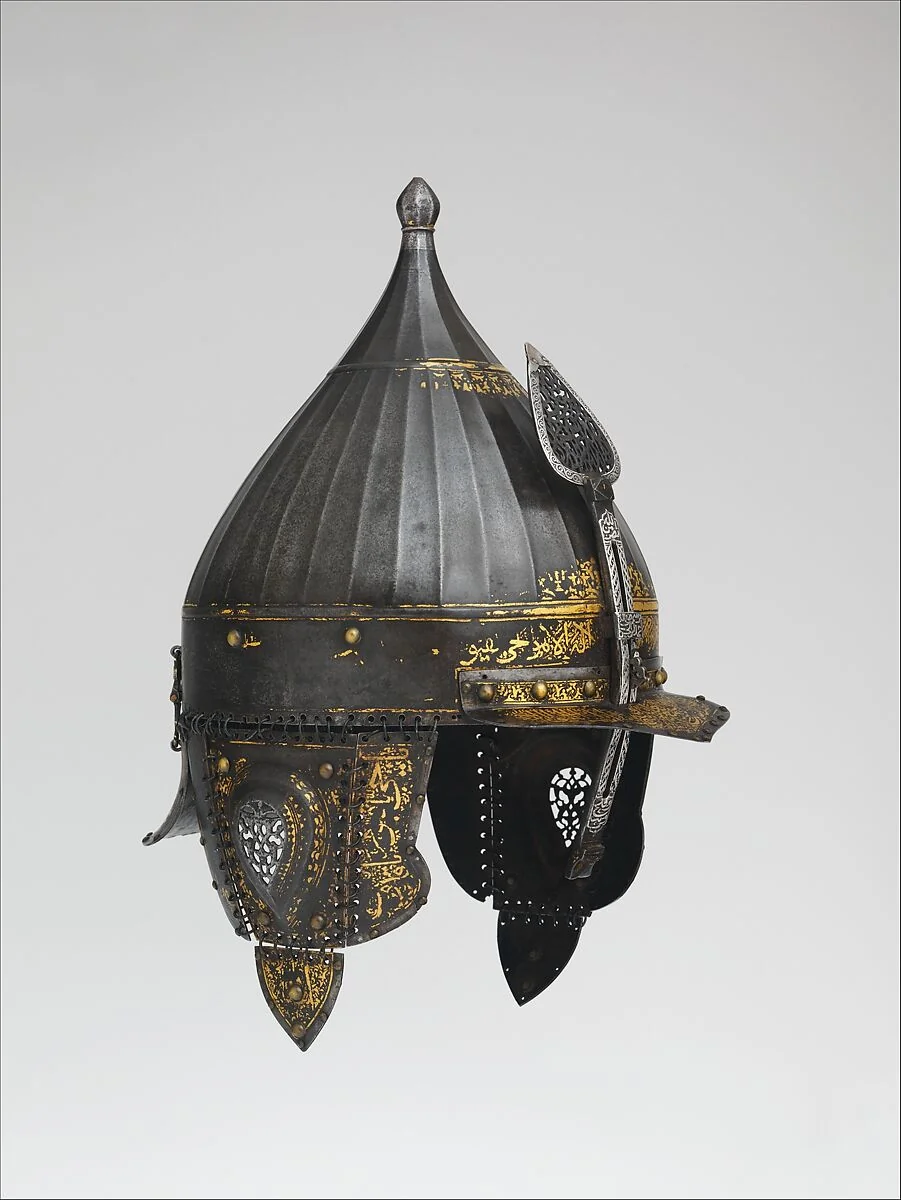
Swords, daggers, and shields inlaid with gold and intricate engravings—the aesthetics and artistry of ornamentation on Arab and Islamic weaponry and armor.
Knowledge Affairs – Special
The forms of decorative art in Arab-Islamic civilization are remarkably diverse, among the most prominent being Arabic calligraphic inscriptions, whether found in literary works, books, and manuscripts, or on murals and in the writing of Quranic verses inside mosques, on walls, minarets, and domes. They also appear through the art of miniatures, which adorn books and manuscripts. Ornamentation is an authentic Islamic art that falls within the scope of arabesque. Bashir Fares says:
“In the field of ornamentation, Arab genius emerged with the advent of Islam, and its freshness flourished... The essence of Arab ornamentation lies within what archaeologists call the ‘arabesque,’ which encompasses the concepts of drawing, engraving, ornamentation, embroidery, inlay, and decoration.”
Among the decorative arts of Arab-Islamic civilization is the ornamentation of weapons, such as swords, shields, spears, daggers, helmets, bucklers, and other weapons used by Muslims during their conquests of countries and cities.
In her study “The Aesthetics of Inscriptions and Writings on Islamic Weapons in the Mamluk Era,” Dr. Shereen Al-Qabbani highlights important observations concerning these inscriptions, their forms, and their nature. She points out that, when Muslims manufactured weapons, they did not limit themselves to their practical purpose—that is, as mere instruments of warfare. Rather, like other products of their artistic civilization, they were filled with aesthetic elements:
“Although individual weapons were made of steel and iron, they were embellished with gold and silver and encrusted with precious stones and jewels. They carried many intricate Islamic vegetal and geometric ornaments. The Muslim artist and craftsman was never constrained by metals that were difficult to thin when producing various weapons. Rather, he shaped and decorated sword grips and guards in the forms of animals, and made dagger handles from solid rocks carved with the utmost precision and variety.”
The researcher also notes that inscriptions on weapons can be divided, in terms of their content, into several types: Quranic verses relating to the exhortation to fight and persevere in battle, which promise victory and conquest; letters and words through which the warrior sought blessings for victory; and commemorative inscriptions bearing the name of the sultan or governor in whose name the weapon was made or during whose reign it was produced.
Quranic verses were engraved on swords, which were then decorated with gold and silver. The earliest swords in Islamic history had straight, sharpened blades, either on one side or on both sides. This type of sword was used for many centuries. As for the dueling sword preferred by warrior horsemen, it was the curved sword. During the Umayyad and Abbasid periods, the most common form of sword was the straight blade sharpened on both edges.
From Coloring to Inlay:
Muslim artists used a range of elements in decorating various weapons and shields, forming the basis of their artistic approach to ornamentation. These elements added aesthetic qualities to the appearance of weapons and demonstrated the pride that knights and warriors took in them. Among these was coloring, one of the common forms of decoration on weapons and shields. This involved coloring certain areas or the entire surface of an object with paint, covering it with textiles, or attaching material to the surface of the weapon—whether a sword, shield, or helmet—using glue, stitching, or nails.
Surfaces and components made of iron or steel could also be polished, either through heat or chemically, as well as through gilding.
The preferred color for shields and edged weapons was dark blue, along with brown.
Artists also gilded military equipment with either gold or silver by attaching a very thin sheet of gold or silver to the surface of a buckler, shield, sword hilt, or dagger using an adhesive material. Another method was fire gilding, in which gold powder was mixed with mercury and applied to the surface, then heated to drive off the mercury, leaving the gold bonded to the armored metal surface. This method was known as fire gilding.
Decorative artists also used a technique known as inlay, which became particularly famous in what was known as the “Damascus sword” during the Islamic periods. This decorative technique was applied to the metal surfaces of edged weapons and shields, where various weapon components were inlaid and embellished.
Weapons were also engraved, either by depicting particular motifs or by inscribing Quranic verses.
Engraving is a technique through which decorative patterns or inscriptions are cut into a metal surface using a sharp, pointed tool made of hardened metal. Along with drawing, engraving is considered one of the oldest forms of decoration on weapons and shields and can be found on weapons dating from the Stone Age and Bronze Age. Although relatively rare on shields, it is frequently found on blades and other remnants of edged weapons.
Decorating Daggers
The manufacture of daggers dates back to the second or third century AD. In Islamic civilization, distinctive features can be seen in the nature of decorative art applied to daggers in the Levant. Ornaments were engraved on the hilt and sheath, which were made of silver, with the hilt taking the form of a crown in its decorative style. The sheath was divided into four sections separated by slightly raised, undecorated metal rings.
During the nineteenth century, a number of people interested in Islamic icons and artifacts collected examples of these objects, including the Henri Moser Charlottenfels Collection at the Bern Museum and the Lord Hertford Collection at Hertford House in London, in addition to the Imperial Arsenal collection in Vienna. There were also diverse collections at the Istanbul Museum in Turkey and the War Museum in Cairo, while the East India Company also acquired a share of the heritage of Islamic weapons and instruments of warfare.
The interest in collecting these weapons was not limited to documenting instruments of combat as historical objects; it also reflected their aesthetic qualities. Muslim craftsmen decorated them with gold and silver and encrusted them with precious stones, Islamic vegetal and geometric motifs, and Arabic inscriptions containing Quranic verses and supplications.
Historians mention that Sa‘d ibn Sayl, the maternal grandfather of Qusayy ibn Kilab, was the first to embellish swords with silver and gold. Ibn Khaldun also referred to the flourishing of swordmaking in Damascus, including the swords of Mu’ab and Al-Ailah, whose production employed a technique known as “Damascene.”
In addition to Arab and Islamic museums, the Metropolitan Museum of Art in New York, the British Museum, the Louvre Museum, and the Vienna Museum house large collections of ancient Arab and Islamic weapons bearing diverse decorative motifs and written in various forms of Arabic script, most of them featuring Quranic verses.
The Metropolitan Museum of Art in New York houses a large number of decorated Islamic weapons, including swords, shields, daggers, helmets, bucklers, and iron pieces that were used in ancient warfare.
The Institut du Monde Arabe in Paris also houses a valuable and rare collection of swords and daggers, forming part of the holdings of the Foundation for the Art of Horsemanship. A substantial portion of this collection was documented in a dedicated book entitled Islamic Art of Horsemanship, which contains explanations and photographs of various white weapons used by cavalrymen.
The collection includes examples of swords from the Seljuk period, produced during the eleventh and twelfth centuries AD. They are distinguished by their short blades and feature decorations depicting several hunting scenes, alongside a broad and rich collection of daggers.
Footnotes:
· Bashir Fares, The Secret of Islamic Ornamentation, Hindawi Foundation for Publishing and Distribution, Cairo, second edition, 2019.
· https://www.albayan.ae/paths/life/2012-07-01-1.1679393
· https://www.cdf.v.eg/khate/?q=node/2239