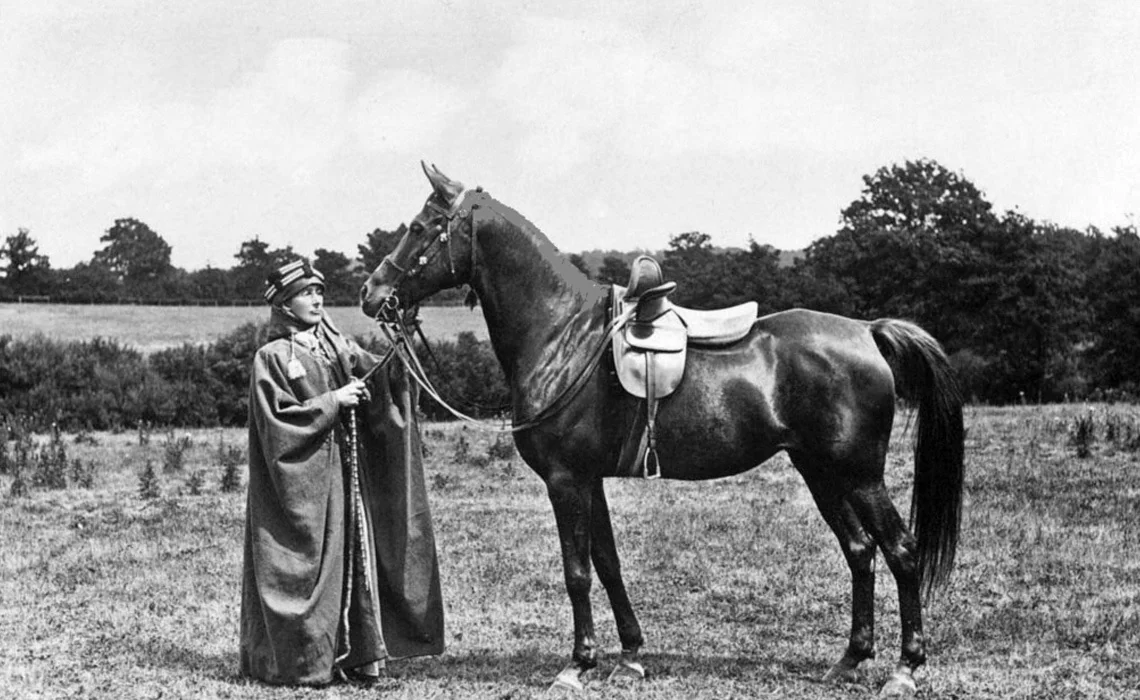
The most prominent of them are: Lady Anne Blunt and the two princesses: Yurbachova and Alice, European travelers, adventurers and visitors to the Arabian Peninsula and the Kingdom.
Women's Journeys to the Arabian Peninsula and Saudi Arabia
Princess Alice was not the only woman to visit the Kingdom of Saudi Arabia in 1938. She was preceded by Western female travelers from Russia and Europe who undertook many adventures during their journeys to the Arabian Peninsula and the Kingdom. However, the visit of Her Royal Highness Princess Alice, Countess of Athlone, to the Kingdom became the most famous women's visit, as it was the first visit by a member of the British royal family, and indeed of any European royal family, to the Kingdom at that time in 1938. The visit lasted 21 days, during which she took 350 photographs as part of her exploratory journey.
While most sources and references have focused on the successive journeys undertaken by famous male travelers to the Arabian Peninsula between the fifteenth and twentieth centuries, there is another scene that is no less important than the journeys made by male travelers such as Cabot, Pedro Covilhã, Ludovico di Varthema, Niebuhr, Steinthal and Badley, Burckhardt, George August Wallin, William Gifford Palgrave, Carlo Guarmani, Charles Huber, Julius Euting, Charles Doughty, Baron Eduard Nolde, Archibald Forder, S. S. Butler, Alois Musil, and St. John Philby.
This historical scene is represented by the journeys of women to the Arabian Peninsula and the Kingdom. Alice's visit to the Kingdom was preceded by two important visits during the 1930s by Lady Evelyn Cobbold in 1934 and Violet Dickson in 1937.
A Feminist Beginning:
Lady Anne Blunt began the early journeys undertaken by women to the Arabian Peninsula in the late nineteenth century, specifically in 1878. She and her husband also visited the region again between 1879 and 1880, expanding their knowledge and experience while staying among the tribes of Najd, and purchasing horses for their large farm.
In her book, A Pilgrimage to Nejd, Annie Blunt recounted what she experienced on her way to Hail. Bedouins attacked the caravan, and she was struck by a spear and fell to the ground. She was wearing a man's cloak, and when she cried out, “Ana dakheelak” (“I seek your protection”), the attackers realized that she was a woman. They felt ashamed and offered extensive apologies.
The Russian Princess Shcherbatova, wife of Prince Shcherbatov, visited Arabia in 1900 in search of a number of purebred Arabian horses. Princess Shcherbatova recorded a large number of Arabian horse bloodlines, including Kuhaylan, Bint Al-Awj, Zad Al-Musafer, Saklawi, Abeyan, Hamdani, and others.
Gertrude Bell visited Hail and described the political and social life of the region with remarkable precision. She summarized her experience of living in central Arabia in the statement: “It is rather boring to be a woman in Arabia,” despite her fascination with Arab women and the details of their lives.
As for Freya Stark, she was a famous British traveler who visited Hadhramaut and southern Arabia, and is regarded as one of the earliest women to undertake exploratory journeys through rugged and difficult regions.
The Pilgrimage to Mecca:
Lady Evelyn Cobbold was the first European Muslim woman to reach Makkah to perform the pilgrimage in 1934. She wrote her book Pilgrimage to Mecca to document this journey. The book includes an extensive introduction about the author's life, Muslims in the United Kingdom, the reform movement in the Arabian Peninsula, and King Abdulaziz (may Allah have mercy on him). The book is distinguished by its accessible and elegant language and possesses considerable historical, literary, and scholarly value in documenting an important period in the history of the Kingdom.
Violet Dickson, who lived in Kuwait for 61 years with her husband, the British representative in Kuwait, spoke about the wives of King Abdulaziz and his sister Noura, whom she visited when she came to Riyadh in 1937. She said: “The radio was a source of entertainment and joy for them. They would hear the large clock in the majlis strike the hour along with the London broadcast as a signal for setting the time. What they enjoyed most was the music from London at ten o'clock at night, and they also liked Cairo Radio.” They were not permitted to be photographed.
The female travelers generally demonstrated a commitment to appropriate dress, and some of them even wore the abaya and face covering. These women travelers deserve recognition for their perseverance in adapting to a way of life unfamiliar to them in their own countries, in order to convey a realistic picture of central Arabia and fulfill their objectives of learning about the customs and traditions of the Arab tribes, and documenting cities and villages, clothing, pastoral life, horses, camels, and other aspects of Arab life at that time.
Some of them also contributed to mapping inland regions and identifying routes of ancient roads. Many of these journeys focused on the role of Arab women and their daily lives, which female travelers documented more deeply than men because of their closer access to the lives of Arab women and their observation of their daily details.
References:
· http://a.alyamamahonline.com/ItemDetails.aspx?articleId=7829