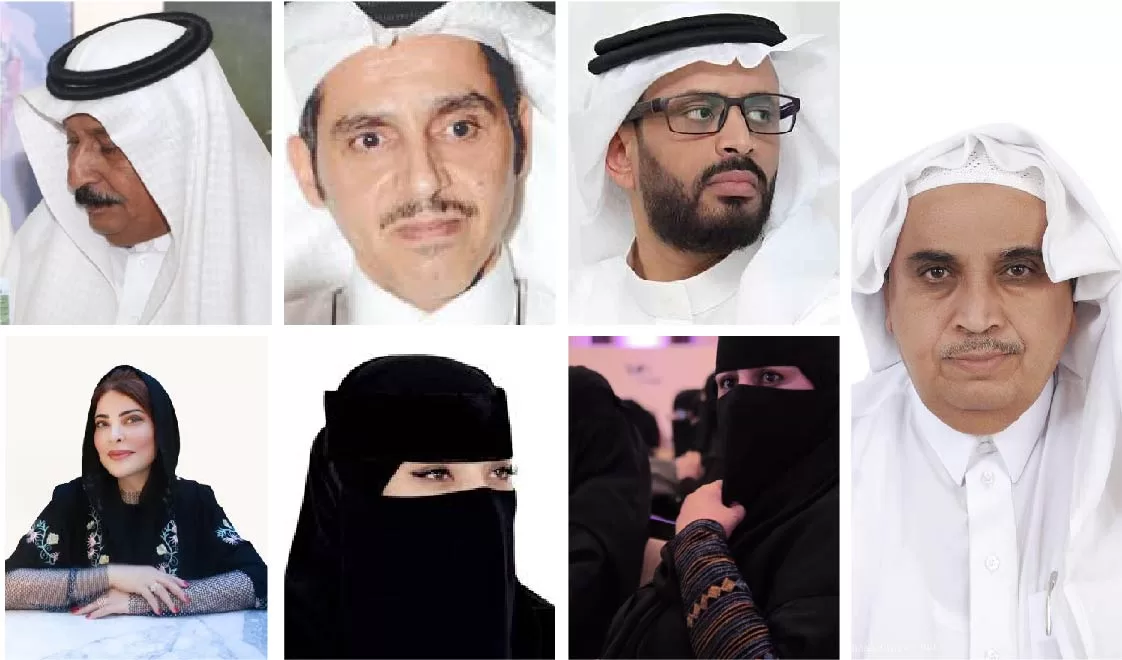
Have pioneering spirit and pioneers disappeared? Saudi writers define the landscape spanning the pioneering generations and the era of open platforms.
· Muhammad Al-Shiqah: The concept of pioneering remains the same.
· Dr. Zakia Al-Otaibi: We are not witnessing the absence of pioneering, but rather a transformation in its structure and definition.
· Dr. Abdulmohsen Al-Qahtani: The old concept of pioneering itself has changed and evolved.
· Dr. Zainab Al-Khudairi: Pioneering today tends toward interactive influence.
· Dr. Abdulmohsen Al-Huqail: There are no longer pioneers in the cultural sense.
· Abdulwahid Al-Ansari: Pioneers in literature have been reduced to the class celebrated by critics.
· Kafa Asiri: Pioneering is represented, for some, by being first to appear rather than by the distinctiveness of the experience.
Ahwal Al-Ma'rifa: Special
The concept of literary and artistic pioneering constitutes an important aspect of the cultural scene. Indeed, the word "pioneering" itself applies to various scientific, intellectual, and national fields and is not limited solely to literature or art. Saudi Arabia has witnessed pioneering figures in various fields both before and after the establishment of the Kingdom. Many names rose to prominence in poetry, literature, novels, the arts, sciences, and other fields.
With the transformations taking place in the cultural scene and the development of the Kingdom's renaissance from one generation to another, and with the emergence of multiple generations of Saudi writers and their widespread presence in the age of media, has great pioneering disappeared and has the presence of pioneers in literature and art declined? Particularly given the existence of renowned pioneers and figures among previous generations? Do pioneering figures emerge and renew themselves with every generation? Or has the old concept of pioneering itself changed and evolved?
A number of female and male writers spoke to Ahwal Al-Ma'rifa. Writer and short-story author Muhammad Mansour Al-Shiqah, one of the pioneers of the short story in the Kingdom, believes that pioneering has not disappeared. The judgment here is measured by age, and today they are witnesses to an era led by the Saudi Ministry of Culture through its various bodies, electronic documents, and the Literary Partner platform, while the generations that preceded them are partners in the media through their printed books, creative works, and studies, within a vibrant and constantly moving cultural scene.
Al-Shiqah explained that the old concept of pioneering remains the same, while its development today resembles an irregular movement living amid the chaos of the single-minded goals of some, who are numerous and have little concern for it.
Digital Speed:
Saudi writer and academic Prof. Dr. Zakia bint Mohammed Al-Otaibi says:
In previous generations, pioneering was often associated with specific names promoted by the media amid limited publishing opportunities and a small number of cultural circles. As a result, the presence of the pioneer was more firmly and consistently established in people's minds.
Today, however, the conditions of both reception and production have changed. Publishing spaces have expanded, voices have multiplied, centralized structures have fragmented, and culture now moves at a digital speed that does not allow pioneering to remain for a long period as it did in the past. Consequently, pioneering no longer means simply being first chronologically. Instead, it has become connected to the ability to produce a distinctive and influential discourse and create intellectual impact that extends beyond the fleeting moment.
Dr. Zakia Al-Otaibi adds: From my perspective, pioneering has not declined, but its criteria have changed. Today it is less conspicuous and more complex.
Media itself has also played a dual role. It has provided broader opportunities for visibility, but at the same time, it has contributed to simplifying some experiences and accelerating their consumption, making the distinction between popularity and pioneering an urgent critical necessity.
Therefore, it can be said that we are not witnessing the absence of pioneering, but rather a transformation in its structure, definition, and function. Accordingly, I do not believe that pioneering has disappeared as much as it has shifted from centralization to pluralism.
In one concise statement, Dr. Abdulmohsen Al-Qahtani said: "The old concept of pioneering itself has changed and evolved."
The Fragmentation of Pioneering:
Critic and novelist Dr. Zainab Al-Khudairi said: The question is not so much about names as it is about the cultural structure that produces these names.
She added: In previous generations, pioneering was associated with the scarcity of platforms and limited space. Newspapers were not numerous, publishing houses were not accessible to everyone, and platforms were not open without gatekeepers. Therefore, the emergence of a single prominent name necessarily meant there was a void around it. Scarcity creates an aura.
That is why names such as Ghazi Al-Gosaibi, Abdullah Al-Ghathami, and Turki Al-Hamad have remained present as distinctive landmarks, not because they were the only ones writing, but because the cultural scene was less crowded and more centralized.
Today, however, the social and cultural structure has changed. Platforms have become open, and writing no longer passes through a single gateway. In the era of X, Instagram, and TikTok, a voice no longer waits for institutional recognition; it creates its audience directly.
Here, pioneering has not disappeared, but it has fragmented. It is no longer a single head at the top of a pyramid, but rather multiple networks of influence.
Traditional pioneering was based on chronological precedence and cultural breakthrough: the first novel, the first critical proposition, the first intellectual confrontation. Today, however, pioneering tends toward interactive influence: Who creates a wave? Who changes people's tastes? Who moves a public debate?
Dr. Zainab Al-Khudairi then highlighted the difference between the pioneers and the new generation, saying: But there is a subtle difference. Previous pioneers wrote within the context of an existential struggle with society, authority, or institutions, while the new generation writes within a competitive environment with algorithms.
There were those who once confronted censorship, while today the challenge is rapid oblivion. In the past, the danger was being excluded; today, the danger is being consumed too quickly.
Dr. Zainab Al-Khudairi asked:
So, has the presence of the pioneers declined? Not in terms of their value. Their works remain because they are foundational. However, their symbolic presence no longer monopolizes the scene because the scene itself is no longer centralized.
The existence of multiple generations does not eliminate pioneering; rather, it redistributes it. Perhaps it is more accurate to say that the size of talent has not changed, but the definition of pioneering has changed.
Those who were once seen as a fixed summit have today become one of the many nodes in a broad network. Pioneering has not disappeared. It has simply ceased to be a throne and has instead become an ongoing act of renewing influence in an era of rapid transformation.
She concluded by saying:
The deeper question now is: Are we searching for major cultural symbols because we need cultural certainty, or because we have not yet become accustomed to a scene without a single center?
Marketing Cycles:
Poet and critic Dr. Abdulmohsen Al-Huqail emphasized that there are no longer pioneers in the cultural sense. Perhaps you may find a thirty-year-old leading an institution containing thousands of people who claim to be intellectuals, and therefore he is considered a pioneer.
He added: Yes, in previous generations there was respect for cultural achievement. I used to stand before Abdullah Al-Zaid, may he rest in peace, with my head lowered and would not raise it.
Today, without mentioning names, some creative figures from the 1980s generation, the golden generation of Saudi poetry, appear, but they do so somewhat timidly because control over matters, evaluation, measurement, and decision-making now lies in the hands of young people.
This is what I have observed, even though I am almost completely detached from the scene. Yes, perhaps I am angry, but it is a personal anger that concerns no one other than myself.
The writer and short-story author Abdulwahid Al-Ansari believes that pioneers in literature have been reduced to the class celebrated by critics.
Thus, the distinguished writer became the one who emerges from beneath the mantle of a modernist or postmodernist critic, or the one crowned by sales or awards. This means that every marketing cycle has its own stars according to a temporary, short-term memory.
This fits the pattern of fashion, trends, and brands, none of which acquire the concept of pioneering or immortality. The documentation of pioneering therefore remains confined to chronological precedence and is recorded in anthologies and bibliographies.
Al-Ansari concluded: We look forward to a cultural environment in which ideas interact, and where they are discussed, exposed to light, criticism, scrutiny, and questioning. Pioneering without the foundations necessary for survival becomes merely a collection of events that can only be distinguished from one another by precedence.
The question then becomes: When? rather than: What and how?
Types of Pioneering:
Writer and short-story author Kafa Asiri said: We cannot definitively claim that pioneering has disappeared altogether. Although I believe that, for some, pioneering is represented by being first to appear rather than by the distinctiveness of the experience, those who remained remained, and those who departed departed, each with their different experiences.
Kafa Asiri divided pioneering into four types, emphasizing that pioneering remains in its traditional sense, but its presence or absence can be understood through several categories:
Type One: Those who chose isolation or severed their connection with their contemporaries and the new generation that followed them, while remaining connected to the creative condition.
Type Two: Those who completely abandoned their creative project and disappeared, or became active in an area other than literature and art.
Type Three: Those who were unable to adapt to the new cultural forms in their various manifestations, whether modern institutions, modern social media platforms, or the expanding geographical reach of the cultural scene. As a result, they remained confined to their own era and its tools, attempting to continue their work.
Type Four: Those who continually renew themselves and keep pace with every development in the cultural scene and its tools, and therefore continue to maintain their presence across all levels.