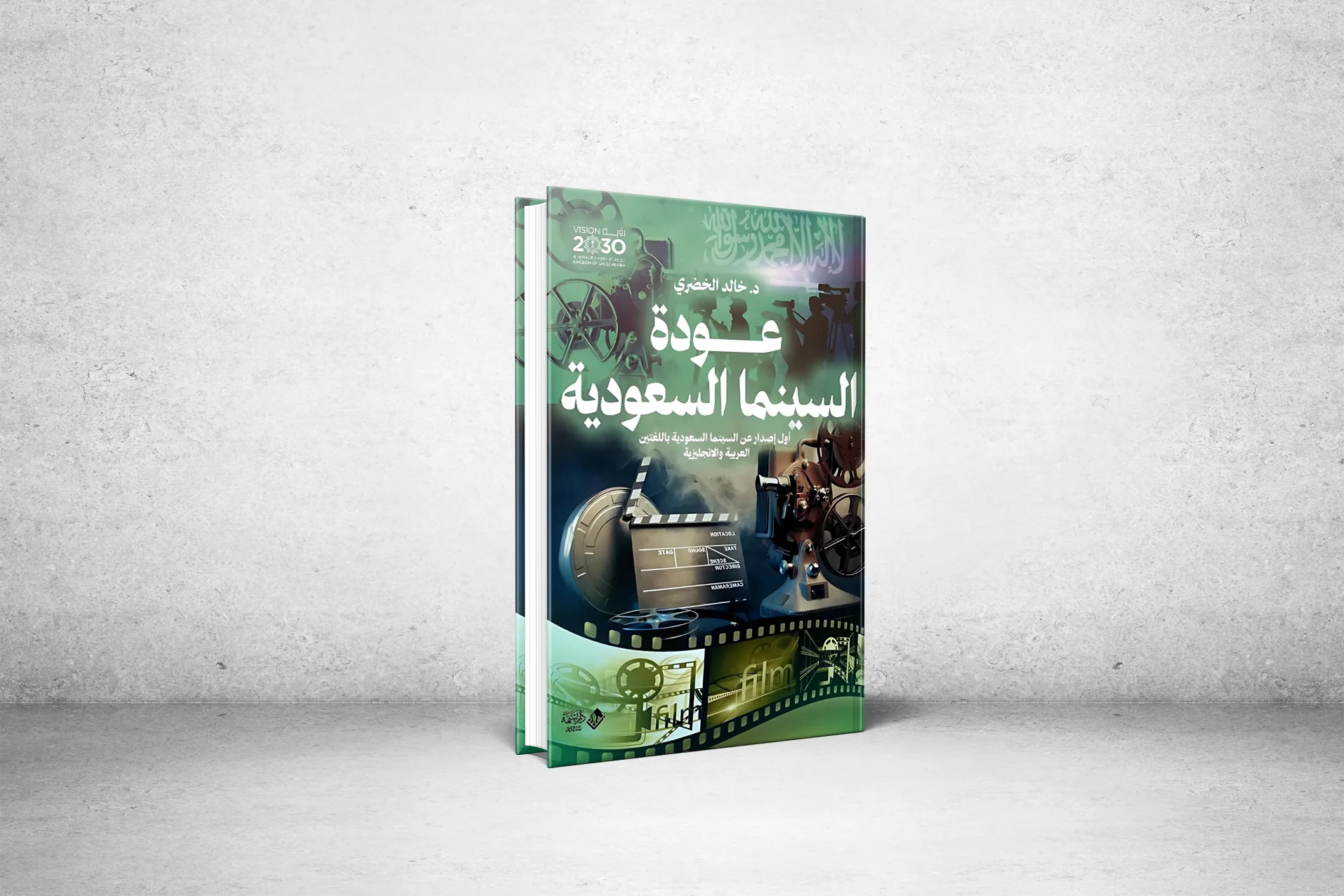
A documentary account of the seventh art: Al-Khodari chronicles Saudi cinema through Vision 2030 in both Arabic and English.
Dr. Khalid Al-Khudairy has published a book entitled Saudi Vision and the Return of Saudi Cinema, considered the first book of its kind to address Saudi cinema in both Arabic and English.
The book was introduced by Saudi artist and producer Mohammed Bakhsh, who praised the author’s efforts to document a significant period in the history of Saudi culture. He noted that the book fills a gap in the Arab library and serves as an important reference for researchers and those interested in the film industry.
The book consists of 220 pages in medium format and was published in 1447 AH. The author aims to provide an in-depth examination of the development of Saudi cinema and its relationship with the major transformations taking place in the Kingdom under Saudi Vision 2030.
Cinema is presented as a visual art that combines storytelling, narrative, dialogue, screenwriting, and diverse visual scenes. Through a lively and direct cinematic narrative, it brings aspects of reality closer to the viewer.
In his book, Dr. Khalid Al-Khudairy argues that the return of cinema is not merely an entertainment activity. Rather, he presents it as a reflection of cultural openness and intellectual and artistic development that corresponds with the Kingdom’s efforts to build a diversified and sustainable economy.
The book contains a dedicated chapter on Saudi Vision 2030, examining its impact on cultural openness, intellectual and creative growth, as well as its role in empowering young people and supporting creative industries. The author argues that, within the Vision, culture is not a marginal sector but a fundamental pillar in building a vibrant society capable of keeping pace with global developments.
Another chapter focuses specifically on Saudi cinema and its return. In it, the author traces the historical development of cinema in the Kingdom, beginning with its modest origins, passing through its period of suspension, and culminating in its official return and the reopening of cinemas.
Al-Khudairy connects this return with major cultural infrastructure projects and with social transformations that have made cinema a means of cultural communication and a platform for presenting the Kingdom’s evolving image to the world.
The book also devotes an important chapter to the art of screenwriting. The author emphasizes that the film industry cannot be completed without strong scripts and that building a sophisticated Saudi film industry requires professional talent in writing, directing, and production. In this context, he offers a number of perspectives on developing the craft of screenwriting, describing it as a cornerstone of a promising cinematic industry.
With this publication, Al-Khudairy adds another contribution to the development of Saudi culture and media. The book combines academic documentation with a forward-looking perspective, serving as a record of an era marked by major transformations taking place in the Kingdom