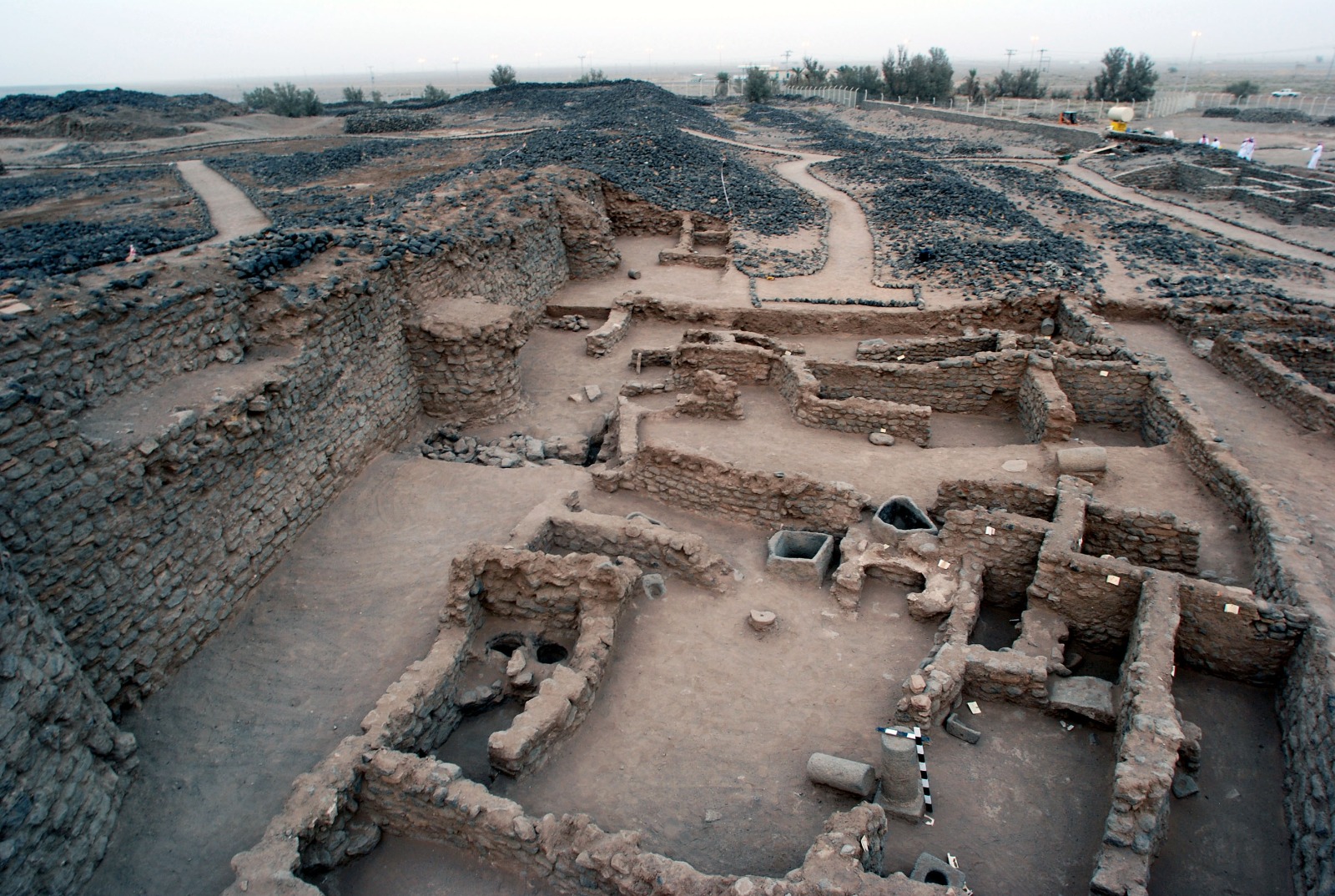
Wells, springs, canals, and pools... Fayd: an archaeological city and Islamic landmark situated midway along the Hajj route between Kufa and Makkah Al-Mukarramah.
More than 45 ancient wells, along with a large number of palaces and Islamic heritage landmarks, are found in the archaeological city of Fayd, located 92 kilometers from Hail on the Qassim Road. Fayd is a promising archaeological destination, distinguished by numerous inscriptions carved into the rocks of its surrounding mountains. The walls of the historic Qasr Kharrash fortress still stand as witnesses to the travelers who once stopped there, providing them with food and water in the land of Fayd, a place renowned for its many wells and water reservoirs, as well as a network of irrigation channels dating back to the early Islamic period. Indeed, one of these wells, Al-Hamra Well, continues to supply the city with water to this day.
Historical Significance:
The historic city of Fayd is regarded as the third most important ancient city after Kufa and Basra. The old Iraqi pilgrimage route, known as the Zubaydah Trail, which connected Iraq with Makkah, passed through the city. Fayd is also home to the archaeological Qasr Kharrash and the Archaeological Museum, which houses a collection of tools, jewelry, and gold and silver coins discovered during archaeological excavations in the ancient city.
The city also contains the Old Fayd Mosque, which dates back to the eighth century AH and is considered one of the oldest mosques in the town. It is distinguished by its mud-brick construction and a wall topped with decorative triangular elements.
Other archaeological sites in Fayd include the Zubaydah Trail, the residential settlement, underground passages, the hill area, the palace water basin, a giant millstone once used for grinding grain, and the network of wells and water channels. These sites are now open to visitors, as the city has been developed as one of the Kingdom's heritage tourism destinations.
Rock art, inscriptions, and ancient writings carved into the mountain faces surrounding Fayd constitute another important aspect of the city's archaeological heritage. Numerous artifacts and archaeological finds have also been uncovered, including a collection of finely crafted red pottery vessels surrounded by a stone platform designed to protect them from falling.
Excavations have also uncovered fragments of pottery and ceramic vessels, including pieces of rims, handles, bodies, and bases of jars, pitchers, pots, and cups. Among the most significant types are unglazed pottery, glazed pottery coated in dark blue or green, white tin-glazed ceramics, and multicolored glazed ceramics.
The Zubaydah Trail:
The ancient city of Fayd gained considerable prominence because of its location along the Iraqi pilgrimage route known as the Zubaydah Trail. Fayd was one of the most important early Islamic cities situated midway between Kufa and Makkah, and it flourished during both the Umayyad and Abbasid periods. The city is mentioned in numerous historical and geographical works, as well as in the writings of travelers, who described it as a major stopping point for Muslim pilgrims arriving from Iraq.
Al-Bakri referred to Fayd, writing: “The first person to dig wells there in Islam was Abu al-Dulaym, the freedman of Yazid ibn Umar ibn Hubayra. He dug the spring that remains standing today, caused its water to flow, and planted around it...”
Al-Muqaddasi, Ibn Rusta, and Al-Hamawi also described the distance between Al-Ajfar and Fayd as half the journey. They noted that the city had a flowing spring, a pulpit, markets, water reservoirs, and running springs, and that the official responsible for the road would stay there. Al-Harbi provided a more detailed description, stating: “In Fayd there is a palace belonging to the sultan, orchards, and fortresses, some of which have fallen into ruin; a congregational mosque and pulpit; a square water reservoir; three springs; and a number of wells.” Al-Tabari also recorded that Fayd was surrounded by a moat during the reign of the Abbasid caliph Abu Ja'far al-Mansur in 145 AH.
More than 45 ancient wells dating to the early Islamic period have been documented in Fayd. Some are still used by local residents to irrigate their crops. The city is also included on UNESCO's Tentative List alongside ten other archaeological sites that are being considered for future inscription as World Heritage Sites. These would join the Kingdom's existing UNESCO-listed heritage sites, including Al-Hijr (Madain Salih), At-Turaif District in Diriyah, Historic Jeddah, and the Rock Art of the Hail Region.
References:
- Saudi Tourism Authority: Historic Fayd City in Hail
- Arabic Wikipedia: Fayd
- Comprehensive Encyclopedia of the Kingdom of Saudi Arabia, Volume 14, King Abdulaziz Public Library, First Edition, 1428 AH.