From Particles to Spacetime: Five Cosmic Concepts That Will Change Our View of Reality
Ahwal Al-Ma'rifa – Special Report
Can we revisit the history of the universe from scientific, philosophical, and cultural perspectives?
Numerous studies in physics and astronomy seek to reconsider the vast universe and explore the divine significance of its creation, its diversity, and the extraordinary phenomena it contains—phenomena that are difficult for humanity to fully imagine. Scientific research, however, continues to describe, analyze, and bring these mysteries closer to readers. This intellectual and philosophical endeavor has become a significant phenomenon in the West.
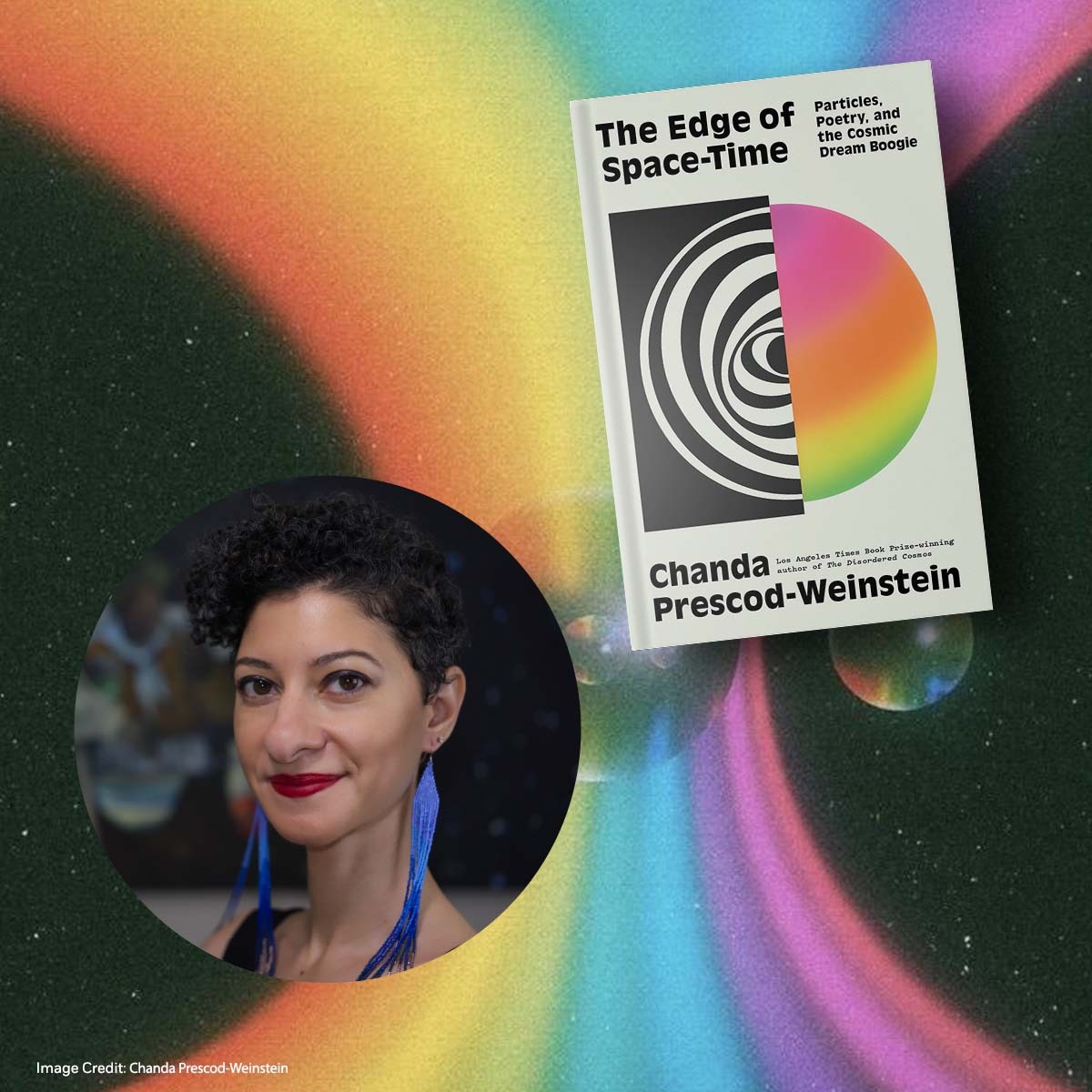
In her latest book, cosmologist and particle physicist Chanda Prescod-Weinstein presents five cosmic concepts that seek to transform our understanding of reality. In The Edge of Space-Time, published by Penguin Random House, Dr. Prescod-Weinstein takes readers on an intellectual journey through particles, poetry, and the cosmic dance of dreams. Across 368 pages, she argues that at the edge of the universe, we can contemplate space-time—the interwoven fabric of space and time—and gain a broader perspective that can ultimately lead us toward a deeper understanding of ourselves. She presents five cosmic concepts from her perspective:
- Particles are not simply one thing or the other. They are both particles and waves at the same time.
- Space-time expands, and this is a gravitational effect. The distances between galaxies increase, a phenomenon best explained by our fundamental theory of gravity: Einstein's general theory of relativity.
- There are particles that are not simply three-dimensional. Neutrinos are fundamental particles that oscillate randomly among three types as they move through space-time.
- A Black physicist provided some of the earliest evidence for quantum physics. In his 1918 doctoral dissertation, Elmer Imes, who was for a time married to Harlem Renaissance novelist Nella Larsen, demonstrated that atoms possess quantum properties.
- Black holes are defined by some of the most extreme boundaries in the universe. A black hole's event horizon cannot be crossed from within—it represents an absolute boundary. Once you enter a black hole, you can never return.
The History of the Universe:
Guided by her firm conviction that humanity's progress requires an understanding of our cosmic past, and drawing on poetry and popular culture—from Langston Hughes, Queen Latifah, and Lewis Carroll to Big K.R.I.T., Sun Ra, and Star Trek—Prescod-Weinstein simplifies some of the most abstract concepts in theoretical physics, telling captivating stories about the history of the universe and its fundamental nature.
Here, we encounter the quantum cat that is simultaneously dead and alive, learn about the difference between dark matter and dark energy, explore how black holes work, and consider the possibility of a unified theory of quantum gravity. We follow the evidence to the farthest reaches of the cosmic event horizon and down to the smallest—and strangest—neutrinos.
Along the way, she calls on us to resist colonial approaches to the exploration of space and instead imagine a better path in our pursuit of humanity's profound connection with the stars.
Through Prescod-Weinstein's distinctive perspective, informed by her deep knowledge of postcolonial history and Black feminist thought, The Edge of Space-Time argues that physics is a fundamental way for everyone to engage with the universe. It makes a compelling case that the “edge” can serve as a powerful starting point for seeing the bigger picture.
Particle Physics:
Ed Yong, author of An Immense World, describes Chanda Prescod-Weinstein's work as extraordinary, establishing her reputation as one of the most prominent and important science writers of our time.
In The Edge of Space-Time, the author captures this sense of cosmic wonder, taking readers on a transformative journey to the boundaries of the universe and inviting us to spend some time at the edge of what we know about space-time—and about ourselves.
Prescod-Weinstein previously published a book titled The Disordered Cosmos: A Journey into Dark Matter, Spacetime, and Dreams Deferred, which became a bestseller upon its release. Smithsonian magazine describes the book as a journey by the acclaimed astrophysicist and author of the bestselling The Edge of Space-Time into the world of particle and cosmic physics, as well as a call for a fairer and more inclusive scientific practice. It is presented as a love letter to the remarkable universe we call home and an invitation to think critically about how we explore its depths.
In 2011, Prescod-Weinstein, who has received several scientific awards, was awarded a Martin Luther King Jr. Postdoctoral Fellowship at the Massachusetts Institute of Technology (MIT), where she held joint appointments at the Kavli Institute for Astrophysics and Space Research and the Department of Physics.
She also worked with Alan Guth's team at the Center for Theoretical Physics. From 2016 to 2017, she served as a research associate with Ann Nelson in the High Energy Theory Group in the Department of Physics at the University of Washington. She later became the principal investigator of an FQXi grant examining “epistemic maps of astronomy and physics: reconstructing observers,” seeking to address questions about how the concept of the “observer” might be reformulated, how observers outside the framework of the European Enlightenment might be recognized, and how this could affect the production of knowledge in science.
She is also associated with NASA and serves as a faculty member in physics and astronomy, as well as in Women's and Gender Studies, at the University of New Hampshire.