Featuring heritage villages, historic routes, and oases—14 Saudi archaeological sites are nominated for inclusion in the UNESCO World Heritage List.
When researchers examine the map and geography of Saudi Arabia, they encounter a remarkable diversity of topographical features, ranging from highlands and lowlands to mountains, plains, valleys, vast open landscapes, deserts, lakes, and sand dunes. This rich geographical diversity contains hundreds of heritage and archaeological sites that Saudi Arabia is seeking to nominate for inclusion on the UNESCO World Heritage List. This effort began successfully in 2008 with the inscription of its first archaeological site, Al-Hijr (Madain Salih), on the list.
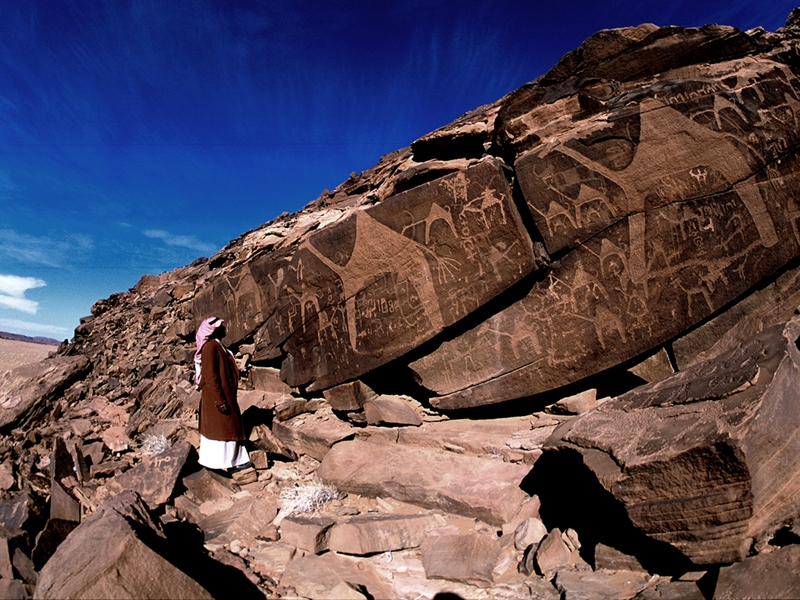
As the list has continued to expand, several other sites have been inscribed, including At-Turaif District in Diriyah, Historic Jeddah, the Rock Art of the Hail Region, Al-Ahsa Oasis, the Hima Cultural Area in Najran, the 'Uruq Bani Ma'arid Nature Reserve on the western edge of the Empty Quarter, and the cultural landscape of the Al-Faw Archaeological Area.
Nominated Sites:
Alongside these archaeological sites already inscribed on the UNESCO World Heritage List, Saudi Arabia is seeking the recognition of 35 additional heritage sites across various regions of the Kingdom. These sites have been included on the Tentative List. In addition, 15 elements have been inscribed on UNESCO's Intangible Cultural Heritage List, including the Saudi Ardah, Taif rose, majlis, Al-Sadu weaving, the simsimiyya musical instrument, henna, Arabic calligraphy, Al-Qatt Al-Asiri, Arabic coffee, falconry, camel herding chants, Saudi Khawlani coffee, harees, metal engraving, and date palm cultivation.
There are also 14 other Saudi sites that have been included on UNESCO's preliminary nomination list. Five were submitted in 2015, one in 2019, two in 2022, five in 2023, and one in 2024.
In another area of UNESCO's programs, 10 geoparks and learning and creative cities have been recognized. These include Salma Geopark north of Riyadh and Thadiq Geopark. The learning cities include Yanbu Industrial City, Jubail Industrial City, King Abdullah Economic City, Madinah, and Al-Ahsa Governorate. Under UNESCO's Creative Cities Network, Al-Ahsa has been designated for crafts and folk art, Buraydah for gastronomy, and Taif for literature. Under the Man and the Biosphere Programme, the Farasan Islands Nature Reserve and Harrat Uwayrid Nature Reserve have also been included.
Heritage Landscapes:
The heritage sites included on UNESCO's Tentative List represent a variety of heritage categories. Among them are historic villages such as Dhee Ayn Heritage Village, which was built from stone, roofed with juniper branches, and decorated with balconies featuring carefully arranged quartz stones in triangular patterns. The village is located in Upper Tihamah in the Al-Baha region, at an elevation of approximately 1,985 meters above sea level.
Another is Rijal Almaa Heritage Village in the Asir region. It consists of 60 buildings constructed from natural stone, mud, and wood, and includes the Dar Almaa Museum of Culture and Heritage.
The list also encompasses ancient historic routes, including the Egyptian Hajj Route, which was used over successive periods by pilgrims from Egypt, the Maghreb, and Al-Andalus. The route contains a number of forts and archaeological sites. Another is the Syrian Hajj Route, also known as the Tabuk Route, after the city of Tabuk. It begins in Damascus and extends into Saudi Arabia through Tabuk, Al-Hijr, AlUla, and onward to Madinah. Historic routes also include the Hejaz Railway, along which several historic stations remain, including the stations at Tabuk, Madain Salih, and Madinah.
Among the most prominent routes is the Zubaydah Trail, whose origins date back to the pre-Islamic period. It flourished particularly during the Abbasid era and was named after Zubaydah bint Ja'far, the wife of the Abbasid caliph Harun al-Rashid. She played a major role in establishing stations and rest areas and providing water for pilgrims. Archaeological surveys have identified 27 major stations and 27 secondary stations along the route. Several landmarks remain in Saudi Arabia today, including Al-Jumaymah, Al-Shihiyat, Fayd, Samira, Al-Rabadha, and Dhat Irq.
Other categories represented among these sites include nature reserves such as the Farasan Islands Nature Reserve; ancient walled oases in the regions of Tabuk, Al-Jouf, and Hail, including Tayma, Qurayyah, Dumat Al-Jandal, and Al-Hait; and the rural cultural landscape of the Sarawat Mountains, among many other heritage sites reflecting the geographical diversity of the Kingdom.
It is worth noting that the UNESCO World Heritage List comprises sites considered to possess Outstanding Universal Value, representing cultural or natural heritage worthy of protection for the benefit of humanity. The list is administered by the United Nations Educational, Scientific and Cultural Organization (UNESCO) under the 1972 Convention concerning the Protection of the World Cultural and Natural Heritage.