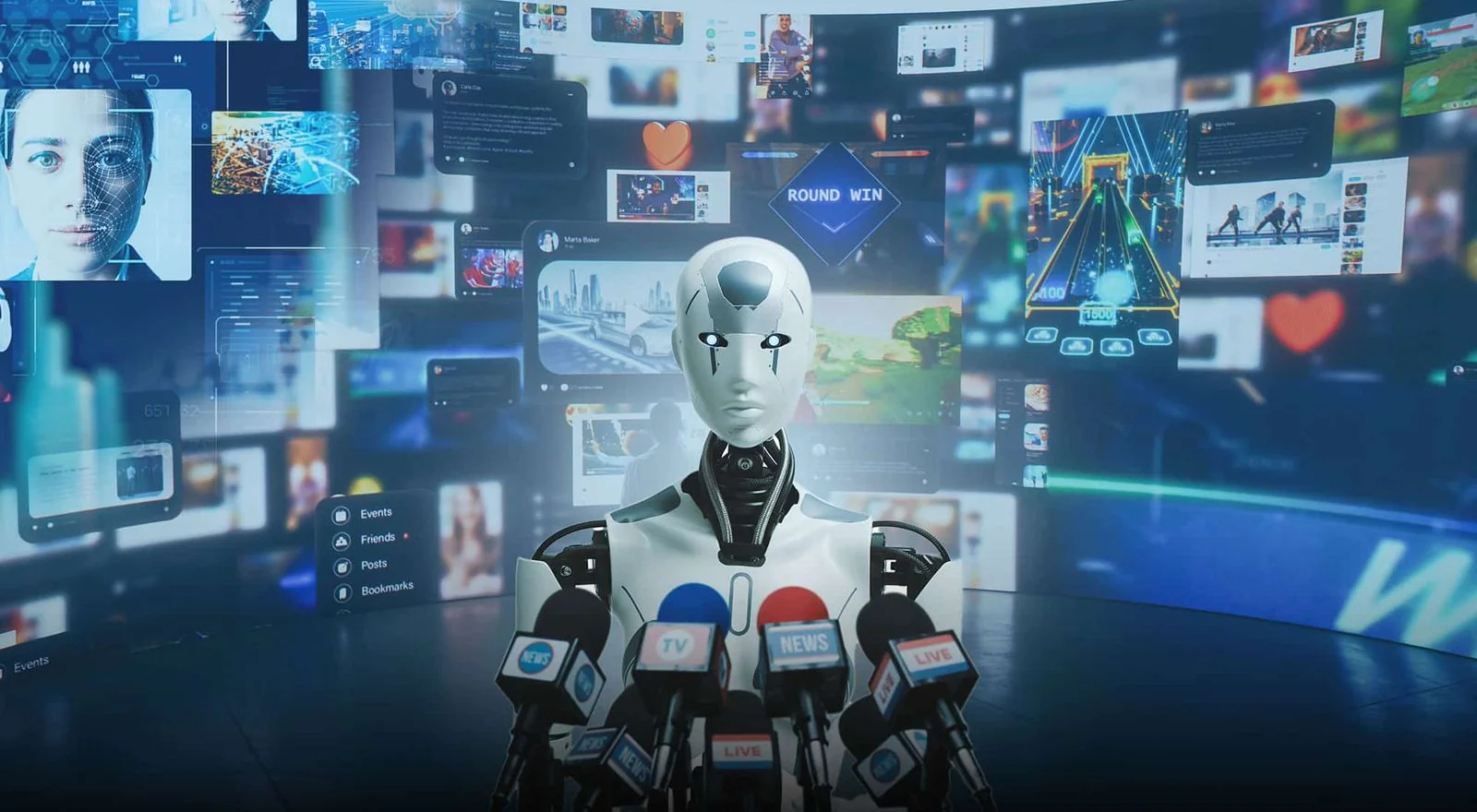
Artificial intelligence is shifting human thinking into the realm of automation, algorithms, and virtual and augmented reality.
Conditions of Knowledge – Special
Artificial intelligence is a powerful tool capable of improving all aspects of media work. AI technologies help enhance work efficiency and contribute to improving content quality by verifying information quickly and efficiently and combating fake news. They can also analyze users' behavior and interests and provide personalized content that better meets their needs, reach a wider audience by translating texts into different languages, and improve audience engagement by analyzing their responses to content.
However, the use of artificial intelligence in the media sector raises several concerns, including job losses in certain areas of the media industry, issues related to intellectual property rights, bias in media content and discrimination against certain groups, manipulation of public opinion, and the dissemination of misleading information.
AI is expected to play a pivotal role in the coming years. As media organizations increasingly adopt this technology, the work of journalists and media professionals is expected to become more focused on creativity, innovation, and analysis.
The book Applications of Artificial Intelligence in the Media, by Dr. Rabab Abdelrahman Hashem, published by the Egyptian General Book Organization in its first edition in 2025 and consisting of 320 pages, aims to explore the fields of artificial intelligence use in the media and its various applications.
To achieve this research objective and examine these applications, the chapters of the book define the concepts underlying these applications and demonstrate the ability of artificial intelligence to engage with various areas of the media. The four chapters are titled: Artificial Intelligence: General Background; Artificial Intelligence in Journalism; Artificial Intelligence in Television Channels and Podcasts; and Artificial Intelligence and Deepfakes.
Nature of Artificial Intelligence:
The first chapter reviews the concept of artificial intelligence and its history, as well as some of the fields in which it is used, including combating crime, the military and medical fields, transportation, the management of companies and organizations, media, social media, education, and marketing. It also examines the relationship between artificial intelligence, the metaverse, and the virtual world.
The author identifies several AI-related concepts, including algorithms, automation, models, inputs, generative artificial intelligence, artificial neural networks, data, virtual reality technology, and augmented reality technology. According to some technical references, the author defines artificial intelligence as a means of creating a computer, robot controlled by a computer, or program that thinks intelligently in the same way that intelligent humans think. Artificial intelligence is achieved by studying how the human brain thinks and how people learn, make decisions, and act while attempting to solve a problem, and then using the findings of this study as a basis for developing intelligent programs and systems.
The author explains that artificial intelligence operates through ten fundamental elements:
Dual networks, computing, human involvement, zeros and ones, neural networks, the learning process, speech understanding and recognition, image detection and recognition, open-source models, and certainty and knowledge.
Journalism and Newsrooms:
The second chapter examines how artificial intelligence is used in journalism, including monitoring and gathering news, verification and fact-checking, content production and distribution, monitoring audience reactions and engagement, automated writing, generating and editing textual content, rewriting and paraphrasing, generating and editing images, visualizing data and information, and producing and editing video clips.
The third chapter examines artificial intelligence in television newsrooms and its use during the pre-production stage, including scriptwriting and scenario preparation, automation of certain aspects of production such as scheduling and logistics, television production, digital broadcasting platforms, and podcasts.
The fourth chapter presents the concept of deepfakes and how they work, whether involving deepfake video, audio, or lip synchronization.
The author defines deepfakes as a highly modern form of information disorder that uses artificial intelligence, such as machine learning and neural networks, built on massive datasets to produce audio or visual content, including sound, images, or video, that appears authentic.
AI technologies allow objects and facial features to be modified, images to be animated, and voices to be cloned. Deepfakes are therefore considered a form of audiovisual manipulation that enables the creation of realistic simulations of people's faces, voices, and actions. The greatest danger posed by deepfake technology lies in its ability to spread false information that appears to originate from trusted sources.
The book contains a large collection of images, tables, and models generated by artificial intelligence.