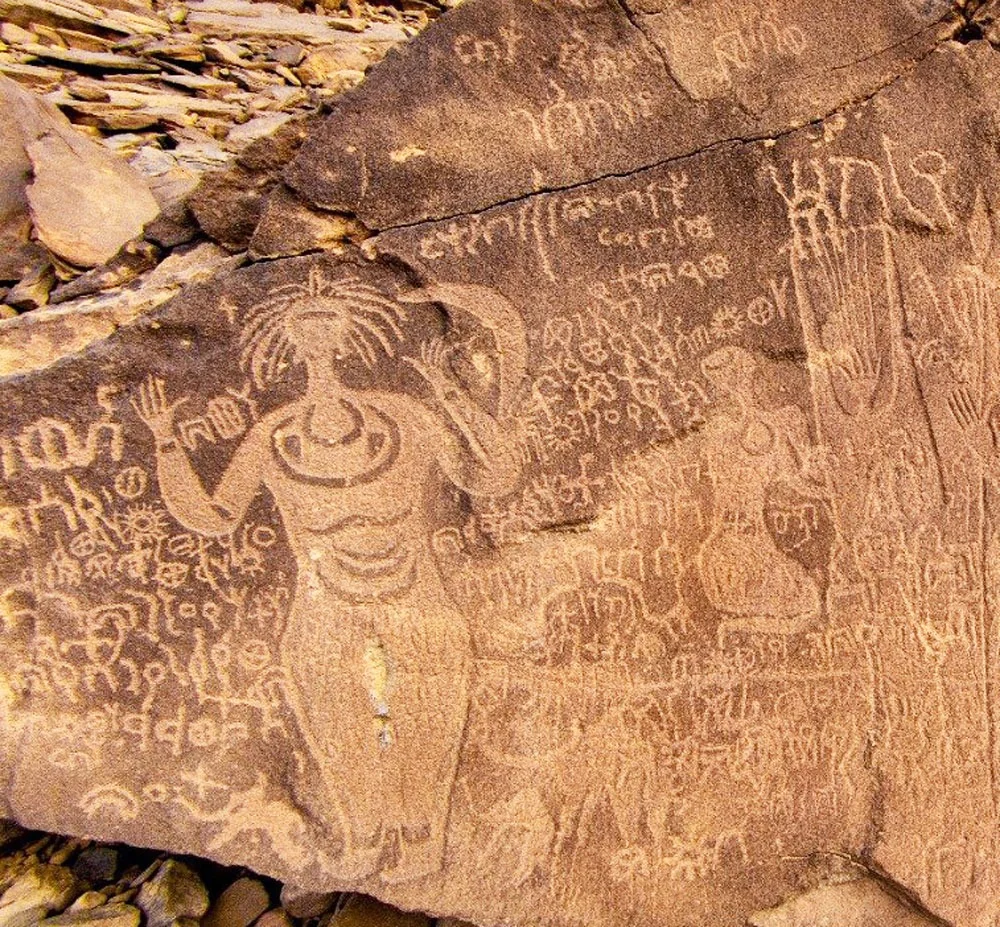
Amidst the inscriptions, drawings, writings, and dwellings... the Kingdom’s mountain carvings stand as visual and tangible legacies, masterfully crafted by the hands of history and civilization.
Writing
Knowledge Affairs – Special
Madain Saleh in AlUla is not the only prominent place in the Kingdom that contains numerous carvings. The passage of time has not left its formations solely across the mountainous area of AlUla, which was the first archaeological site in Saudi Arabia to be inscribed on UNESCO’s World Heritage List. Rather, these formations extend across various mountains and locations throughout the Kingdom.
The Kingdom’s vast geographical landscape encompasses numerous mountains and natural rock formations distributed across its thirteen regions. The Kingdom is, in effect, one of the world’s vast natural museums—a small continent or museum situated in the southwestern corner of Asia, the largest continent in the world.
Archaeological Sites:
The scenes of heritage beauty at the site of “Mughair Shu’ayb,” located in the western part of the Tabuk Region, are no less significant than those of Madain Saleh in Al-Hijr.
Mughair Shu’ayb is an ancient oasis carved into rock, featuring façades dating back to the Nabataean civilization. It also contains the remains of an ancient city dating to the early Islamic period, known as “Al-Malqatah.” This was the site of the Islamic city east of the famous Wadi Afal. On the eastern bank lies “Musa’s Well,” also known as the Water of Midian. The Madain Shu’ayb site is a historical landmark dating back to before the time of Prophet Moses, peace be upon him.
The caves at Mughair Shu’ayb are carved into the mountains in a remarkable geometric style, reflecting an ancient civilization. The site contains twelve houses carved into the mountains, each with rooms meticulously detailed.
Mountain carvings, some dating back 2,000 years, have been discovered deep in the Saudi desert in the Al-Jouf Region, approximately 1,000 kilometers north of Riyadh. The discoveries were made as part of a national archaeological project carried out with assistance from Italy and France.
Civilizational Heritage:
The Madain Saleh site itself contains more than 851 cultural and natural sites of outstanding value to the heritage of humanity. Its inclusion on the World Heritage List represents international recognition of the great historical significance of these archaeological sites and highlights the Kingdom’s historical standing and its rich civilizational heritage.
The Kingdom is home to the peaks of the Tuwaiq, Tamiya, Qatan, and Fayfa mountains, as well as the Sarawat mountain range, with its towering peaks extending from the north to the south of the Kingdom. There are also numerous other high mountain peaks, many of which contain important historical remains and inscriptions. Across the Kingdom’s various regions and governorates are mountains such as Al-Sawda in the Asir Region, which rises to approximately 3,015 meters, as well as Farwa, Al-Majaz, Mishrif, Al-Sahla, Mana’a, Shawkan, Al-Qama, and Jabal Al-Lawz. The latter, located in the Tabuk Region, is among the mountains in the Kingdom that receive the most snowfall during winter, reaching an elevation of 2,580 meters above sea level. Fayfa, in the southwest of the Kingdom near the city of Jazan, consists of a mountain range rising more than 1,200 meters above sea level.
The Kingdom is also home to the mountains of the Hisma Desert in the Tabuk Region, the Al-Lawz Mountains, the areas of Alaqan and Al-Zaytah, and Jabal Ikmah in AlUla. Jabal Ikmah is regarded as a natural canvas bearing some of the earliest forms of Arabic script. Its rocks are filled with numerous carvings and inscriptions, earning it the title of “the open-air library.”
Jabal Ikmah contains 450 inscriptions in ancient pre-Nabataean languages, including Aramaic, Dadanitic, Thamudic, and Minaic.
The oldest inscriptions on Jabal Ikmah date back to 644 BC. These inscriptions shed light on the nature of the ancient Kingdom of Lihyan, its civilization, and the way its people lived, as well as their religious beliefs and culture.
The rock formations of Jabal Ikmah are sedimentary, which made it easier for the ancient civilizations of AlUla to carve, draw, and document their daily lives and history on the rock surfaces.
The rock carvings and inscriptions of Jubbah cover an estimated area of 39 square kilometers and date back approximately to 5,500 BC. These carvings depict camels, oryx, and ibex, in addition to a number of Thamudic inscriptions. Jubbah is located 100 kilometers northwest of the city of Ha’il.
An Inscriptions Museum
Archaeological discoveries are not confined to the north of the Kingdom. In the south, specifically in the Najran Region, there is one of the largest open-air museums of ancient rock inscriptions. The region has witnessed the rise and passage of numerous civilizations, placing it among the most important cities rich in antiquities and historical inscriptions. According to the Saudi Heritage Commission, the region contains more than 100 archaeological sites.
The region is home to important archaeological remains and sites dating to the Byzantine, Umayyad, and Abbasid periods. The “Hima Archaeological Site” is considered the country’s largest area of rock inscriptions and lies approximately 130 kilometers north of Najran. It encompasses several archaeological locations, including Jabal Sidayh, Jabal Hima, the site of Aan Jamal, Shas’a, and Al-Kawkab. These locations are rich in inscriptions and drawings that represented some of humanity’s earliest attempts to write an ancient alphabet.
The ancient writings and rock inscriptions scattered across mountain rocks throughout the Kingdom constitute a historical treasure of immense value. They are among the principal sources from which historians have drawn—and continue to draw—their knowledge of the history and civilization of the Arabian Peninsula.
In a study on Arabic and Islamic writings and inscriptions on stone in Saudi Arabia, archaeologist Dr. Ahmed Al-Zayla’i emphasized that the Kingdom’s mountains and rocks contain enormous numbers of archaeological inscriptions and writings of great historical value. Many Hajj and international trade routes, as well as some internal caravan routes and their connecting local paths and trails, passed through the Kingdom. Along these routes and in their vicinity were numerous villages and major cities, commercial centers, water sources, and stations where travelers rested after arduous journeys. As a result of this extensive movement of travelers, settlement, and migration, and the long periods of human habitation in the historic cities and commercial centers of the country, enormous numbers of Arabic and Islamic inscriptions carved into stone have been discovered throughout Saudi Arabia.
The importance of these rock inscriptions is underscored by the fact that they include the oldest dated Islamic inscription known to humanity, dating to 24 AH / 644–645 CE. This is the Zuhayr inscription, which is registered on UNESCO’s World Heritage List.
The rock inscriptions discovered in Saudi Arabia have also provided examples of finely executed texts, with clear lettering and well-organized layouts. Most lack diacritical dots, although a small number do contain them. This may be regarded as material evidence that these texts were marked with dots well before the time of Nasr ibn Asim and Yahya ibn Ya’mar.
This type of rock inscription is widespread along the Hajj routes leading to Makkah, particularly the Syrian Hajj route, the Iraqi Hajj route, and the inland Yemeni Hajj route. Archaeological survey efforts have also yielded remarkable discoveries of rock inscriptions scattered around Makkah, Madinah, and Taif, as well as throughout the mountain ranges extending across the Al-Bahah, Asir, and Najran regions.
Footnotes:
· https://www.alarabiya.net/saudi-today/2020/12/22