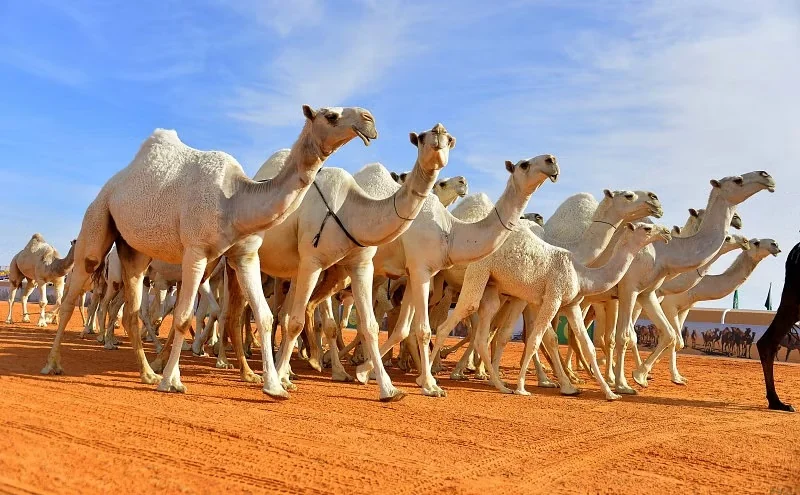
The heritage of Arab daily life serves as a source of inspiration: from the camel, the Arabs derived the concept of *al-arud* (prosody); from the banquet, the term *al-adab* (literature/refinement); and from the spear, the concept of *al-thaqafa* (culture).
Knowledge Affairs – Special
As we read one of the books of the Arab heritage, browse Ibn Manzur’s “Lisan Al-Arab” dictionary, or look through some pages of Al-Isfahani’s “Kitab Al-Aghani”, we may encounter many cultural words and expressions rooted in the Arab desert environment and the daily life of ancient Arabs. We may be particularly intrigued by the inclusion of specific terms relating to camels, horses, gazelles, tents, settlement and travel, desert roads and paths, as well as the vocabulary of warfare, nature, plants, and animals, all of which point to the rich Arabic desert lexicon.
Many people today may not realize that most of the Arabs’ poetic, literary, and cultural terminology emerged from this simple environment in the Arabian Peninsula. It was an environment characterized largely by a mobile, rather than settled, way of life, unlike that of the cities. These terms formed the linguistic, literary, and intellectual foundations of the Arab and Islamic world.
Thus, the word “adab” (literature) came from this verse:
We are in winter, and we invite everyone,
You will not see among us the one who picks and chooses.
The word “thaqafah” (culture) derives from “thaqafa”, meaning to straighten or sharpen a spear. As for the movement of camels themselves, it contributed to the development of poetic meters and rhythms, beginning with the Rajaz meter. The Arabs began their poetic creativity with the urjuzah, composing poetic rajaz verses that they could memorize and use to express their lives and journeys through the art of “Al-Hida’.”
Al-Hida’ is the singing performed for camels while they are traveling, usually at night along particular routes that travelers followed as they moved through the deserts of the Arabian Peninsula from one place to another. The art of Al-Hida’ relies on composed and sung rajaz verses. For this reason, the Rajaz meter was the first of the Arabic poetic meters. In terms of prosody, it consists of six repeated feet as follows:
Mustaf‘ilunْ Mustaf‘ilunْ Mustaf‘ilunْ .. Mustaf‘ilunْ Mustaf‘ilunْ Mustaf‘ilunْ
The poetic meter allows for the introduction of “zihaf” (metrical variation) into the foot, whether through reduction in the internal part of the verse or through addition in the rhyme.
In this way, the Arabs developed the first Arabic poetic meter, which became the gateway to the invention of a variety of poetic and prosodic meters, eventually reaching 16 fundamental Arabic poetic meters, along with the various meters derived from them.
Here, the camel may be regarded as the holder of the intellectual property of this rhythmic innovation, in today’s terminology, and as the holder of the first patent. From the movement of camels as they traveled emerged the Rajaz foot, (Mustaf..‘ilun). It reflected the movement of their four legs and the rhythmic, regular striking of their feet against the ground as they traveled at night. One of the unknown Arabs who practiced the art of Al-Hida’ was able to sing to the rhythm of the camels’ footsteps and movements, thereby generating the first Arabic poetic meter.
Prosody scholars also represented this movement in the form “la la na‘am” in the art of prosodic vocalization, or through other rhythms such as “dum dum dudum.” When the great Arab linguist Al-Khalil ibn Ahmad Al-Farahidi, author of “Kitab Al-Ayn,” discovered the science of prosody, he documented all of this in his work and continued his discoveries in Arabic poetry until he identified fifteen poetic meters. He was then followed by the linguist and grammarian Al-Akhfash, who added a new meter, bringing the number of Arabic prosodic meters to 16.