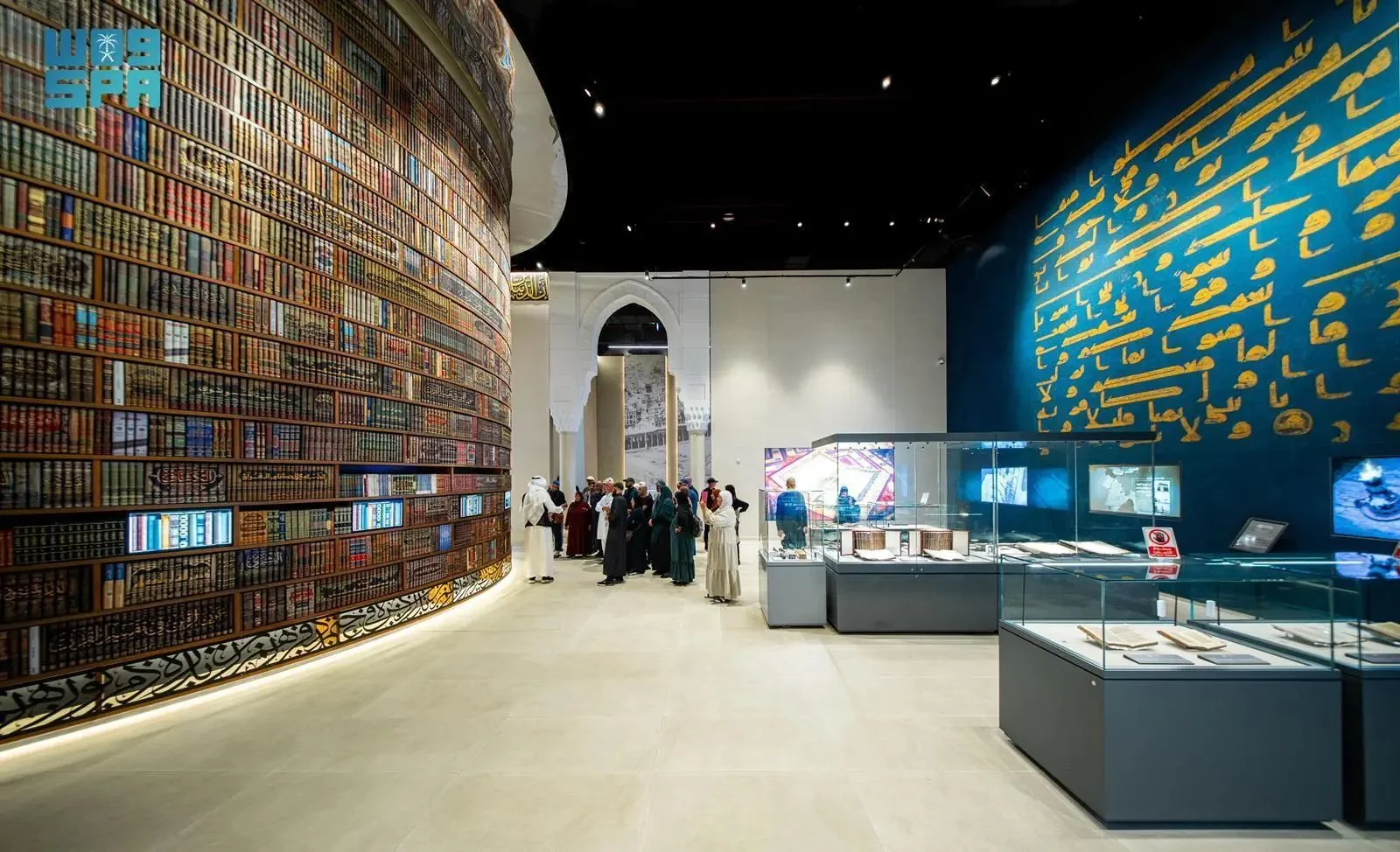
Inscribed in pure gold leaf in the ancient Kufic script, the Blue Qur'an stands as one of the rarest and most magnificent illuminated Qur'ans in the history of Islamic civilization.
The Quran Museum in the Hira Cultural District in Makkah is displaying a rare copy of the “Blue Quran,” featuring verses from Surah Al-Baqarah, from the end of verse 37 through the beginning of verse 42. The display highlights the richness of Islamic Quranic heritage and its long-standing artistic history.
The Blue Quran is regarded as one of the rarest and most luxurious illuminated Quran manuscripts in the history of Islamic civilization. It was written in pure gold ink in an early Kufic script on a dark blue background, a distinctive artistic style that reflects the early Muslims’ dedication to the aesthetics of Quranic writing and their reverence for the sacred text.
The manuscript dates back to the third century AH, corresponding to the ninth century CE, giving it significant historical and scholarly value. It serves as evidence of the development of Arabic calligraphy and manuscript decoration during the early Islamic period. The surviving pages are also exceptionally rare, with individual folios now distributed among a limited number of museums and collections around the world.
The display of this manuscript is part of the Quran Museum’s efforts to introduce visitors to the history of the Holy Quran and the artistic stages through which Quranic manuscripts developed. It also provides an opportunity to view exceptional examples of Quranic manuscripts, enhancing cultural and intellectual awareness and enriching the experience of visitors to the Hira Cultural District from within Saudi Arabia and abroad.
The Quran Museum in the Hira Cultural District in Makkah is a cultural and intellectual landmark that highlights the history of the Holy Quran and its journey since the revelation of the divine message.
The museum houses rare manuscripts and historical copies of the Holy Quran, along with interactive exhibits and modern technologies that reflect Muslims’ care for the Quran throughout the ages, in a location closely associated with the beginnings of the Islamic message.