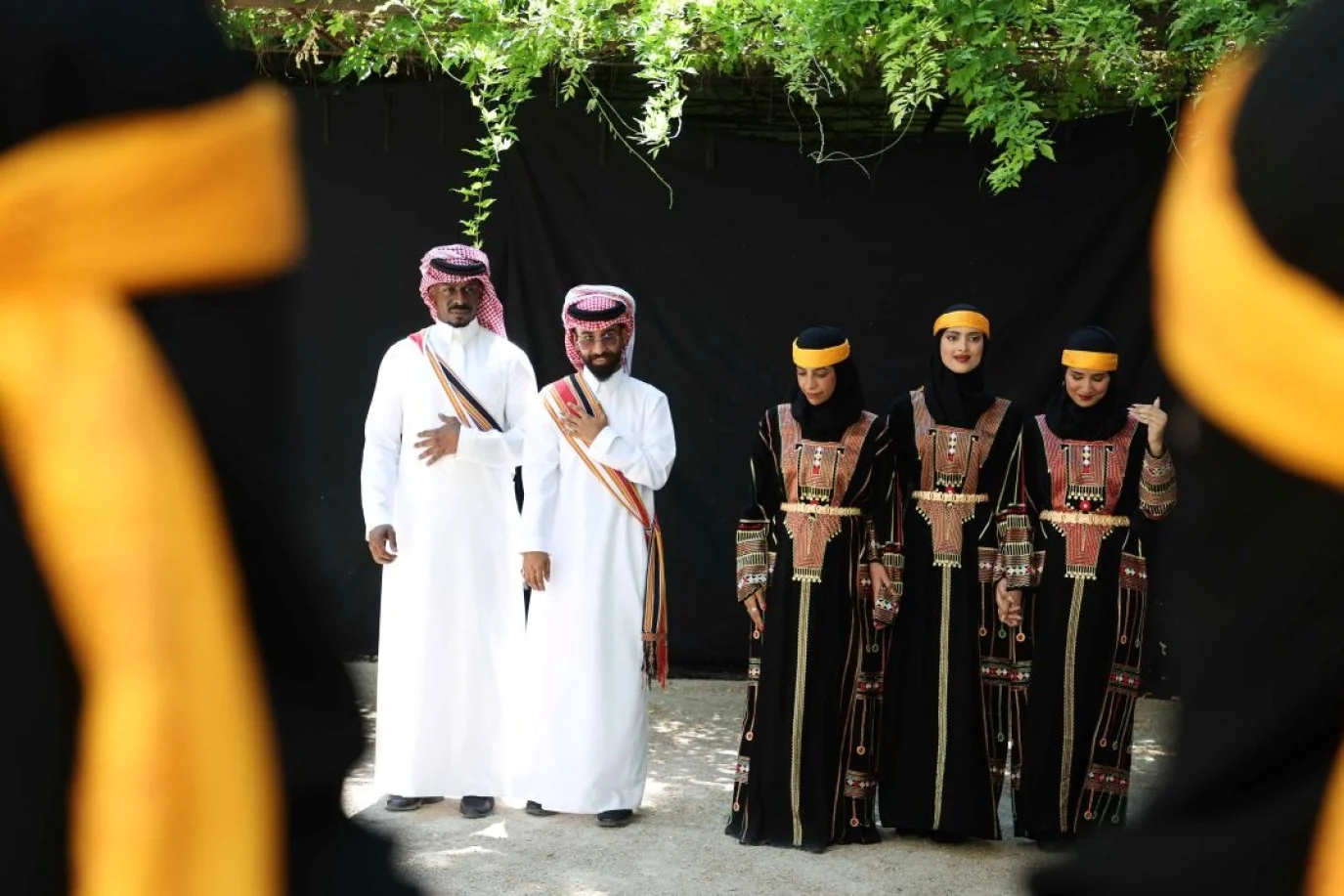
Women's Mountain Performing Arts in the South of the Kingdom
Conditions of Knowledge: Special
Saudi women participate in many traditional social activities, presenting folkloric forms that emerge from the Saudi environment. Examples include women's participation in southern Saudi Arabia, particularly in the Asir region, in women's performing arts through several distinctive forms: Al-Khatwah, Al-La'b Al-Shahri, Al-Samrah Al-Badawiyah, Al-Mahshoush, Al-Nashiyah, Al-Majalisi, Al-Razha, Tariq Al-Jabal, Al-La'b Al-Bishi, Al-Mashabani, women's Al-Majroor, Al-Surayya, Al-Tab'ah, Al-Bishah, and Al-Mal'abah.
Among the most prominent of these popular artistic forms is what is known as Al-Majalisi, an art form that emerged in the Taif region and then spread to some other regions of the Kingdom. It was given this name because it is performed while the performers sit together in the same gathering. It has male and female poets and relies on repeating the final hemistich of the poetic line. It has its own poetry, which differs in its meters and poetic themes.
As for Al-Marrad, or Al-Mal'abah, known in the Gulf as Al-Qalta, it is a traditional folk art that continues to be preserved among the Bedouin communities of the Hijaz in general and Taif in particular. Usually, no celebratory occasion takes place without Al-Mal'abah being performed. Its method of performance, whether performed by women or men, is as follows: the performers form two facing rows while reciting verses of Nabati poetry composed spontaneously. In Al-Marrad, the female performers perform coordinated movements by striking their palms together and making light, steady dance movements to stir the enthusiasm of those present.
Women in the Asir region excel in the art of Al-Khatwah, which is considered one of the most prominent southern performing arts. It has numerous melodies and poems that are predominantly emotional and romantic in character. It was named Al-Khatwah because of the coordinated steps of its performers, who stand in two facing rows. It has a distinctive form of movement that sets it apart from other arts, consisting of a vertical bending movement known as Al-Hakbah. Al-Khatwah has numerous rhythms, the most prominent of which are Al-Zay, Al-Zulfah, Al-Jazzah, Al-Mihraz, Al-Tankah, and Al-Barmil. Performers of Al-Khatwah wear the traditional clothing associated with the region.
Al-La'b Al-Shahri is a heritage tradition of all the Rijal Al-Hajar tribes, namely Bani Shahr, Bani Amr, Ballahmar, and Balsamr. Heritage in both its material aspect, such as Al-La'b Al-Shahri, and its intangible aspect, such as customs and traditions, encompasses everything that a person inherits from a chain of material and intangible customs and traditions. It forms the original and fundamental part of the present that distinguishes the culture of one society from another.
Al-La'b Al-Shahri is one of the performing arts in which poetry, music, and coordinated collective movement come together. It is a performing art independent in itself from music and poetry, and it undergoes a slight variation in Al-Hakbah, which constitutes the most prominent part of its performance movements. It is the foundation of all the movements upon which this entire art is based, and through it one style is distinguished from another. Al-Hakbah itself has become well known and developed into a subsidiary performing art branching from the basic Al-La'b Al-Shahri. It is classified as Hakbat Tanumah, named after the southern Bani Shahr tribes, or Hakbah Shamiyah, named after the northern Bani Shahr tribes. In many cases, its practitioners and performers classify it as an independent performing art, calling it Shami La'b or Tanumi La'b, as a performing art independent of the other. This demonstrates that the independence of its subsidiary performance resulted from the independence of its primary performance from poetry and music.
The art of women's Al-Majroor is also widespread, both in singing and performance. Examples of Al-Majroor poetry include:
Forgive and pardon
For your own sake, my beloved, I pleaded with you
And still, it is enough
And if I have sinned, then I was raised that way
Take your due and depart
And if you see me, O delight of my eyes, and find that I have erred
Then let my eyelids not rest
With my food and drink, my master, I have been content
Before me and behind me
I behold your beauty whenever morning comes and whenever evening falls
And I extinguish my longing
And if you grant me union, you have brought this soul back to life
The poet Ahad bin Zaid said:
A gift from God
In the valley of Al-Hawiyah, horses and the wandering gaze are bewildered
And it has the ability
To sing with the oud's melody and the recitation, delightfully
And she moved it
She glanced at me with the corner of her eye, her gaze drowsy
And she increased it
While my condition is wretched and fires burn within my heart
Even if only a little
I said: Forgiveness, O fair one, is a remedy in the form of a cure
References:
· https://www.spa.v.sa/viewstory.php?lang=ar&newsid=2420890
· See: Abdullah Al-Shahri: Al-La'b Al-Shahri and Al-La'b Al-Shi'ri
· https://www.tanomah.com/article-action-s-id-3706.htm
· https://ar.wikipedia.org/wiki