Including literary and scientific translations as well as personal memoirs, the King Abdulaziz Public Library unveils rare holdings of translated books.
King Abdulaziz Public Library has unveiled a selection of rare literary, scientific, and historical books published during the 19th and early 20th centuries, including first editions, to mark World Translation Day, observed annually on September 30.
Among the rare translated books held by the library is A Preliminary Study of Physical Geography by Félix Lamrous, translated by Ahmed Hassan Rashidi. The book was printed at the Bulaq Press in Cairo in 1254 AH (1838 CE). In its introduction, the translator writes: "I undertook to translate this book from French into Arabic, adhering to the principles of faithful translation and avoiding exaggeration and arbitrary interpretation, for I do not claim to have reached the highest level of excellence in translation, nor am I among those who boast of such claims." Following the introduction, the translated work explores astronomy, stars, the sun, planets, the moon, and the poles. It also examines a range of geographical concepts, including the equator, the meridian, the zodiac, the measurement of time, the Earth, longitude and latitude, vapors, fog, clouds, rain, snow, atmospheric electricity, lightning, thunder, winds, streams, lakes, water, seas, oceans, heat, animals, plants, and other subjects.
Another rare volume is Unveiling the Secrets of Arithmetic, written by Baron Reynaud and translated from French by Muhammad Effendi Shimi. The book, including its appendix, consists of 495 pages and was printed at the Bulaq Press in Cairo in 1288 AH. Its introduction states: "This is a book on arithmetic that resolves difficult problems and is useful to beginners as well as accomplished scholars. I translated it from French and arranged it in the style of Arabic works." The first chapter covers basic definitions, counting, and the four fundamental arithmetic operations—addition, subtraction, multiplication, and division. The second discusses properties related to the divisors and multiples of numbers and the greatest common divisor. The third deals with common and decimal fractions, while the fourth addresses distinctive numbers and new systems of measurement. The book contains numerous other chapters, along with explanations, examples, solutions to complex and compound problems, and a large number of mathematical tables.
Another rare translated work is The History of the Ancient Egyptians, Known as a Summary of the History of Egypt, written by Auguste Mariette Bey, director of the Egyptian Antiquities Service, and translated by Abdullah Abu Al-Saud Effendi, a translator at the Translation Bureau of the Egyptian Schools. Its first edition was published at the Khedivial Press in Bulaq, Cairo, in 1281 AH. The book consists of five sections covering ancient Egypt, including the country's earliest period; the Middle Kingdom; the era of the Greeks in Egypt; ancient Egyptian monuments and architecture; and other subjects related to the Pharaonic dynasties, from the First through the Thirty-Fourth Dynasties.
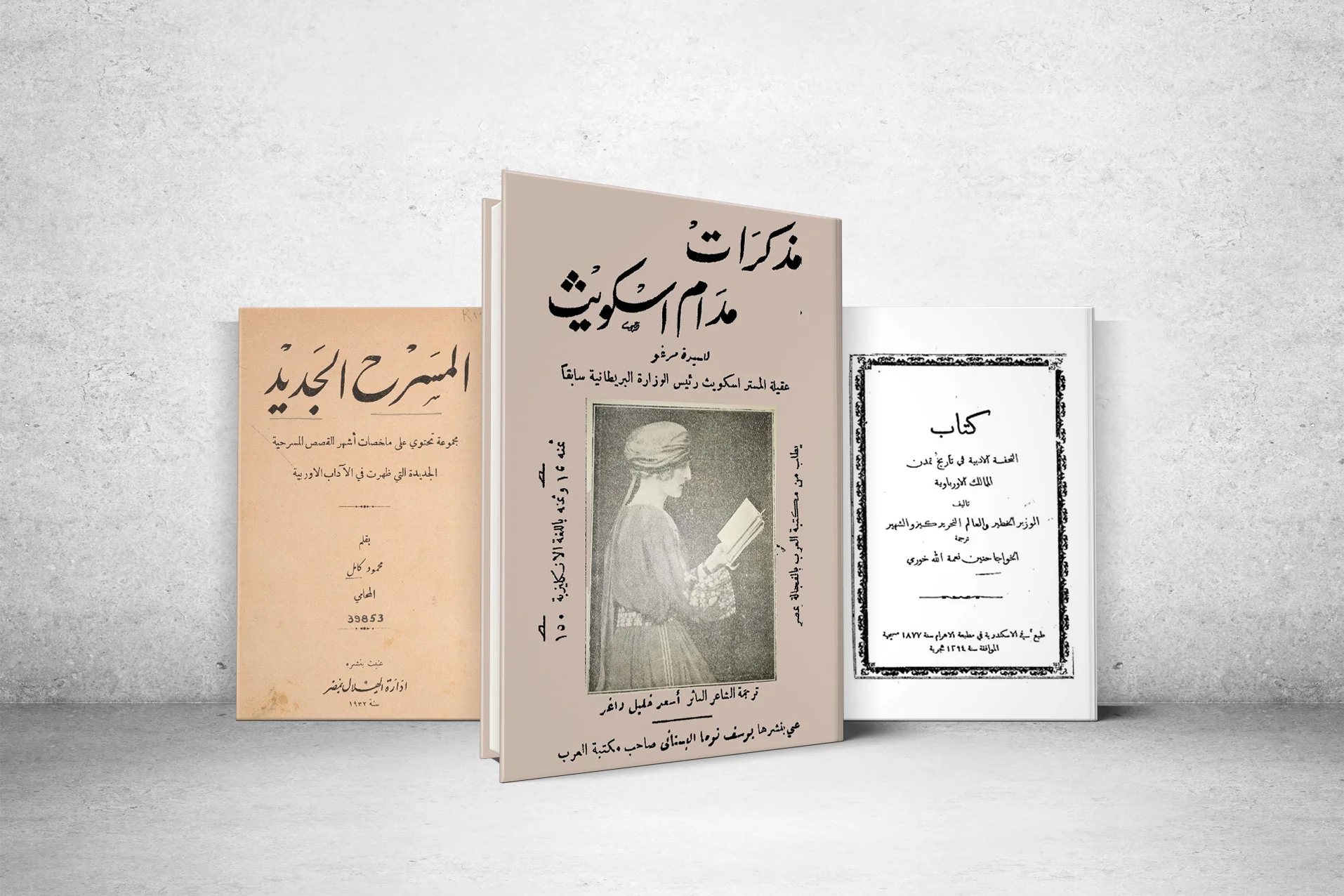
Other historical works include The Literary Masterpiece on the History of the Civilization of the European Kingdoms by Guizot, translated by Haneen Ne'matallah Khoury in 1294 AH (1874 CE), and The Rising Suns: The Story of Minister Eustachius, translated by Anton Elias Al-Hamawi and published in Alexandria in 1874.
Among the library's holdings is also The New Theater by Mahmoud Kamel, a lawyer, published by Dar Al-Hilal in Cairo in 1932. The book seeks to bring Arabic and European literature closer together and consists of summaries of some of the most famous modern plays that had appeared in European literature. In his introduction, the author states: "I would not be exaggerating if I said that this book is the first of its kind in the Arabic language. It consists of comprehensive summaries of some of the most famous plays that appeared during the present century." The book includes translations of works by a number of prominent European playwrights, including Lenormand, Lucien Bernard, Joe Zorki, Henrik Ibsen, Henri Bataille, and others.
The library also holds a number of rare works translated into Arabic, including a translation by Rifa'a al-Tahtawi published in 1281 AH under the title The Beginning of the Ancients and the Guidance of the Wise. Another is a medical work titled Surgical Bandages, consisting of 180 pages and translated from French by Ibrahim Effendi Al-Nabrawi. Published in 1254 AH, it was the tenth book printed for the School of Medicine in Egypt at the time. The collection also includes General Anatomy by Claret, translated by Issa Al-Nahrawi in 1845.
Among the rare translated memoirs are The Memoirs of Madame Esquith by Margot Esquith, translated by Asaad Khalil Dagher in 1921, and Hindenburg's Memoirs, published in 1924, along with numerous other rare translations. These works provide researchers and scholars with an opportunity to explore a remarkable cultural, literary, and scientific history, while contributing to a deeper understanding of heritage and encouraging its re-examination, documentation, and rediscovery.
The library holds a distinguished collection of rare books with unique editions, comprising 32,625 titles. These works are notable for their early and historically significant printing, their antiquity, or the uniqueness of their subject matter. Rare books form an important part of the library's scholarly mission and strategy to preserve the printed Arab heritage across diverse fields of knowledge.