Islamic Inscriptions.. Mecca and Medina in North America.. Did Muslims Discover the American Continent Before Christopher Columbus Arrived?
Ahwal Al-Ma’rifah – Special
Did Muslims play a historical role in the formation and existence of America through the voyages they undertook to discover the New World?
Historical accounts focus on Christopher Columbus as the discoverer of America in 1492. They also focus on Amerigo Vespucci, after whom the two continents were named. So, what reasons have led scholars and historians to reconsider the story of the discovery? Did Muslim geographers and historians of geography really pave the way for European explorers to discover America?
In fact, most geographers agree that there was contact with the American continent before the arrival of the European explorer Christopher Columbus. Throughout the twentieth century, academics and researchers continued to ask the question: Who really discovered America?
Different Early Signs:
In 2000, the Duchess of Medina Sidonia accidentally discovered Islamic documents written in Arabic dating back to the Andalusian period while renovating her palace in Sanlúcar de Barrameda. These documents reportedly contained a detailed description of America and the presence of Muslims there before Columbus. Her ancestors, who ruled Spain and served as leaders in the Spanish army and navy, had hidden these documents.
Fearing that the documents might be destroyed if someone discovered them after her death, she published them in 2008 in a book titled Africa Versus America. The book includes various details about the early presence of Muslims in America and inscriptions found in San Juan, the capital of Puerto Rico, including the phrase “There is no victor except Allah,” which was the motto of the Aghlabid dynasty in Andalusia. It also mentions Quranic inscriptions in churches in Bahia, Brazil, and El Salvador. Were these churches originally mosques used by Native Americans?
Although there are claims of strong indications that Muslims were pioneers in this regard, including Columbus’s own reported statement that he saw a mosque on the American coast, some Western theories have attempted to attribute this achievement exclusively to the Vikings or even the Chinese. However, Chinese documents are also said to point to Muslim leadership in geographical exploration, including the discovery of the American continent.
In a study published by Goethe University Frankfurt in 2012, titled “The Discovery of the American Continent by Muslim Sailors Before Christopher Columbus,” researcher Fuat Sezgin argued that there was broad agreement among some scholars that sea voyages to the New World took place before Columbus, with certain evidence suggesting that some of these voyages reached the continent in the early fifteenth century. However, according to the study, the central question is: Who had the ability to undertake such voyages at that time?
In his answer, researcher Sezgin noted that some Western scholars, such as Armando Cortesão, believed that Portuguese sailors discovered the American continent. However, other researchers rejected this view, arguing that the Portuguese and Europeans in general did not yet possess sufficient maritime navigation expertise at that time.
Multiple Accounts:
Several historical accounts form the basis for research into an alternative interpretation of the well-known Columbian narrative of the discovery of America. These accounts include the following:
The Voyage of Khashkhash ibn Sa’id ibn Aswad: The historian al-Masudi mentioned in his book Muruj al-Dhahab that a sailor from Andalusia named Khashkhash ibn Sa’id ibn Aswad sailed from the city of Labla in 889 CE (279 AH) into the Atlantic Ocean, known as the Sea of Darkness, and returned with spoils. Some researchers consider this a reference to an exploratory voyage westward.
The Voyage of the Mali Emperor Abu Bakr II: Some historical manuscripts, including accounts transmitted by Ibn Fadl Allah al-Umari, indicate that the Muslim emperor of Mali, Abu Bakr II, gave up his throne in 1312 and set out with a large fleet containing hundreds of ships to cross the Atlantic Ocean. They never returned, and some researchers believe they may have reached the coast of Brazil.
Christopher Columbus’s Diaries: Supporters of this theory, including Turkish historian Fuat Sezgin, have relied on notes attributed to Columbus in which he reportedly described seeing a mosque or Islamic signs on hills in Cuba. They also refer to suggestions of Black-skinned traders wearing clothing similar to that of the Andalusians.
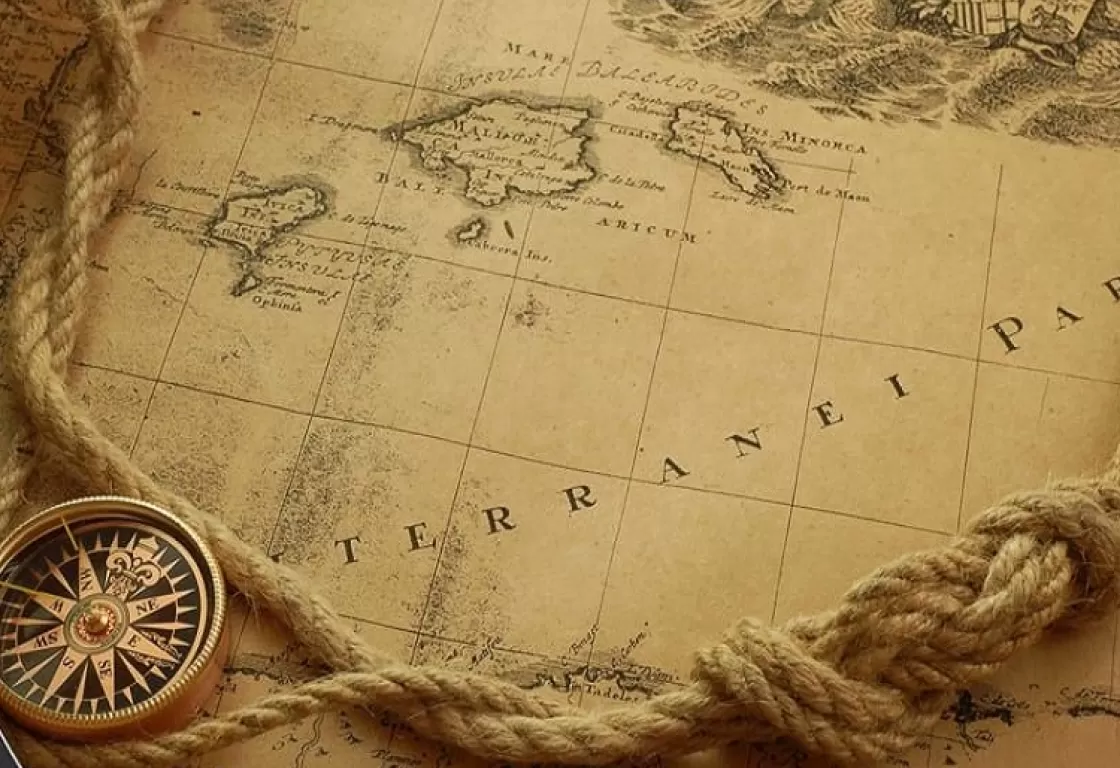
Ancient Maps: Some old Islamic maps, such as those associated with al-Masudi, and claims of reliance on Ottoman navigators such as Ahmed Piri, have been interpreted as containing knowledge of parts of the New World.
Despite all these accounts, some historians and archaeologists consider these references to be speculation and stories unsupported by tangible evidence. The internationally accepted academic account maintains that Christopher Columbus was the first to establish a documented and lasting connection between the Old World and the New World in 1492. However, the Vikings, led by Leif Erikson, reached North America, in present-day Canada, around the tenth century.
Historical Debate:
A long-standing historical debate about the discovery of America continues to this day. According to the commonly documented account, the Italian navigator Christopher Columbus sailed on August 3, 1492, from the port of Palos de la Frontera in the province of Huelva, in the kingdoms of Castile and Aragon, in present-day Spain. His voyage was financed by Queen Isabella I of Castile.
News of Columbus’s first voyage and his discovery of the Bahamas, Cuba and Hispaniola quickly spread throughout Europe. Columbus continued his explorations, surveying a large part of the Lesser Antilles during his second voyage. On his third voyage, he discovered Trinidad and Tobago while passing along the northern coast of South America. His fourth voyage involved surveying the coast of Central America. Christopher Columbus’s voyages opened the New World to European exploration.
It can be argued here that, since Columbus used maps created by Andalusian Muslims, those Muslims may have reached the continent before him. One claim presented as evidence of a Muslim presence is the city of Mecca in the state of Indiana, whose name is linked to Mecca in the Arabian Peninsula. There is also a city called Medina in Ohio and Texas, while the city of Mona is located in Utah. These names are said to have Native American origins rather than having been introduced by settlers.
In northern Brazil, some villages reportedly still bear names of Moroccan cities, such as Fez, Marrakesh, Tlemcen and Salé. Meanwhile, in North America, several places, including villages, towns, mountains and rivers, have names said to date back to the pre-Columbian era and to derive from Islamic or Arabic linguistic roots.
The Moroccan historian Ali Ben Al-Muntasir al-Kettani (1941–2001), internationally known for his studies on the earlier presence of Muslims in America, argued that the languages of Native Americans contain many Arabic and Berber words. He maintained that this could only be explained by an ancient Arab and Berber presence on the continent.
Al-Kettani presented linguistic evidence, including similarities between certain Arabic terms and words used by Native Americans. For example, the Arabic word “ghina,” meaning “wealth,” and the word “ghanimah,” meaning “spoils,” are said to have become “Guani” in a Native American language, where the term refers specifically to gold. Other Arabic terms include “nuqud” (money) and “naqiy” (pure), which allegedly became “Nikay,” meaning “golden jewelry,” among Indigenous peoples.
References: