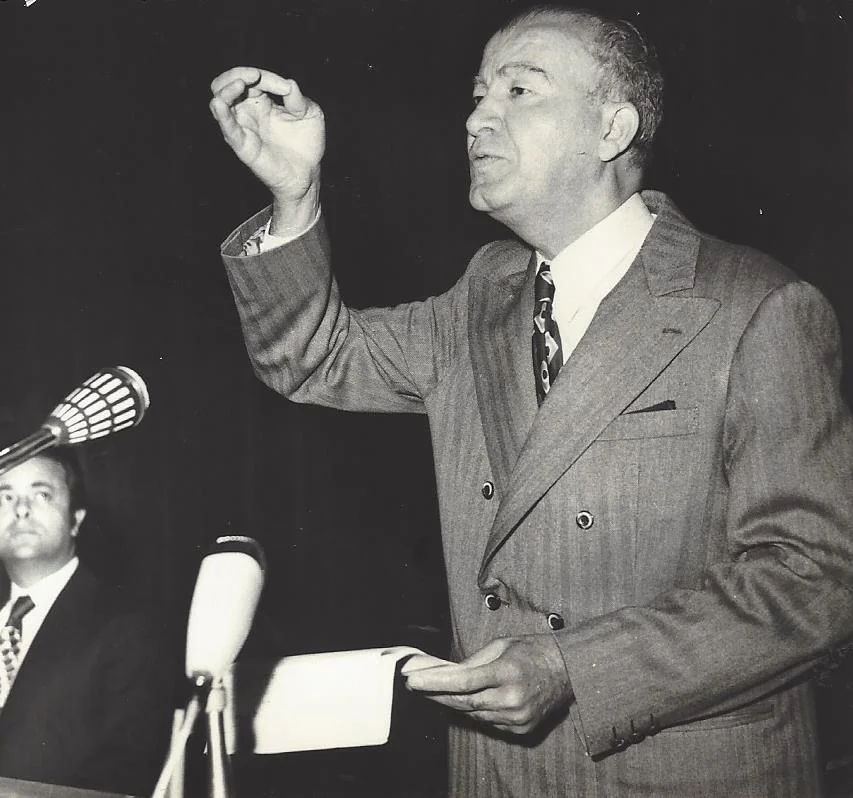
Sealed with red wax and set to be opened in 2041—what are the secrets of the file deposited by poet Omar Abu Risha at the Library of Congress?
What does the file deposited by the poet Omar Abu Risha (April 10, 1910 – July 14, 1990) at the Library of Congress in the United States contain? Is it a poetic file, or one devoted to literature and criticism? Does it contain his autobiography, or a different account of the Arab poetic scene, of which Abu Risha was one of its prominent poets?
In a rare interview with his wife, the writer Suad Makrabal, conducted by the Syrian writer and translator Kamal Fawzi Al-Sharabi and published in Al-Ma'rifa magazine (Issue 490) on July 1, 2004, Makrabal stated that the poet Omar Abu Risha had deposited a large file sealed with red wax and instructed that it not be opened until fifty years after his death, that is, in 2041. No one knows what it contains, or what literary or cultural secrets it holds.
Perhaps it contains handwritten poetry collections, as he wrote almost daily. According to his wife in the interview, there were “seven poetry collections ready for publication,” as well as his interviews with the heads of state in the countries where he served as his country's ambassador, a study of 63 female poets from the pre-Islamic era and 110 female poets from the Islamic era, and other literary subjects.
Omar Abu Risha was a Syrian poet born in Manbij, in the Aleppo Governorate of Syria. He grew up in a family in which most of its members composed poetry. He received his primary education in the city of Aleppo and completed his secondary education at the Syrian Protestant College, which later became known as the American University, in Beirut. His father then sent him to England in 1930 to study industrial chemistry at the University of Manchester.
Omar Abu Risha is considered one of the great poets and literary figures of the modern era, with a distinguished place in the canon of Arabic poetry. He was a poet, writer, and diplomat who carried in his mind and heart love and affection for his homeland, humanity, and Syrian and Arab history. Through his works and poetry, he expressed these sentiments through the finest and most creative images, words, and meanings.
Omar Abu Risha began his poetic and literary career at an early age by publishing in a number of Arab cultural magazines, including Al-Tali'a, Al-Risala, Al-Muqtataf, Al-Adib, and Al-Qithara, along with other literary and cultural magazines published during the 1930s and 1940s.
Omar Abu Risha crowned his poetic career by publishing a large collection of his poetry in several volumes, including Bayt wa Bayan, Women, I Sang at My Own Funeral, and Your Will Be Done, O Lord. He also wrote several plays, including Taj Mahal, Semiramis, The Court of Poets, The Banners of Dhi Qar, and The Flood. His complete poetic works were also published.
Abu Risha served as director of the National Library in Aleppo. In 1948, he was elected a member of the Arab Scientific Academy in Damascus, a member of the Brazilian Academy of Letters in Rio de Janeiro, and a member of the Indian Academy of World Culture.
He also served as Syria's cultural attaché to the Arab League. His subsequent positions included:
Syria's Minister Plenipotentiary to Brazil, 1949–1953; Syria's Minister Plenipotentiary to Argentina and Chile, 1953–1954; Syria's Ambassador to India, 1954–1958; Ambassador of the United Arab Republic to India, 1958–1959; Ambassador of the United Arab Republic to Austria, 1959–1961; Syria's Ambassador to the United States, 1961–1963; and Syria's Ambassador to India, 1964–1970. He spent his final years in the Kingdom of Saudi Arabia as a cultural adviser and died in Riyadh on July 14, 1990, after suffering a cerebral stroke that left him bedridden. He was transported to Syria by private aircraft and buried in the city of Aleppo.
References:
· Al-Ma'rifa magazine (Issue 490), July 1, 2004.
· https://ar.wikipedia.org/wiki