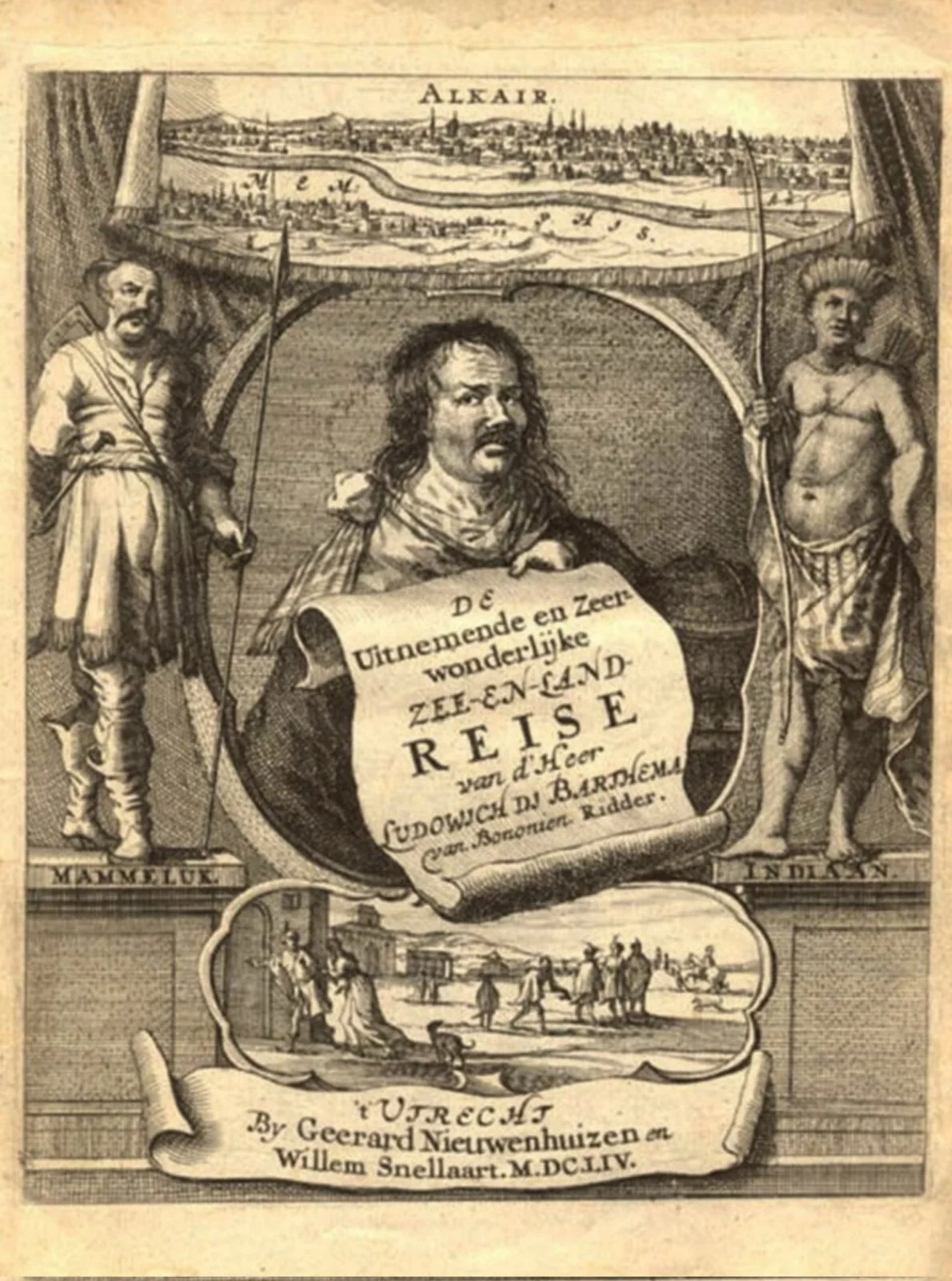
He converted to Islam and changed his name to Yunus al-Masri... The Italian traveler Varthema: The first European visitor to Jeddah, Makkah Al-Mukarramah, and Al-Madinah Al-Munawwarah.
Foreign visits and journeys to the Kingdom of Saudi Arabia became an important source of knowledge in the historical, geographical, archaeological, and scientific landscape. These journeys were not all undertaken for tourism. Many were motivated by exploration, excavation, and a desire to discover the history, antiquities, heritage, and knowledge preserved within the Arabian Peninsula. They also sought to uncover the reality behind the imagined mystery that Europeans had constructed around the region under the evocative expression “the magic of the East.”
The results of these journeys appeared in a large collection of books, particularly those produced during the eighteenth and nineteenth centuries and the beginning of the twentieth century. Numerous travelers from Russia, Portugal, Britain, France, Spain, Germany, Poland, and other European countries visited the region.
Historians, however, clearly identify the Italian traveler Ludovico di Varthema (1465–1519) as the first Western traveler known to have visited the cities of Jeddah, Mecca, and Medina.
Varthema’s journey began in late 1502 or early 1503. He traveled from Europe to Alexandria and then to Cairo, passing along the Nile. He subsequently left Egypt and traveled to Beirut, followed by Tripoli, Aleppo, and Damascus. There, he managed to obtain a new identity and was registered under the name “Yunus” in a Mamluk garrison.
From Damascus, he traveled toward Mecca and Medina as one of the companions accompanying the Mamluks in a Hajj caravan. He reached the region on April 11, 1503. From Mecca, he traveled to Jeddah, which he described as follows:
“It is surrounded by very beautiful houses, as is customary in Italy, so we shall not dwell at length on describing it. It is a very crowded city because many Muslims come here.”
Varthema then continued his journey toward Yemen and eventually India.
Varthema’s Travels
Varthema’s travel account was translated into several languages, including English, German, Spanish, Dutch, and French. It was later translated into Arabic under the title The Travels of Varthema: Hajj Yunus al-Masri, published as part of the Second Thousand Books Series by the Egyptian General Book Organization in its first edition in 1994, comprising 222 pages.
Dr. Abdulrahman Al-Sheikh, the editor and translator of the book, wrote that despite the importance of Varthema’s journey, very little is known about his life. The Orientalist Percy Badger observed that most of what is known about Varthema comes from Varthema himself.
In the Universal Biographical Encyclopedia of Ancient and Modern Times, published in Paris in 1827, there is a French account describing him as an Italian traveler who undertook a journey during the sixteenth century, although the exact year or years are not specified. The account emphasizes that his journey was particularly important to scholars of geography and historians in general because it provided valuable knowledge about the world around them.
Fantuzzi states that Varthema worked on behalf of the King of Portugal, who financed his journey. The king’s representative in India reportedly granted him a patent of privilege and knighthood and occasionally incorporated him into military forces.
Dr. Abdulrahman Al-Sheikh, translator and editor of The Travels of Varthema, further explains:
“Despite all the mystery surrounding the life of this traveler, there is general agreement that he was born in Bologna, Italy, and traveled from there to Venice. His father was a physician, and he may himself have been a soldier. He was also a husband and a father.”
Al-Sheikh also discusses the historical circumstances surrounding Varthema’s journey. He argues that Europe, during the late fifteenth and early sixteenth centuries, needed to reassess its knowledge of the Islamic world and reorganize its approach to confronting it through new methods based on knowledge and learning.
The Islamic role in shaping European history did not end with the conclusion of the Middle Ages. Rather, it continued to exert an active influence on the development of modern history. Muslims contributed to the formation of European history, within Europe itself, to a degree comparable to the contribution Europeans made to shaping the history of the modern Islamic world.
The Route of the Journey
Varthema explained the motivation behind his travels, writing:
“The desire that prompted others to see the different countries of the world was the same desire that prompted me to undertake these journeys. Since all the countries were already well known to our people, I decided to see those lands that the people of Venice had not seen or had rarely visited. Therefore, we spread our sails on a day of favorable winds, asking God for help, entrusted ourselves to the sea, and when we reached Alexandria, one of the ports of Egypt, I eagerly looked for everything new.”
Because Alexandria was already well known, Varthema soon left it and traveled to Cairo by way of the Nile.
Upon reaching Cairo, di Varthema remarked that the city was not as large as the reports had suggested, but that it contained more dwellings than Rome and had a larger population.
From Egypt, Varthema sailed to Beirut, then traveled through Tripoli, Aleppo, and Damascus before continuing toward Jeddah.
He described Jeddah and its inhabitants, noting:
“Jeddah has no surrounding wall. Rather, it is surrounded by very beautiful houses, as is customary in Italy, so we shall not dwell at length on describing it. It is a very crowded city because a large number of Muslims come here.”
Mecca and the Holy Kaaba
Varthema also provided a detailed description of Mecca and the Kaaba. He wrote:
“At each corner of the Kaaba there is a large ring ... and at a distance of ten or twelve steps from the Kaaba there is a tower with three or four doors, containing a wonderful well ... Its water is slightly salty. At this well stand six or eight men drawing water for the people...”
He continued by emphasizing the extraordinary gathering he witnessed in Mecca:
“In truth, I have never seen such a tremendous gathering of people assembled in one place as I saw here during the twenty days I stayed in this country.”
In his travel account, Varthema described the two Holy Mosques and the routes leading to them with considerable detail. He also provided what is described as one of the earliest European plans or diagrams of the Kaaba and offered a detailed account of the Hajj rituals.
His account represented an early European description of the pilgrimage and presented European readers with information about Islamic religious practices, culture, principles, and values that were largely unfamiliar to them at the time