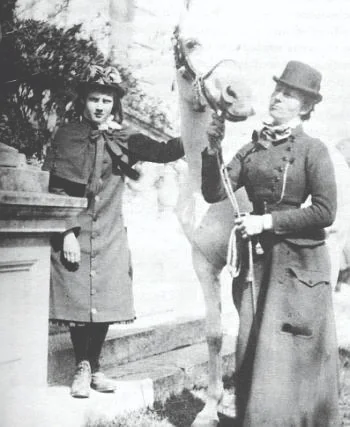
Lady Anne Blunt—an Arabian horse enthusiast—documented unique information gathered from the Bedouin; she was the first European woman to visit the Arabian Peninsula.
Lady Anne Blunt’s journey to Najd and northern Arabia stands out prominently in the writings of many Western travelers who came to the region after her. Her expedition was considered the first journey by a European woman to Arabia and the Arabian Peninsula. The journeys resulted in two books: The Bedouins of the Euphrates, published in 1879, and A Pilgrimage to Nejd, published in 1881. Lady Blunt was fluent in Arabic, in addition to speaking French, Italian, Spanish, and German fluently.
Many travelers relied heavily on the records made by Lady Anne Blunt and her husband, Wilfrid Blunt, during their journeys among the northern Bedouins and in Najd between 1878 and 1881, particularly their writings concerning purebred Arabian horses, their types, and their bloodlines. Much of this information was obtained directly from the Bedouins through their oral accounts, stories, and traditions.
After separating from her husband, Lady Anne developed an even deeper attachment to Bedouin life, the desert, and Arabian horses. She continued to live in the Arabian Peninsula and later in Egypt until the end of her life.
Prince A. G. Shcherbatov and Count S. A. Stroganov frequently cited Blunt’s observations about Arabian horses in their book The Arabian Horse, published by the King Abdulaziz Public Library, particularly on pages 103–127. In her writings, Blunt identified several horse strains, including Hamdani Samri, Saklawi Shaifi, Kuhaylan Ajuz, Saklawi Jedran, and others.
She also provided detailed descriptions of the ideal Arabian horse's head. According to her account, the head should be large, while the Bedouins particularly disliked a small head. However, the greater part of the size should be concentrated in the upper portion of the skull, with considerable space between the ears and the eyes and between the eyes themselves.
Among the finest horses she mentioned were Kuhaylan Ajuz, Kuhaylan Krush, Obeyan Sharak, Ma'naqi Hadraji, Raban, and Kbeishan. She also recorded bloodlines such as Wadhnan, Rishan, Raban, and Shuwayman.
The Life of a Lady Traveler
Anne Isabella Noel Blunt was the 15th Baroness Wentworth. Before marriage, her family name was King, and she was later known as King-Noel. She lived from September 22, 1837, to December 15, 1917, and was widely known throughout her life as Lady Anne Blunt.
Together with her husband, the poet Wilfrid Blunt, she co-founded the Crabbet Arabian Stud in England and the Sheikh Obeyd estate near Cairo.
The couple married on June 8, 1869. From the late 1870s onward, Wilfrid and Lady Anne traveled extensively throughout Arabia and the Middle East. They purchased Arabian horses from Bedouin princes in Jordan, including Prince Fendi Al-Fayez, and from the Egyptian Ali Pasha Sherif.
Among the influential horses they brought to England were Azrek, Dajania, Queen of Sheba, Rodania, and the famous stallion Maysoun, owned by Ali Pasha Sherif. Even today, the majority of purebred Arabian horses can trace their ancestry to at least one horse associated with the Crabbet Stud.
They established the famous Crabbet Arabian Stud in 1878. Four years later, they arrived in Cairo, and in 1882 they purchased the Sheikh Obeyd estate and stud farm, covering approximately 36 acres. The property contained fruit trees and pastureland outside the city, and they established a breeding farm there for the Arabian horses they owned in Egypt.
Lady Anne Blunt was the granddaughter of the famous English poet Lord Byron. After her marriage to Wilfrid Blunt, the couple undertook numerous journeys throughout North Africa, the Arab lands, and India.
After separating from her husband, Lady Anne entrusted the management of her estate and stud farm to her daughter Judith. She left Britain in 1915 and spent the remaining years of her life at the Sheikh Obeyd estate. She died in Cairo in 1917.
Her Description of Arabian Horses
Lady Anne Blunt’s book A Pilgrimage to Nejd consists of seven sections covering a wide range of social and historical subjects, with particular emphasis on the description of Arabian horses.
Among the topics discussed in the book are Qaryat al-Milh, the town of Kaf and its inhabitants, a visit with the town's sheikh, the town of Athri, Wadi Sirhan, the wells of Qaraqar, the land of Al-Jawf, the theory that the Al-Jawf basin was once a sea, the climate and geography of Al-Jawf, an archaeological inscription, the Nafud between Al-Jawf and Jubbah, characteristics of certain caravans, the hills of Najd, the journey from Jubbah to Ha'il, the clarity of the atmosphere in Najd, the horses of the Al Saud, the horses of the Anizah and the horses of Najd, and horse racing.
Lady Anne is regarded as the first woman to visit northern Arabia. She traveled through Ha'il, Al-Jawf, Najd, and Riyadh, with one of her principal objectives being the acquisition of purebred Arabian horses.
Through purchasing and preserving rare and purebred horses, Lady Anne Blunt contributed to the preservation of established Arabian bloodlines. Historians have therefore regarded her as a significant figure in the preservation of the Arabian horse.
She purchased large groups of Arabian horses and transported them to her farms in Cairo and England. In doing so, she established one of the most influential Arabian horse bloodlines in Britain.
Lady Anne was deeply passionate about Arabian horses and was an accomplished rider and breeder. She also wrote extensively about the Arabian desert and, at times, wore traditional Arab clothing. Her writings portrayed the world of the desert, Bedouin communities, and Arabian horses in a highly literary and evocative manner.
References
A Pilgrimage to Nejd, Lady Anne Blunt, translated by Muhammad An'am Ghalib, Dar Al-Yamamah Publications, Riyadh, first edition, 1967.
The Bedouin Tribes of the Euphrates, Lady Anne Blunt, translated by Dr. Ahmad Abish.
The Arabian Horse, Prince A. G. Shcherbatov and Count S. A. Stroganov, edited and reviewed by Dr. Awad Al-Badi, King Abdulaziz Public Library, first edition, 1999.
Al-Yamamah Online: http://a.alyamamahonline.com/ItemDetails.aspx?articleId=653