More than 32,000 titles in unique scientific and historical editions.. Rare Books at King Abdulaziz Public Library An open space for cultural discoveries
Ahwal Al-Ma’rifah – Special
King Abdulaziz Public Library holds distinguished collections of rare books with unique editions of scientific, cultural, historical and literary value. The collection has reached more than (32,625) titles of distinguished books, according to the library’s website:
https://www.kapl.org.sa/library/32/rare-books
These rare books are distinguished by the age of their printing or the uniqueness of their subjects. The collections are available to researchers and interested readers. These books are part of the library’s interests and strategy to preserve the printed Arab heritage in various fields of science and knowledge.
European Editions and Special Collections:
The library has a collection of rare books featuring old and rare European editions. It consists of (78) books about the life of Prophet Muhammad (peace be upon him). The collection also includes (113) books containing translations of the Holy Quran in old European languages, in addition to (55) books on Quranic studies and (54) books related to Islamic sources. This collection represents the beginning of European interest in the Holy Quran and its studies.
The library has also acquired a collection of Arabic editions printed in Europe in (1592–1593). These editions are part of the library’s interest in authentic Arab and Islamic heritage. They include very rare books, such as Al-Qanun by Ibn Sina, Asrar al-Balagha by Abd al-Qahir al-Jurjani, edited by H. Ritter, Hawliyat Nashr al-Mathani by Balyunus al-Hakim, edited by Osla Weiser, the commentary on Kitab Isagoge by Porphyry, written by Abu al-Faraj Ibn al-Tayyib and edited by Kawamijiki, and Islamic Astronomy by Jalal al-Din al-Suyuti, edited by Anton M. Heinen. The collection includes (8,271) rare Arabic book titles that have been catalogued, classified and entered into the database.
The library also owns several private library collections, including the library of the American Orientalist George Rentz. This private collection contains many rare books, manuscripts, maps and documents. It includes books in Arabic and approximately (3,265) books in foreign languages.
Another collection is the library of Hamza Boubakeur, former director of the Islamic Institute and former imam of the Paris Mosque. It is a complete library containing (17,170) titles across (19,821) volumes, including books, periodicals, newspapers, manuscripts, documents, press clippings, studies and important rare books in Arabic, French, English, German and Russian.
These collections include books on Islamic law, literature, travel writing, descriptions of countries, their heritage, customs and traditions, particularly those connected to Saudi Arabia, the Arabian Gulf and the Islamic world. These books are available for research and can help readers discover new literary, cultural and historical insights.
Between Poetry and Language:
In this field, we can highlight some of the book titles held by the library, including Insha’ al-Sheikh al-Allama al-Attar. This is a rare book on correspondence, official letters, writing legal documents and setting out conditions, covering matters needed by both specialists and the general public in a complete and detailed manner.
The book is divided into two sections. The first deals with correspondence and related forms of writing, while the second focuses on writing conditions and related matters. It artistically presents a collection of letters addressed to sultans, kings, princes, judges, scholars and sheikhs. These letters include artistic prose and selected verses from the author’s poetry and Arabic poetry.
This unique book consists of 140 pages. It was printed at the Bahiyya Printing Press in Bulaq, Egypt, during the reign of Khedive Abbas Pasha, in Jumada al-Thani in the year 1266 AH.
Another book is Majmu’at al-Sarf. Written by a group of authors, it contains several texts and treatises on Arabic morphology, including Al-Shafiya, Al-Marah, Kitab Izzi, Al-Maqsud, Kitab al-Bina and Kitab Amthila Mukhtalifa.
The book was printed at Mustafa al-Halabi Press in Egypt in 1340 AH. All its texts relate to Arabic morphology, including verb conjugation and various chapters on active participles, passive participles, nouns of time and place, doubled verbs, hamzated verbs, hollow verbs, assimilated verbs and defective verbs. It also contains many examples and presents 35 chapters from Kitab al-Bina. The book consists of 72 large-format pages.
Among the rare books in the library is Proverbs of the Common People of Egypt. This rare book discusses Egyptian proverbs from the nineteenth century. It was written by Mahmoud Effendi Omar al-Bajouri and presented as a research paper at the Eighth Scientific Conference in Sweden and Norway, in Europe, in 1889.
The author collected more than 3,000 common proverbs used by the people of Egypt and arranged them alphabetically. He explained each proverb separately, describing its meaning and supporting it with examples from Arab proverbs in some cases, and Quranic verses, Prophetic hadiths and poetic verses in others. He also followed the proverbs with a collection of folk songs that ordinary people sing during times of happiness, sadness and complaint. The book consists of 200 pages.
Another rare book in the library is Nafh al-Azhar wa Wasf al-Anwar. This rare book was published in Tetouan, Morocco, in 1934. It was compiled by Abd al-Rahman al-Saqqal and Muhammad Bakhousha. Its introduction was written in both French and Arabic.
The book contains a large collection of poetry in classical and colloquial Arabic, as well as malhun poems by poets from Tlemcen and Morocco. Its titles include “The Flowers Filled the Gardens with Fragrance,” “When Spring Came to You” and “O Companion, Look at the Morning.” The book contains (60) poems and consists of 136 pages.
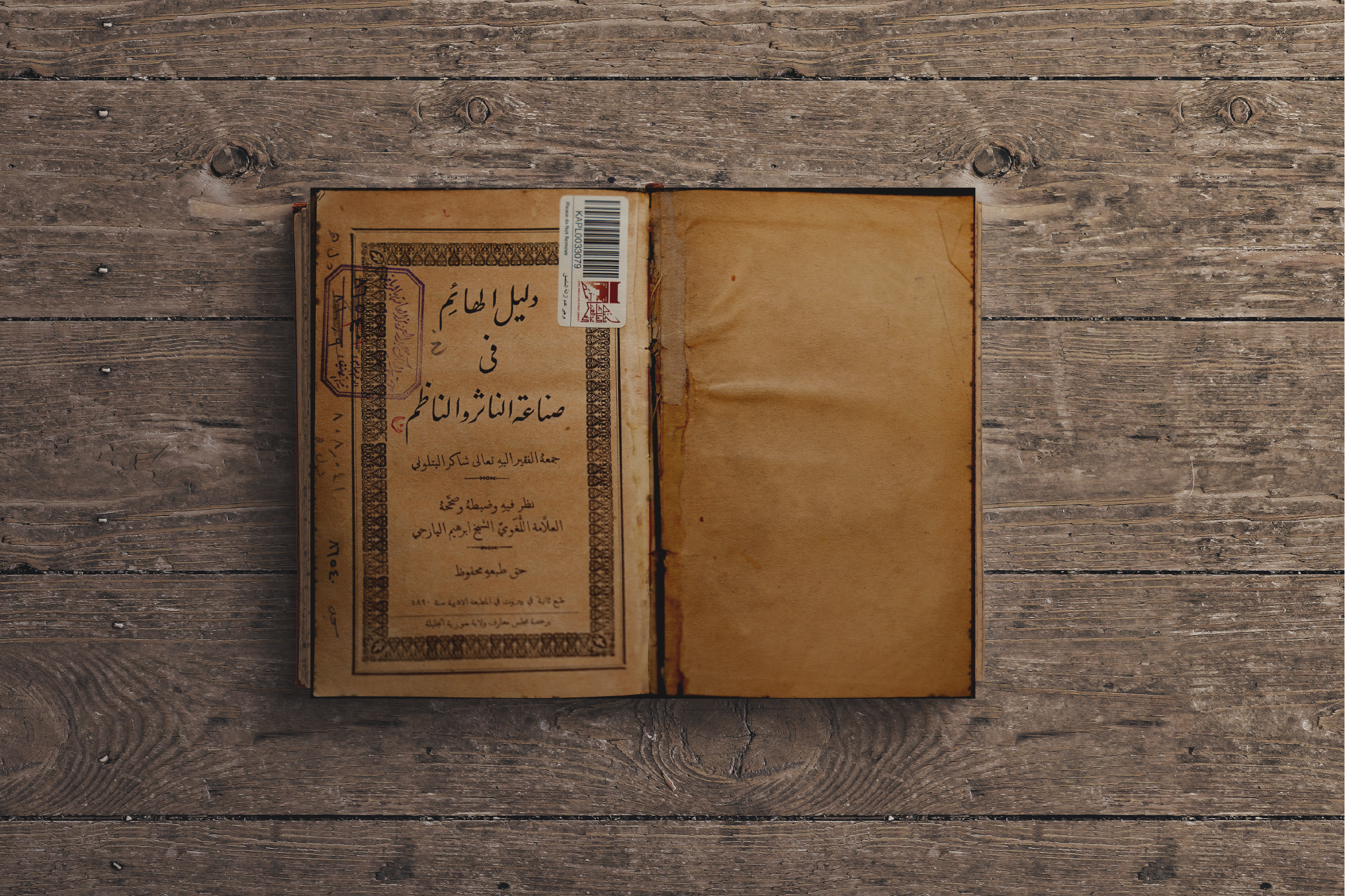
Another book is Kanz al-Nazim wa Misbah al-Ha’im. This rare book was printed in Beirut in 1878 and written by Salim Effendi Anjuri al-Dimashqi. It deals with language and the pearls of Arabic vocabulary. It resembles a shortened version of Fiqh al-Lughah by al-Tha’alibi.
The book includes poetry, prose, language and linguistic conjugations. Its titles include Talisman of the Treasure, Gate of the Treasure and The Opening of the Treasure on the Most Beautiful Names of Allah. It then discusses the titles of some prophets, angels and disciples, followed by names related to the sky, planets, stars, auspicious stars, weather signs, clouds, water, fire and other terms.
The book is a small encyclopedic dictionary of words and their meanings. It consists of 180 pages.
As for Islamic Egypt and the History of Egyptian Urban Plans, it is one of the few rare books that discuss medieval Egyptian history and present plans for the development of Egypt, along with its conditions during the Middle Ages.
Written by Muhammad Abdullah Anan, the book was printed at the Egyptian Books Press in 1931. It consists of two major sections. The first includes Urban Plans in the History of Egypt and contains two chapters: the capital of Islam in Egypt and the origins of Fustat and Cairo.
The second section discusses historians of urban plans, including al-Maqrizi, al-Kindi, al-Qina’i, Ibn al-Mutawajj and others, as well as al-Sakhawi, al-Suyuti, al-Maqrizi’s urban plans and the Tawfiqi Plans.
The second book discusses the history of Islamic Egypt through eight chapters, beginning with al-Mu’izz li-Din Allah al-Fatimi, continuing through Egyptian society in the fifteenth century and ending with the Ottoman conquest. The book consists of 184 pages.
Among the rare books held by the library is Robert’s Rules of Order. Written by General Henry Robert, this rare book discusses the rules and procedures followed in legislative councils and assemblies.
It was translated by the Society for Reform and Public Assistance, with the translation undertaken by Farid Gabriel Najjar, and printed in Beirut.
The book consists of two sections. The first explains how proceedings are conducted in formal assemblies through 11 legal provisions. The second discusses the organization of associations, their meetings and their legal rights through a series of organizational and procedural rules.