The Western "Other" Viewed Through the "Self": Europe and America as a Stage for Saudi Literary Creativity
Until several decades ago, it was not part of the Saudi writer's conception that he would engage extensively with the Western experience, or that Europe and America would become settings for the events of his novels and other literary works, whether poetry or prose. In the early stages of Saudi literary development, Saudi writers focused on engaging with and drawing inspiration from the Arab geographical landscape.
The poems of Hamza Shehata, for example, expressed Cairo and the Nile, as well as certain details of Egyptian life, particularly because he lived in Cairo for many years. Decades later, the poetry of Dr. Abdulaziz Khoja featured Cairo, Beirut, and Casablanca, along with numerous other poems written by Saudi poets about various Arab countries, whether they had visited or lived in them.
This was also reflected in some of the novels of Ibrahim Al-Nasser Al-Humaidan, Abdulrahman Munif, and Ghazi Al-Gosaibi, particularly his famous novel An Apartment Called Freedom, whose events take place in Cairo. There is also Ahmed Al-Sane's novel Opera 40, whose events take place between Riyadh and Baghdad.
Saudi writers continued to portray literary and fictional events in Arab capitals, as seen in the novels of Abdulrahman Al-Juhani, including A Saudi in Beirut 1955 and his novel A Saudi in Morocco.
A Qualitative Shift:
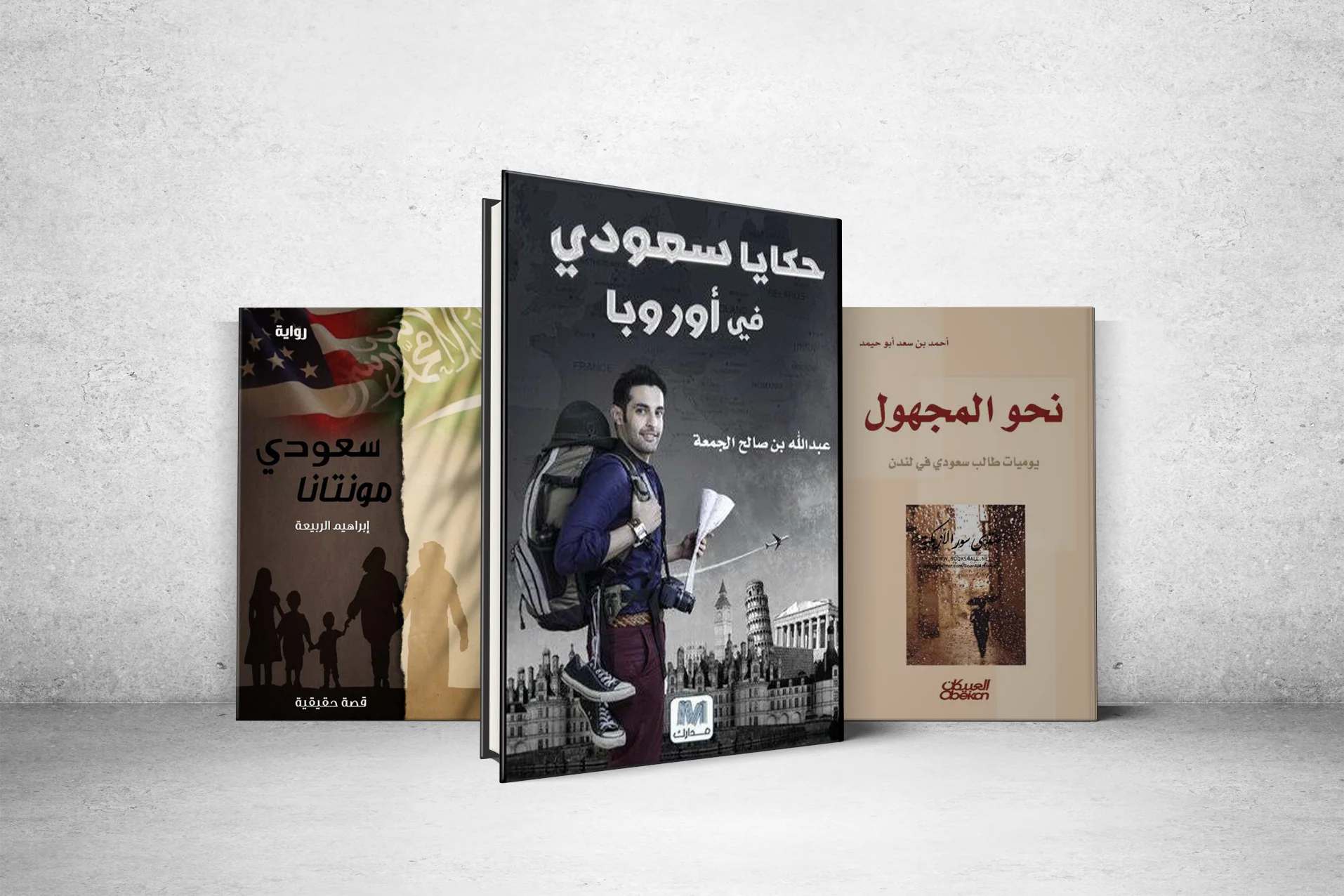
Among the Saudi literary works that drew inspiration from European and Western spaces as settings for their events, details, and narratives is the book Tales of a Saudi in Europe by writer Abdullah bin Saleh Al-Jumah. The book falls within the genre of travel literature, with its narratives, chapters, situations, and scenes. In this book, Al-Jumah documents a series of experiences and adventures, ranging from getting lost in a forest in England and taking a sea voyage across the Baltic Sea and then to Greece, to searching for the recipient of a forgotten letter in an old book, along with many other diverse stories in which Europe serves as the setting.
In the novel In December, All Dreams Come to an End by Atheer Al-Nashmi, the story revolves around a Saudi writer who leaves everything behind and travels to London, Britain, after his family refuses to allow him to marry the woman his heart has chosen. While living abroad, the writer recalls his past, his sorrows, and his longing for his homeland.
East and West:
Mohammed Hasan Alwan wrote a novel in which some of the events take place in Europe, The Beaver. Dr. Turki Al-Hamad also wrote a novel entitled East of the Valley. These novels present their narrative perspectives on the Western Other and the Arab self's view of it.
Meanwhile, writer Ahmed bin Saad Abu Humaid expresses his perspective on London through his book Toward the Unknown: A Saudi Student's Diary in London.
Dr. Mujab Al-Zahrani's novel Dance explores the interaction between the Arab self and the Western Other. Meanwhile, Maqbool Al-Alawi's novel The Little Bedouin addresses the cultural conflict between East and West. This is a perspective also found in the Sudanese writer Tayeb Salih's novel Season of Migration to the North, the Egyptian writer Tawfiq Al-Hakim's The Sparrow from the East, and the Lebanese writer Suhail Idris's The Latin Quarter.
Saudi writer Awda Al-Huwaiti also published the novel Saudi Scholarship Students, in which two Saudi students travel to America on scholarships, beginning a journey of education alongside the experience of living abroad and the emergence of Saudi student communities.
The Kingdom's scholarship programs, which have expanded significantly in recent years, have created communities and spaces among Saudi scholarship students that can serve as sources of creative inspiration for poetry and narrative literature. This is reflected dramatically in Ibrahim Al-Rabiah's novel Saudi Montana, which portrays a human conflict between East and West, involving a Saudi father and an American mother over custody of the Saudi protagonist's children. It is a haunting novel that raises many questions about the relationship between East and West.
Saudi novels, travel books, and diaries have thus represented a qualitative shift in Saudi creativity and in Saudi writers' perspectives on the West, expanding the geographical spaces in which the events of stories and novels take place and broadening the horizons of contemporary literary writing among Saudi authors.