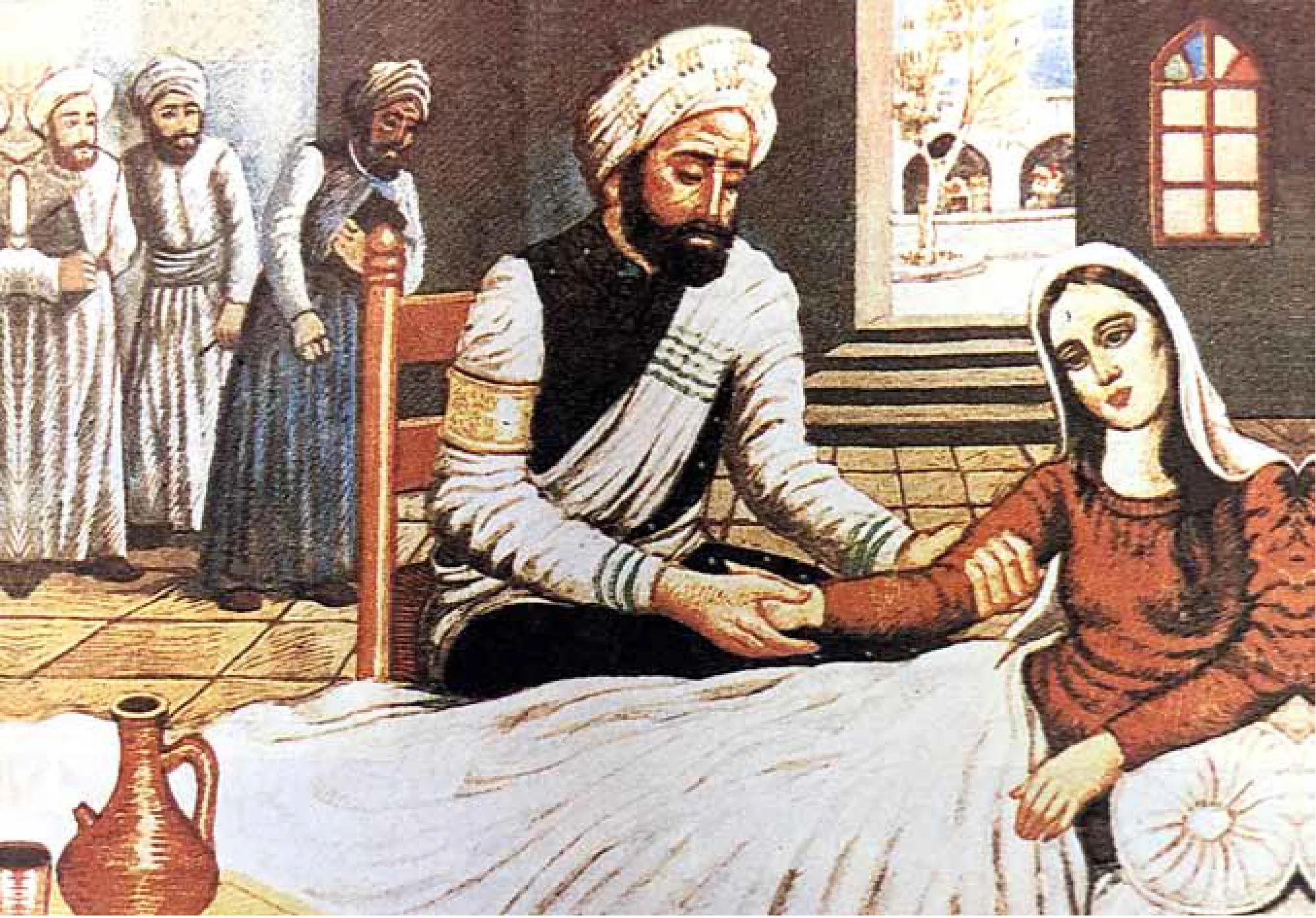
The Medical Heritage of Arabs and Muslims in the Library of Dr. Sami Ibrahim Haddad
Dr. Abdulkarim Ibrahim Al-Samak
The French scholar Roger Garaudy, one of the world’s great encyclopedic thinkers, said while discussing the prominent position of Islamic scientific civilization that the civilization which carried knowledge to its highest peaks was the Arab civilization. The legacy created by Arab and Muslim scholars confirms the genius and deep-rooted scientific tradition of this nation.
He is joined in this view by Professor Muhammad Abdus Salam, the Pakistani Nobel Prize winner in Physics, who emphasized the importance of the scientific contributions of the Islamic world. At that time, Arab science was science itself. There is no doubt that Western science inherited much from Greek knowledge, but one should also look at what was developed from the legacy of Al-Khwarizmi.
Yet we often hear the prevailing claim that Islamic science was derivative, that Muslim scholars merely followed the Greek theoretical tradition, and that they therefore contributed nothing genuinely new to the scientific method.
This claim is incorrect and unfair. It is enough to read the works of Al-Biruni to recognize this.
All of this is important because of the attempt to obscure the Arab-Islamic identity of scientific heritage and its contribution to the human civilization of today, whose foundations in many fields can be traced back to Arab-Islamic civilization.
Private Libraries and Their Role in Preserving Heritage
The importance of privately owned libraries lies in the many forms of intellectual contribution they make and in the support they provide for scientific advancement within the societies where they exist.
Among the most valuable are specialized libraries devoted to particular sciences and their related disciplines. One example is Dr. Haddad’s library, which specialized in medicine and whose shelves contain many of the medical books known to Islamic civilization.
Ibn Abi Usaybi'a did excellent work in his famous book The Best Accounts of the Classes of Physicians, in which he recorded the biographies of more than one hundred physicians, including Muslims, Syriac Christians, Jews, and Sabians. All of these individuals belonged to the broader society and civilization of the Islamic world. In this intellectual contribution, they were all participants.
It was from this perspective that Dr. Sami Ibrahim Haddad, despite being a Christian, sought to contribute to this scholarly tradition through his academic lectures and major scientific writings, presenting an exemplary picture of medicine throughout the history of Islamic civilization.
He also devoted himself to collecting the scientific heritage of medicine in his library. This required him to pursue books wherever they could be found and, when necessary, obtain copies through photography. His journeys to London provide one example, where he photographed eleven manuscripts associated with Galen, Al-Zahrawi, and Ibn al-Nafis.
Medicine and Physicians in the History of Islamic Civilization
The German school of Oriental studies is considered one of the Western schools of Orientalism that gave substantial recognition to the scientific contributions of Islamic civilization across different sciences and arts. This included medicine and its related fields, such as pharmaceuticals, pharmacy, and auxiliary sciences.
Among its scholars was the German Orientalist Eilhard Wiedemann, who spent fifty-two years investigating the Islamic intellectual heritage. He produced more than two hundred scholarly studies published in academic journals, demonstrating that many scientific opinions, theories, and discoveries attributed to European scholars had in fact been developed or anticipated by Muslim and Arab scholars.
The French scholar Dribey is also quoted as saying that European scholarship had deliberately concealed the scientific achievements of Muslims. According to him, such achievements would not remain hidden for much longer and that injustice based on religious prejudice and national arrogance could not continue forever.
Dr. Rushdi similarly argued that science was Arab in origin, development, and historical transmission, and that Renaissance-era Latin science relied heavily on the scientific knowledge that preceded it in the Arab world.
Muslim scholars made important contributions to numerous sciences and fields of knowledge, particularly medicine and its related disciplines, as well as astronomy, mathematics, and other sciences.
In this context, the library of Dr. Sami Ibrahim Haddad serves as a repository containing more than 125 foundational works on medicine and related medical sciences.
Among the pioneers of medicine in Islamic civilization were Abu al-Qasim Al-Zahrawi, who died in 1013 CE, and Ibn Sina, known as the “Prince of Physicians,” author of The Canon of Medicine, who lived from 980 to 1037 CE.
During the era of these two physicians, certain church authorities restricted the practice and study of medicine. Pope Alexander III, for example, is cited in this context, as is Pope Honorius. In 1243 CE, Honorius reportedly issued a decree prohibiting monasteries from introducing medical studies into their institutions.
This was roughly contemporaneous with the period in which Ibn Abi Usaybi'a, who was born in 1203 CE, was living and working. He produced his famous work The Best Accounts of the Classes of Physicians.
The article therefore contrasts two intellectual environments: one in which certain church authorities restricted scientific studies and another in which Islamic civilization supported the development of sciences and arts.
The scientific heritage of Islamic civilization can be found today in libraries throughout the world, including the library of Dr. Sami Ibrahim Haddad, which contains 125 books devoted to medicine. These works represent an important foundation of the medical tradition that Islamic civilization contributed to human knowledge.
The Prophetic tradition also encouraged Muslims to seek treatment and pursue practical means. A well-known hadith states:
“Seek treatment, servants of God, for God has not sent down a disease without also sending down its cure, except old age.”
This encouragement contributed to the strong interest among Muslims in medicine and its related sciences.
The Medical Library of Dr. Sami Ibrahim Haddad
Dr. Haddad’s library attracted the attention of the Institute for the History of Arabic Science in Aleppo, affiliated with the University of Aleppo.
It also attracted the attention of the German Institute for Oriental Research in Beirut, which commissioned Dr. Hans Heinrich Bitterfeld to travel to Beirut to prepare a catalogue of Dr. Haddad’s library. He worked on the project together with Dr. Farid Sami Haddad, the son of the library’s founder, who followed his father into the medical profession.
A catalogue documenting the library’s holdings was published by the Institute for the History of Arabic Science at the University of Aleppo under the title Catalogue of Medical Manuscripts in the Library of Dr. Sami Ibrahim Haddad in 1404 AH, corresponding to 1984 CE.
The book contains fourteen color plates and nineteen black-and-white plates, all relating to medicine and its sciences. It consists of 223 pages, excluding the unnumbered pages containing the plates.
According to the catalogue, the library contained 350 titles. Their subjects were generally identified, while the medical works were catalogued in greater detail.
Among the holdings were:
125 medical manuscripts
15 rare manuscript copies of the Qur’an
123 manuscripts covering literature, history, language, jurisprudence, and Prophetic traditions
33 manuscripts relating to astronomy and mathematics
Approximately 300 of the manuscripts were in Arabic. Around 25 were in Syriac, while the remainder were written in various languages, including Ottoman Turkish, Persian, Armenian, and Hebrew.
The library also contains a large collection of photographs of the bimaristans, or hospitals, of Cairo, Palestine, Damascus, and Aleppo. Dr. Haddad personally photographed these during his travels to those cities.
The library also contains photographs of medical manuscripts whose originals are preserved in museums in London and Paris. During visits to those cities, Dr. Haddad photographed thirteen manuscripts for which no known originals existed elsewhere.
Dr. Sami Ibrahim Haddad: Birth and Life (1890–1957)
Dr. Sami Ibrahim Haddad was born in the Ottoman province of Beirut, where he also later died.
He studied medicine at the American University of Beirut and apparently specialized in general surgery outside Lebanon. He subsequently worked at the university as both a physician and medical instructor.
In 1947, he established his own hospital in Beirut, known as The Hospital of the East. The hospital became a destination for patients because of its medical reputation and the professional standing of its founder as a surgeon.
His interest in establishing the library that bears his name was closely connected to his scholarly interest in medicine. He produced numerous works, some originally delivered as lectures and others published as scholarly medical studies or biographies of physicians.
He published articles in the Egyptian journal Al-Muqattam, the Journal of the Lebanese Medical Association, Al-Sharq magazine, and Qafilat Al-Zayt.
His Arabic publications amounted to approximately twenty scholarly pieces.
He also published thirteen works in English. These publications are documented in Appendices 3 and 4 of the catalogue.
Dr. Haddad and His Library
In addition to his work as a surgeon and physician at the American University of Beirut, Dr. Haddad devoted himself to collecting antiquities and manuscripts.
A substantial collection had accumulated before he established his private hospital in 1947. He subsequently focused his efforts particularly on medical manuscripts, seeking out and purchasing whatever he could find.
The first manuscript he received was a gift from Saeed Kurdistani in 1930. It was Al-Hawi by Al-Razi, listed as item number 10 in the library catalogue.
He then purchased his first manuscript, The Selected Pearl Concerning Authentic and Tested Medicines by Al-Qusuni, on September 15, 1930. It is listed as item number 83 in the catalogue.
From that point onward, he entered the world of manuscript collecting and searching. More than 95 percent of the manuscripts in the collection were acquired through purchases from manuscript dealers in Damascus, Iran, Lebanon, and Egypt.
Dr. Haddad personally recorded the date and place of purchase on the manuscripts he acquired. He also documented those that had been given to him as gifts.
When a manuscript could not be purchased, he sought out its location and photographed it instead. This included manuscripts preserved in museums in London and Paris.
Among them was one of the oldest known Arabic medical manuscripts, Al-Ghathi wal-Mughtadhi by Ibn Abi al-Ash'ath, copied in Mosul in 348 AH / 959 CE. He also photographed other Arabic manuscripts attributed to Galen, Ibn al-Nafis, and Al-Zahrawi.
Creating and Cataloguing the Library
The scientific information concerning the library was compiled according to a systematic scholarly method under the supervision of the Institute for the History of Arabic Science at the University of Aleppo, in cooperation with the German Institute for Oriental Research in Beirut.
Dr. Sami Haddad had initially catalogued his library according to a traditional system. His son, Dr. Farid Sami Haddad, later developed the system at his father’s suggestion.
The new system was based on the decimal classification system developed by Melvil Dewey, but adapted to include the categories necessary for the Arabic and Islamic sciences.
Under this system, each manuscript was assigned a subject-based identification number.
Ultimately, each manuscript was given four numbers:
The number corresponding to its subject.
The date of its composition.
The date of its transcription.
The date on which it was entered into the catalogue.
All the manuscripts were presented in the book according to this classification system.
The book concludes with an index of eleven appendices. These appendices explain the methodology used in compiling the catalogue, provide a biography of Dr. Sami Haddad and an account of his efforts to build the library, and include a final appendix documenting photographs taken from the manuscripts, together with their catalogue numbers and the pages on which the corresponding images appear.
Conclusion
This study highlights the importance of private libraries and their rich intellectual heritage, particularly when a library specializes in a field such as medicine within the scientific legacy of Islamic civilization.
The catalogue and its accompanying photographs provide a valuable picture of the history and development of medicine within Islamic civilization.
May Dr. Sami Ibrahim Haddad be remembered for his remarkable efforts in preserving and presenting this important heritage. Appreciation is also due to his son, Dr. Farid, who followed in his father’s footsteps and continued to preserve this precious library.
Praise be to God, Lord of the Worlds