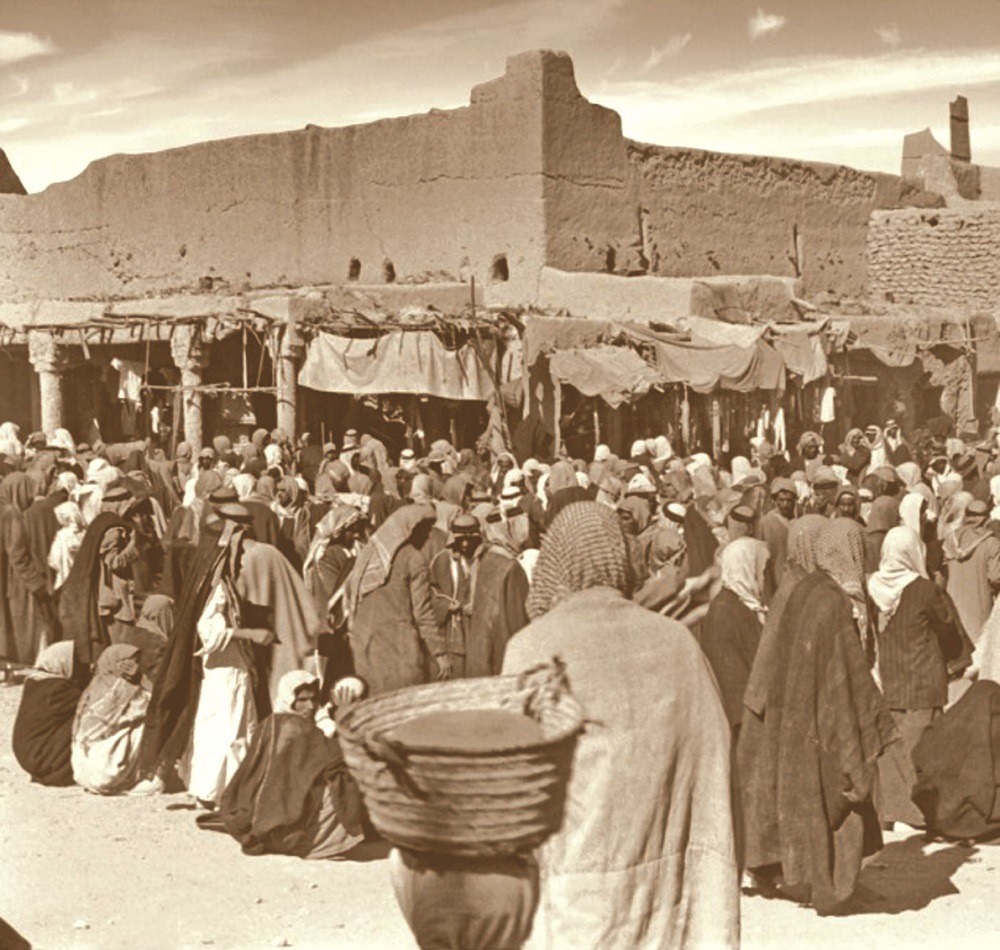
The most famous among them—Al-Zal, Haraj Ibn Qasim, Al-Qaisariyah, Al-Balad, and Al-Thulatha—are traditional markets in the Kingdom that represent a historical legacy reinforcing the national cultural memory.
Ahwal Al-Ma'rifa – Special Report
“You’ll find it at Ibn Qasim’s auction market.”
One of the most familiar expressions in Riyadh’s popular culture, this phrase refers to the historic traditional market that was established in Riyadh in the early 1950s, south of the city along Al-Ha’ir Road. Although the market has since moved to a new location in southern Riyadh, with a more modern architectural style but still along the same Al-Ha’ir Road, the tradition of popular shopping remains very much alive. The market offers shoppers an enormous variety of goods, both new and used.
Traditional markets play an important role in preserving popular and cultural awareness of objects, crafts, and everyday tools. They serve as repositories of heritage and collective memory because of their connection to the past, traditional crafts, and earlier historical periods. Here, we explore a number of these markets to highlight their heritage value and their continuing role as lively centers of everyday buying and selling.
Memory of Place:
Historically, places of buying and selling were scattered throughout old Riyadh, ranging from public squares to open areas in the heart of the city. Among the most important was Al-Safah, also known as Al-Barahah, the principal square of old Riyadh. Its central location made it the heart of the city, surrounded by the main market and overlooking the Palace of Government and several other palaces. Horses, camels, and weapons were sold in Al-Safah, while traditional ardah performances were held there on special occasions. Northwest of the Palace of Government were other markets, extending southward toward a large open square known as Al-Muqaybirah Square.
Among the most famous traditional markets of old Riyadh were:
- Al-Hadm Market: specializing in clothing.
- Al-Thumairi Market.
- Dakhna Market.
- Qaysariyat Aba Oud: located north of Al-Hadm Market and west of Ibn Mudaymih School.
- The Date Market.
- Al-Kharrazin Market: the traditional market of leatherworkers and related crafts.
- The Fodder Market.
- Al-Ahsa Market: named after the large number of people from Al-Ahsa who worked there. It specialized in tailoring traditional garments and was one of the markets that developed from Al-Safah Square.
- The Women’s Market: located adjacent to the northern wall of the palace, where women sold goods intended for women, including cosmetics, adornments, and personal items.
Al-Safah Square encompassed all these markets. It was a large open area in front of the Grand Mosque, constantly bustling with people and commercial activity. Other markets offered goods through immediate auction, as was the case with the auction market known as Ibn Qasim’s Auction Market, one of Riyadh’s most famous popular markets.
It is said that during the reign of the kingdom’s founder, King Abdulaziz bin Abdulrahman Al Saud, in 1371 AH, a man known as Ibn Qasim, who worked as an auctioneer for the public treasury, approached the King and asked permission to auction the estates of deceased persons. His name was later associated with what became one of the largest traditional markets in the Kingdom, located in Riyadh.
Ibn Qasim’s Auction Market:
The new Ibn Qasim Auction Market is located on Al-Ha’ir Road and opened in April 2015. It covers a total area of approximately 280,000 square meters and contains numerous commercial shops. There are 792 shops occupying an area of 39,172 square meters.
The market also contains 448 market stalls covering a total area of 12,628 square meters, while the walls and gates extend for approximately 2,159 meters.
At Ibn Qasim’s Auction Market, shoppers can find used electrical appliances and electronics—including mobile phones, televisions, and computers—as well as used furniture, motorcycles, generators, tents, kitchens, used restaurant equipment, building materials, sporting equipment, children's toys, clothing, household utensils, books, rare antiquities, and many other products and goods.
Al-Zal Market in Riyadh is another one of the capital’s oldest markets. Established in 1319 AH/1901 CE, it is located in the Al-Dirah district near the Palace of Government. It is particularly known for antiques, carpets, mashlahs (traditional cloaks), oud, and swords.
Al-Ahsa Qaysariyah:
Al-Qaysariyah Market in Al-Ahsa is considered one of the largest covered heritage markets in the Kingdom and the Arabian Gulf. Its shops and stalls are arranged along enclosed and covered passageways in an organized traditional style. Its historic architecture features distinctive forms, details, and ornamentation inspired by the beauty of Islamic art. The former General Commission for Tourism and National Heritage classified it as one of the most important cultural and architectural sites in Al-Ahsa Governorate.
The market is located in the Al-Kut, or Al-Rifaa, district of Al-Ahsa. It is believed to have been built more than 600 years ago and remained in existence until the late nineteenth century, specifically until 1862. It was mentioned in the accounts of several travelers who visited the Arabian Peninsula and the Kingdom, as well as in a number of historical documents. King Abdulaziz Al Saud later rebuilt the market. It is one of the oldest markets in the Arabian Gulf, and UNESCO included Al-Qaysariyah Market on its World Heritage List in 2018, confirming its historical and cultural importance.
Al-Qaysariyah Market contains 422 shops and has historically served as an important source of goods for several Gulf markets, particularly in Qatar, Kuwait, and Bahrain, owing to their proximity to Al-Ahsa. Among its notable products are rice and the famous dates of Al-Ahsa, one of the world's largest oases for date-palm cultivation.
The market also contains shops selling herbal and traditional medicines, copperware, leather products and footwear, gold and watches, fabrics, clothing, traditional cloaks and mashlahs, abayas, men's and women's accessories, household furniture, electrical appliances, household utensils, and food products.
The English traveler William Gifford Palgrave, who visited Al-Hofuf in 1269 AH/1852 CE, described the market in his account of his journey through the Arabian Peninsula.
Markets of Jeddah:
The historic district of Jeddah is renowned for its traditional markets, which form a distinctive feature along its passageways and narrow alleys. They remain among the liveliest places in the heart of the city, where old and modern goods come together. Over the years, these markets have developed a distinctive cultural identity and become symbols of the historic district. They include:
- Al-Badu Market.
- Qabil Market.
- Al-Alawi Market.
- Al-Balad Market.
- Al-Nada Market.
- Al-Khaskiyah.
- Bab Makkah.
- Bab Sharif.
Al-Tabbakhah Market in Medina, located near the Prophet’s Mosque, contains a number of traditional restaurants serving a wide variety of local dishes, including:
- Mandi heads.
- Kebab.
- Liver.
- Maqalqal, a traditional meat dish.
- Kamouniyah.
- Sheep trotters.
- Grain soup.
- Harissa.
- Rice dishes, including Kabuli, Bukhari, Arabic-style, and Biryani rice.
- Various types of fish.
- Mantu.
- Yaghmash.
- Bouf.
The market forms part of Medina’s social life and remains an important destination for local residents and visitors alike.
Traditional Markets of Najran:
The traditional markets in the Abu Al-Saud district of Najran offer a wide range of locally made heritage goods and products, including the Najrani dagger, known as the janbiyah, as well as leather goods, wooden crafts, and textiles for which the Najran region is renowned.
The markets also include pottery and stonecraft shops offering products made from soapstone and clay. Other shops sell leather goods made from cow, camel, sheep, and goat hides after they have been tanned and prepared.
The Women’s Market, located beside the historic Emirate Palace in Najran, is one of the region’s oldest markets dedicated to women. It provides clothing, jewelry, perfumes, cosmetics, and skincare products. Women have practiced buying and selling there since ancient times and continue to do so today through the traditional shops known to visitors and marketgoers.
Tuesday and Thursday Markets:
Tuesday Market in Abha, in the Asir region, is one of the old weekly traditional markets found throughout the region’s governorates. With its long history, it occupies a central position in Abha beside the King Fahd Cultural Center, also known as Al-Muftaha Village.
Before 1242 AH, Tuesday Market was known as Ibn Madhhan Market. It later became known as Tuesday Market because it was held weekly on Tuesdays. It brought together members of the tribes of southern Saudi Arabia, from Zahran to Dhahran Al-Janoub, as mentioned by Al-Hamdani.
The market served as an open forum for exchanging information about agriculture, herding, and trade. It was also an important social landmark where people met for reconciliation, friendship, acquaintance, and closer social ties, while exchanging news about rainfall, harvests, and livestock.
Thursday Market in Qatif attracts vendors from various villages in Qatif Governorate and beyond. Stalls and shaded areas are set up at night to sell agricultural products and traditional handicrafts made from palm fronds, known locally as khous, including:
- Baskets.
- Mats.
- Palm-frond handicrafts.
- Fans.
- Traditional ghee.
- Prayer beads.
- Rings.
- Pottery.
- Clothing.
- Products made from palm trees and other trees.
- Vegetables.
- Fruits.
- Honey.
- Spices.
- Dates.
- Women’s accessories, clothing, and handmade crafts.
- Antique copper utensils.
On the western side of the market is a section for pets, livestock, and birds. The southern side contains a section selling fabrics and footwear, in addition to imported goods and modern products.
References: