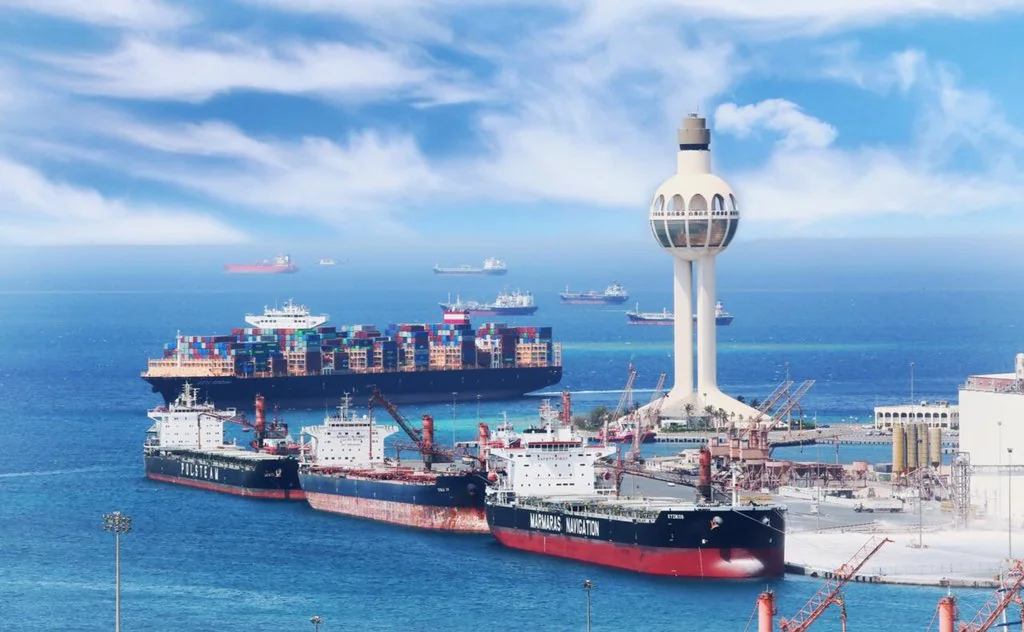
Achieving the largest leap among 100 global ports... Jeddah Islamic Port: A dialogue of economic innovation between sea and shore.
Jeddah Islamic Port, located on the Red Sea on the western coast of the Kingdom of Saudi Arabia, is considered one of the world’s prominent ports, achieving major advances in container handling, loading and dispatch, as well as transshipment.
It has evolved from an old port that received ships carrying pilgrims performing Hajj and Umrah to Makkah into a global port with international systems and coordinates and a significant presence on the world maritime map.
Jeddah Port consists of two main components: the port facilities and container terminals. It is one of the Kingdom’s most vital ports due to the wide range of functions it performs and the diversity of maritime activities carried out there.
Jeddah Islamic Port has undergone a long and productive journey, evolving from an old harbor into a modern port capable of competing with the world’s most advanced ports. At the same time, it has preserved its historical and heritage dimensions while looking toward the future and its developments.
In another sense, the port represents a historical, cultural, and heritage memory, being part of one of the world’s oldest cities.
A Rich History
The establishment of Jeddah Islamic Port dates back to the era of Caliph Uthman ibn Affan in 26 AH (646 CE), when the Caliph designated it as the port of the city of Makkah. Since then, it has served as a major gateway for receiving pilgrims from all over the world.
Today, the port covers an area of 12 square kilometers and serves as an economic and religious hub. It consists of 62 multi-purpose berths, with a total length of 12.3 kilometers, and water depths reaching 18 meters. It can accommodate modern generations of container ships carrying up to 19,800 standard containers.
The number of modern pieces of equipment available for cargo handling at Jeddah Port exceeds 1,752 units.
The port includes three container-handling terminals and two general cargo-handling terminals. Its designed general cargo-handling capacity reaches 130 million tons.
The port also contains a number of investment projects, including a sugar refining plant, an edible-oil refinery, rice storage silos, and a re-export zone.
Strategic Location
The strategic location of Jeddah Islamic Port makes it one of the most important ports in the world. It lies along major international shipping routes, making it a connecting hub between three continents: Asia, Africa, and Europe.
It is described as the leading port on the Red Sea coast for transit maritime trade and the transshipment of containers and cargo.
Throughout the ages, the port has witnessed extensive commercial and cultural development and prosperity. It was eventually included on the UNESCO World Heritage List in 2014.
A Logistics Zone
The Saudi Ports Authority, Mawani, is committed to developing all of its ports, connecting them with major shipping lines, and introducing advanced technological services.
Among the authority’s latest projects is the Logistics Zone, launched by Mawani and DP World, with an investment value of SAR 900 million.
The logistics zone covers an area of 415,000 square meters. It is divided into large multi-purpose warehouse areas covering up to 185,000 square meters, in addition to 390,000 storage platforms, facilitating the smooth flow of customers’ goods to and from the city of Jeddah.
The project will provide state-of-the-art storage and distribution facilities, while also helping maximize trade flows in the Kingdom in particular. The project represents a major step in strengthening the port’s position among the world’s ports and enhancing the logistics sector more broadly.
The logistics zone forms part of Mawani’s plan to establish 59 logistics zones across the Kingdom’s ports.
As part of its continued efforts to strengthen the port’s logistics role, Jeddah Islamic Port has also been included in the London Metal Exchange network among 450 global storage facilities/platforms.
The logistics zone also contributes to increasing commercial activity, improving the port’s operational efficiency, and ensuring the smooth functioning of supply chains.
Mawani has also added the new “CBS” shipping service to Jeddah Port through the Chinese shipping line “New New Line,” connecting the Kingdom with international markets.
The service links Jeddah Port with the Chinese ports of Shanghai, Qingdao, Tianjin, and Guangzhou, as well as Damietta Port in Egypt, through regular weekly voyages.
It is worth noting that the first new shipping line serving Jeddah Port was launched in 2021, establishing connections northward to Europe and the Mediterranean, then onward to the Middle East and the Indian subcontinent through North Africa.
This shipping line will connect Jeddah Port with ports in the Indian Ocean and Northern Europe, using seven vessels, each with a capacity equivalent to 8,500 standard containers.
The ports sector in the Kingdom of Saudi Arabia is moving steadily and rapidly toward achieving the objectives of the National Transport and Logistics Strategy, in accordance with Saudi Vision 2030.
References
Wikipedia Encyclopedia