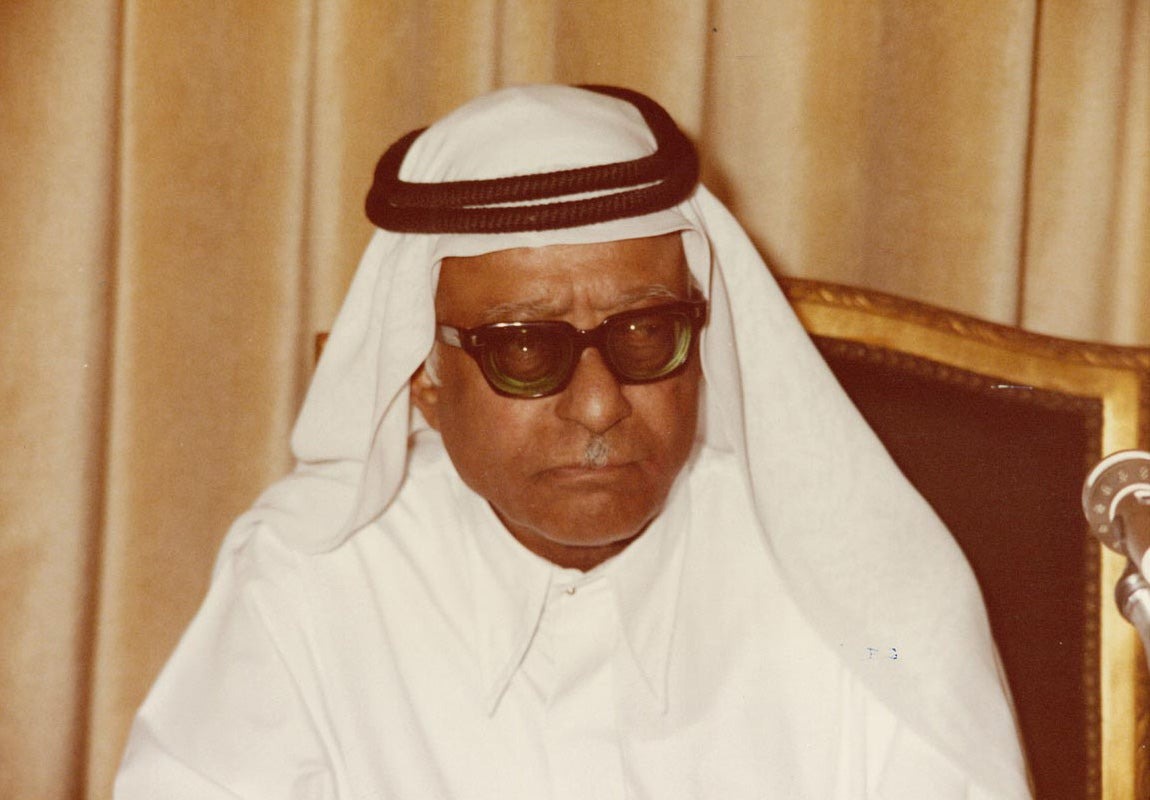
Ahmed Abdul Ghafoor Attar Enriched Linguistic Research and Published the First Issue of His Famous Newspaper from a Hotel
Knowledge Affairs – Special Report
The writer and poet Ahmed Abdul Ghafoor Attar reflected on human language, asking: “What is language? Is it a collection of sounds made up of letters that express thought and emotion? Is it truly a means of expressing thought? Is it really a means of expressing emotion?” He added: “What is language? Is it a means of communication between those who speak it? Does it serve as a link between people? Is it a tool for expression and clarification?”
He went on to provide an answer: “Language is a system of symbols or a pattern of signs through which we represent what we wish to express and communicate to others, conveying it to them. It consists of sounds that reach us through hearing… Writing, meanwhile, is nothing more than symbols represented through images and drawings of the things they signify.”
Ahmed Abdul Ghafoor Attar recognized the importance of linguistic phenomena and was among the first Saudi writers and intellectuals to take a serious interest in language. He wrote numerous articles and studies about it, defending Modern Standard Arabic and calling for the creation of specialized linguistic dictionaries covering all fields.
He highlighted these ideas in his books Views on Language and Defending Modern Standard Arabic, among other works. In addition, Attar was a pioneer in journalism, literature, and linguistics. He founded Okaz newspaper, whose first issue was published from the Al-Aziziyah Hotel in Taif on 3 Dhu al-Hijjah 1379 AH. He also launched Kalimat al-Haqq magazine, publishing four monthly issues before suspending it because of financial difficulties. He established a modern printing press to produce his newspaper, Okaz, which continues to carry the statement in every issue: “Founded by Ahmed Abdul Ghafoor Attar.” He also served as an adviser at the Royal Court and as chairman of the board of the Okaz Media Organization.
Academic Beginnings:
Ahmed Abdul Ghafoor Attar Al-Noor was born in an area known as Jabal al-Kaaba, overlooking the Grand Mosque in Makkah, on 14/12/1337 AH. He grew up in the historic Al-Misfalah neighborhood and pursued his education until he obtained a certificate from the Saudi Scientific Institute in Makkah in 1354 AH.
In Rabi‘ al-Thani 1357 AH, he was appointed to a position in the Public Security Department in Makkah, where he worked until 1359 AH, when he devoted himself to research and writing.
From childhood, Attar was eager to pursue knowledge and learning. He inherited this intellectual passion from his father, Abdul Ghafoor Attar, who was knowledgeable in the Qur’an and Sunnah and had studied the Hanafi school of Islamic jurisprudence. His father was also a merchant dealing in perfumes, silk fabrics, and turbans. Through his travels, Abdul Ghafoor Attar gained knowledge of different cultures, which further enriched his experience.
Attar had a deep interest in journalism. While studying at the Scientific Institute in Makkah, he produced a handwritten magazine titled Al-Shabab Al-Nahid (The Rising Youth). He later collected the articles he had published in it into a book titled My Book.
During that period, King Faisal, may God have mercy on him, visited the institute while serving as the Emir of Hijaz. On that occasion, Ahmed Abdul Ghafoor Attar delivered an impromptu speech and presented King Faisal with his first book. The king examined it and admired the young writer’s initiative. He then ordered 300 copies to be printed at the government printing press in Makkah in 1354 AH.
Publications and Honors:
The writer Attar devoted himself to producing works on linguistic studies and vigorously defended Modern Standard Arabic, establishing foundations for research and discussion on the subject. He also wrote about certain Western methodologies and their potential dangers, while producing works on Islamic studies, history, poetry, and theatre.
Attar was influenced by the literary figure Abbas Mahmoud al-Aqqad, with whom he shared several characteristics, including an encyclopedic approach to writing and a tendency toward criticism that sparked literary debates.
His publications numbered more than 70 books. Among his most prominent works are Desire and Youth (poetry), whose introduction was written by Dr. Taha Hussein; Migration (a play); Falcon of the Arabian Peninsula, in three volumes; Al-Bayan; Classical Arabic and Colloquial Arabic; Islam: Our Path to Life; The Humanity of Islam; Al-Sihah; and Schools of Arabic Lexicography.
In 1404 AH, King Fahd bin Abdulaziz, may God have mercy on him, honored Attar with the State Prize for Literature. Prince Nayef bin Abdulaziz, may God have mercy on him, also awarded him a first-class certificate of recognition in appreciation of his service in Public Security early in his career. He was additionally honored by Tunisian President Habib Bourguiba and Egyptian President Hosni Mubarak.
Attar received a Gold Certificate of Appreciation from the Modern Literature Association in recognition of his literary contributions and his enrichment of intellectual and literary life. The Iraqi Scientific Academy also honored him as a thinker, scholar, and man of letters.
He became a member of the Syrian Scientific Academy and received honorary and distinguished membership in the same institution. He was also awarded a Medal of Valor and the title of Honorary Editor-in-Chief of the Central Daily News newspaper.
Attar passed away on Friday, 17 Rajab 1411 AH, at the age of approximately 77. He had devoted fifty years of his life to writing and publishing, defending the Arabic language until his final years.
References:
Ahmed Abdul Ghafoor Attar, Views on Language, Arab Printing Establishment, Jeddah.
Wikipedia: https://ar.wikipedia.org/wiki/
Saudipedia: https://saudipedia.com/
Al-Maktaba al-Shamela: https://shamela.ws/author/1314