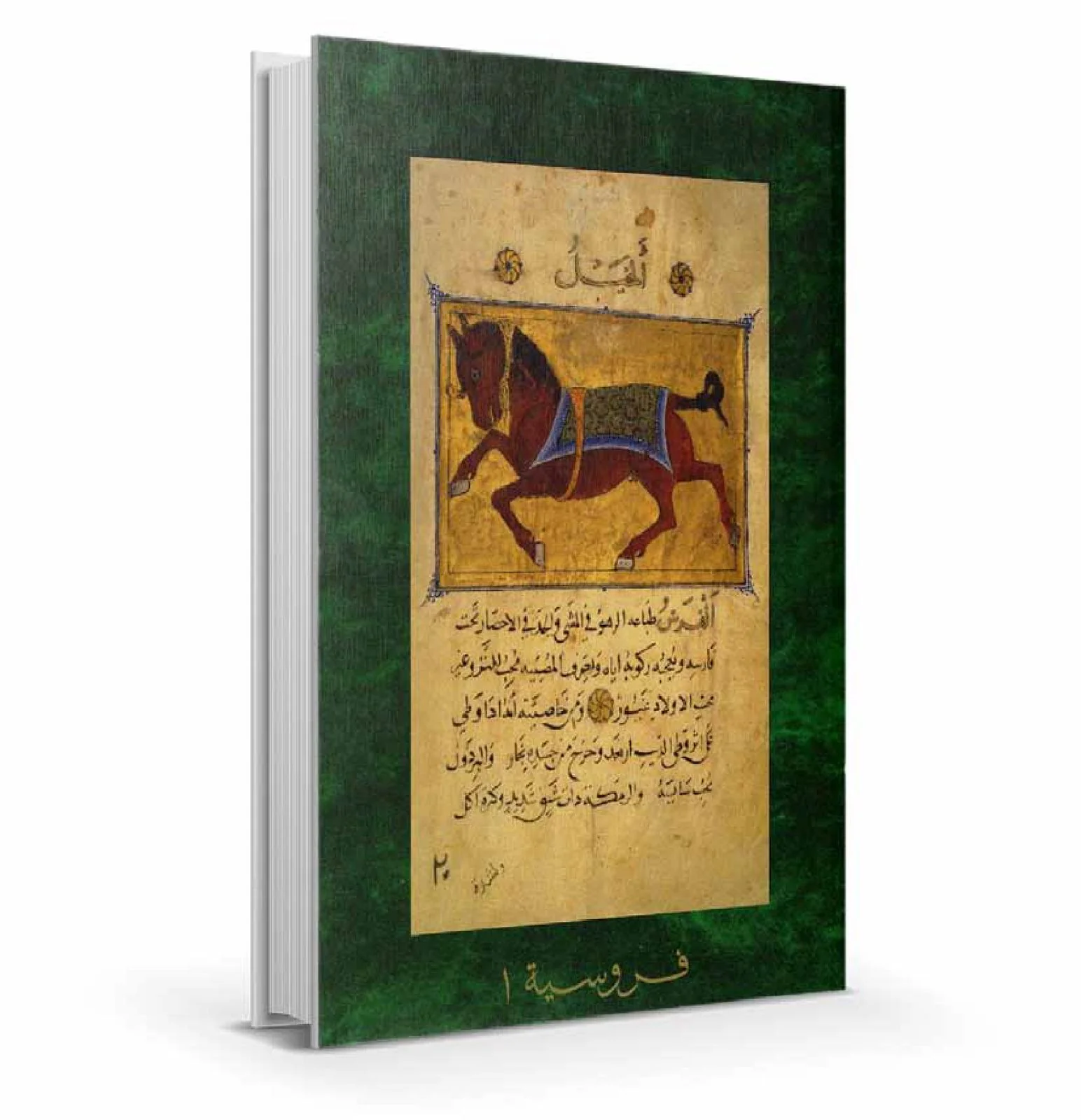
Islamic art acquired by global museums: miniatures from a Furusiyya (horsemanship) manuscript stand as heritage testaments to the aesthetics of color and line.
One of the finest books prepared and published by the King Abdulaziz Public Library—in both Arabic and English editions—is *Furusiyya* (Horsemanship). It serves as a treasure trove of information and historical narrative regarding Arabian horses and the art of horsemanship. The work features hundreds of heritage images, engravings, and sculptures rich in artistic elements and characteristics that depict the horse. Published in two substantial volumes, the book was the product of a collaborative effort involving a committee of nineteen figures, scholars, and specialists. Its visual content was sourced from centers, museums, and libraries across seventeen Arab and international nations. Furthermore, the editing of its text and information was overseen by Dr. Shihab Al-Sarraf and David Alexander, with contributions from a large team of researchers hailing from Spain, Australia, Italy, Portugal, Belgium, Denmark, the UAE, Russia, Saudi Arabia, Egypt, the UK, Austria, the Netherlands, the USA, and Greece. The work comprises two volumes: the first presents a collection of twenty-nine scholarly articles and research papers prepared by an elite group of global academics specializing in the history of the horse, while the second serves as an illustrated catalog of historical artifacts, paintings, and documents—many of which had never been documented before. Regarding horse miniatures, the book—a large-format publication spanning 566 pages—includes a rare and distinguished collection of artistic miniatures. These artworks depict horses in various settings—such as travel, battle, war, and desert life—capturing minute details with astonishing precision. The miniatures appear on pages 104–139 within a chapter titled "Chivalric Literature in the Abbasid and Mamluk Eras," authored by Dr. Shihab al-Sarraf. This chapter features eighteen diverse miniatures in which artists and engravers depicted various aspects of horses and scenes of chivalry. The first miniature portrays a knight wielding a sword and shield while riding a powerful, galloping horse; this image is taken from the manuscript *Nihayat al-Su’l wa al-Umniyya* (The Ultimate Quest and Desire) by al-Aqsarai—specifically a copy dated 767 AH held in the Chester Beatty Library in Dublin (MS 21A). The same book contains other miniatures, including one of a Mamluk knight galloping with his sword drawn and another of a Mamluk knight equipped with a shield and lance. Additionally, the book includes miniatures of horses from *Kitab al-Baytara* (The Book of Veterinary Medicine) by Ibn al-Ahnaf, depicting a horse in isolation as it moves and walks. The illustration captures the horse's rhythmic movement—showing its right leg raised while the other legs remain planted—and depicts it wearing a saddle and bridle. The color palette features distinct shades of brown and light brown, alongside depictions of black horses. Page 114 of the book features a large miniature depicting a novice practicing the *qabaq* (pumpkin) shot; this image is taken from the manuscript *Al-Makhzun Jami‘ al-Funun* (The Treasury: A Compendium of Arts) by Ibn Akhi Hizam al-Khutali—a copy dated 875 AH held at the National Library in Paris. The *qabaq* shot—aiming at a pumpkin—is a training tradition that originated among the pastoral peoples of Central Asia, evolving from the practice of hunting birds with a bow and arrow while mounted. Another illustrative miniature, featuring a horseman holding a bow and arrow, appears in the manuscript *Nihayat al-Su’al* (The Ultimate Quest) from the British Library; it depicts a crescent-shaped arrowhead typically used for bird hunting. A further miniature—also from *Al-Makhzun Jami‘ al-Funun*—showcases the aesthetics and rhythmic flow of movement, depicting a Mamluk horseman wielding an incendiary mace. Other miniatures—preserved in libraries and museums worldwide—illustrate various aspects of equestrian combat: the confrontation between horsemen; the diverse coat colors of the horses (notably brown and black); the different types of combat; the variety of techniques—such as sword fighting, lance combat, archery, and the *burjas* (target) thrusting exercise; training in the use of the mace; mounted grappling; and a scene depicting a horseman spearing a wild boar. The King Abdulaziz Public Library houses a vast collection of manuscripts and books featuring this distinguished Arab-Islamic art form: the art of miniatures and decorative design. This style—which incorporates drawings, patterns, and embellishments to adorn books and written texts—is characterized by meticulous illustration and coloring, a diversity of imagery and line work, and multicolored, ornate margins. It is an art form mastered by skilled calligraphers and painters throughout earlier Islamic eras, who employed it to decorate books and manuscripts.