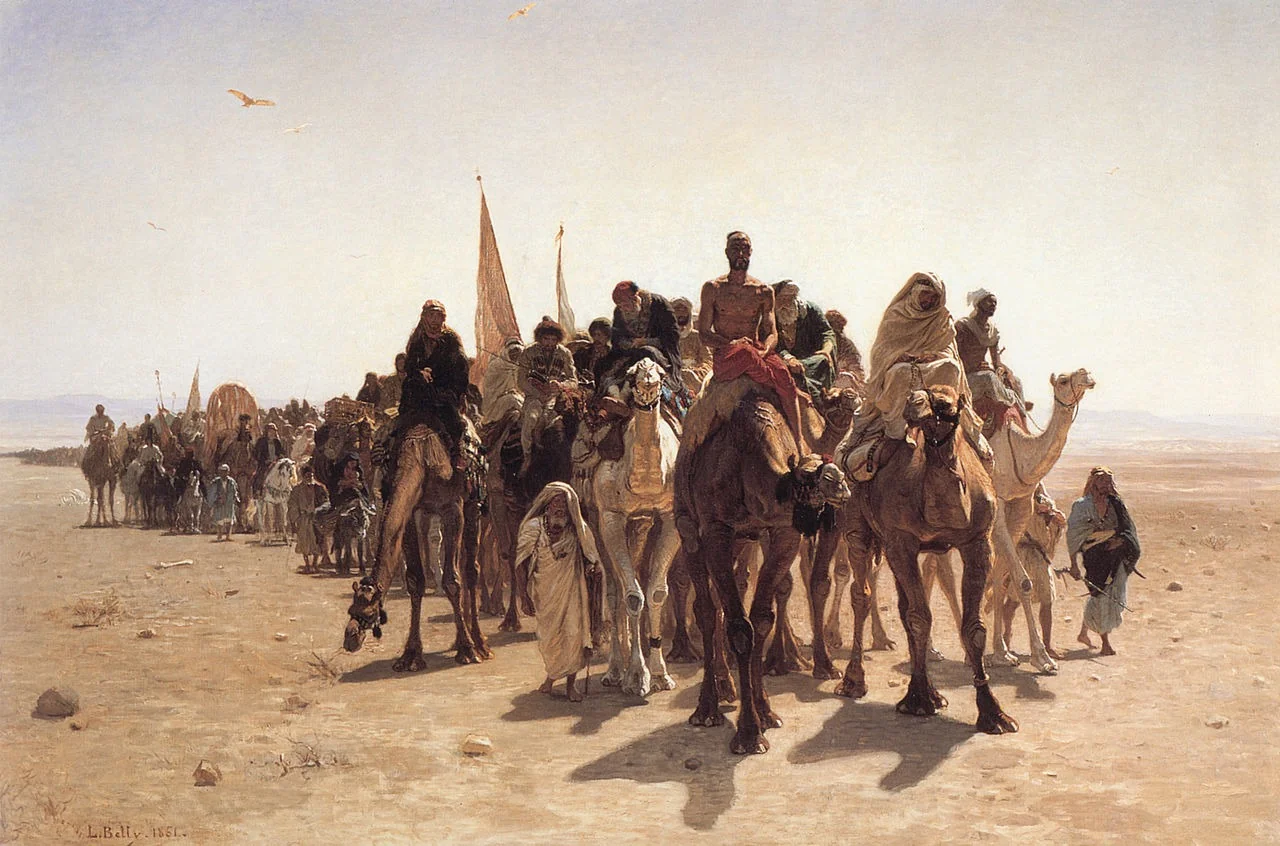
A masterpiece of world art depicting the Hajj: French artist Léon Belly captures the pilgrims' yearning and anticipation in his painting, *Pilgrims Going to Mecca*.
In one of the world’s most famous paintings depicting the journey to Hajj, the French visual artist Léon Belly painted a work entitled Pilgrims Going to Mecca in 1861. The painting depicts a group of pilgrims making their way across the desert toward Makkah, their expressions reflecting exhaustion, eagerness, and longing to arrive. It also evokes the trails, paths, and Hajj routes taken by pilgrims traveling from Iraq, the Levant, and Egypt to the Sacred House of Allah. They cross the desert on camelback or on foot, undeterred by the midday sun.
The painting of the pilgrims won the gold medal at the annual international exhibition in Paris in 1861 and requires no further glorification. It also served as the introductory image for the slogan of Aleppo’s designation as the Capital of Islamic Culture in 2006. In addition, it resides in one of the finest palaces dedicated to art: the Musée d’Orsay, housed in a building that was once a railway station in Paris.
Precise Details:
The painting Pilgrims Going to Mecca (Pèlerins allant à La Mecque) is a famous Orientalist artwork by the French painter Léon Belly. It depicts a caravan of pilgrims crossing the desert with meticulous detail and a spiritual atmosphere. The painting is executed in oil and measures 160 cm (63 inches) × 242 cm (95 inches). It is considered one of the masterpieces of Orientalist art, documenting the hardships of the Hajj journey in the past, before modern transportation.
From an artistic perspective, the painting sparked debate among critics. Some argued that “the pilgrims’ advance toward the viewer makes every visitor a part of it,” while others said that “the crowd is too tightly packed, and the camels occupy too much space in comparison with that occupied by the pilgrims.”
One visual arts critic commented on the painting: “Léon Belly’s painting of the pilgrims to Mecca is what drew the eyes of society, through its beauty, to the subject of humanity, the color composition, and the overall idea.”
The Story of the Painting:
In 1850, Belly traveled to Greece, Syria, and the Dead Sea. Three years later, he participated for the first time in an exhibition in Paris, presenting paintings of Nablus, Beirut, and the Dead Sea that won the admiration of critics.
During his second trip to Egypt in 1856, he devoted all his time to preparing sketches and drawings for his painting Pilgrims on Their Way to Mecca.
The painting depicts a caravan of Muslims traveling to Makkah to perform the Hajj pilgrimage. In 1856, the artist encountered a similar caravan while in Egypt, then spent nearly three years completing the painting. The precision with which Belly portrayed the camels and human figures gives the work an almost photographic quality. Compared with many Romantic depictions of the peoples of the Middle East, Belly’s work is characterized by realism and empathy. The pilgrims he portrays are elderly, exhausted, and quite ordinary in appearance. Yet their calmness, together with the composition of the painting, lends them dignity and solemnity. The painting has been exhibited on numerous occasions, beginning in 1861 at the Palais des Champs-Élysées in Paris, followed by the Paris Exposition Universelle in 1867, the Vienna World’s Fair in 1873, and several international exhibitions in 1977, 1984, 2008, and 2015.
References: