Ahmed Al-Siba'i as a Pioneer of Prose Poetry: Three Previously Unknown Texts
Conditions of Knowledge: Special
The literary figure Ahmad Al-Sibai was not merely a writer of articles, stories, novels, and plays. The scope of his writing expanded, and at certain stages of his creative career, he turned to writing “prose poetry,” which represented the early beginnings, or the first artistic precursors, of what later became known in the Arab cultural scene as the “prose poem,” particularly with the emergence of the “Shi'r” (Poetry) group in Lebanon and other literary groups that spread throughout the Arab world.
Prose poetry had been introduced in its early stages by writers such as Mustafa Sadiq Al-Rafi'i and Amin Al-Rihani, and was written by Khalil Gibran, May Ziadeh, Hussein Afif, Tawfiq Mufarrij, and other writers and poets.
Ahmad Al-Sibai published his prose poetry texts in Al-Manhal Magazine as follows:
In Al-Manhal Magazine, Issue No. 10, dated 1 October 1938, Ahmad Al-Sibai published several pages of prose poetry under the heading “Manhal of Poetry”, carrying the title “Whose Are These Ruins Along the Banks of Al-Aqiq?”, on pages 22–27.
In the same magazine, in Issue No. 10, October 1940, he published a prose poem under the title “To My Mad Friend.” The magazine's editor introduced it with the following statement:
“We publish this artistic piece of prose poetry by Mr. Ahmad Al-Sibai. Prose poetry is the poetry of sublime emotion and magnificent art, and we are pleased that among our distinguished writers there is one who practices this new form of beautiful emotional poetry.”
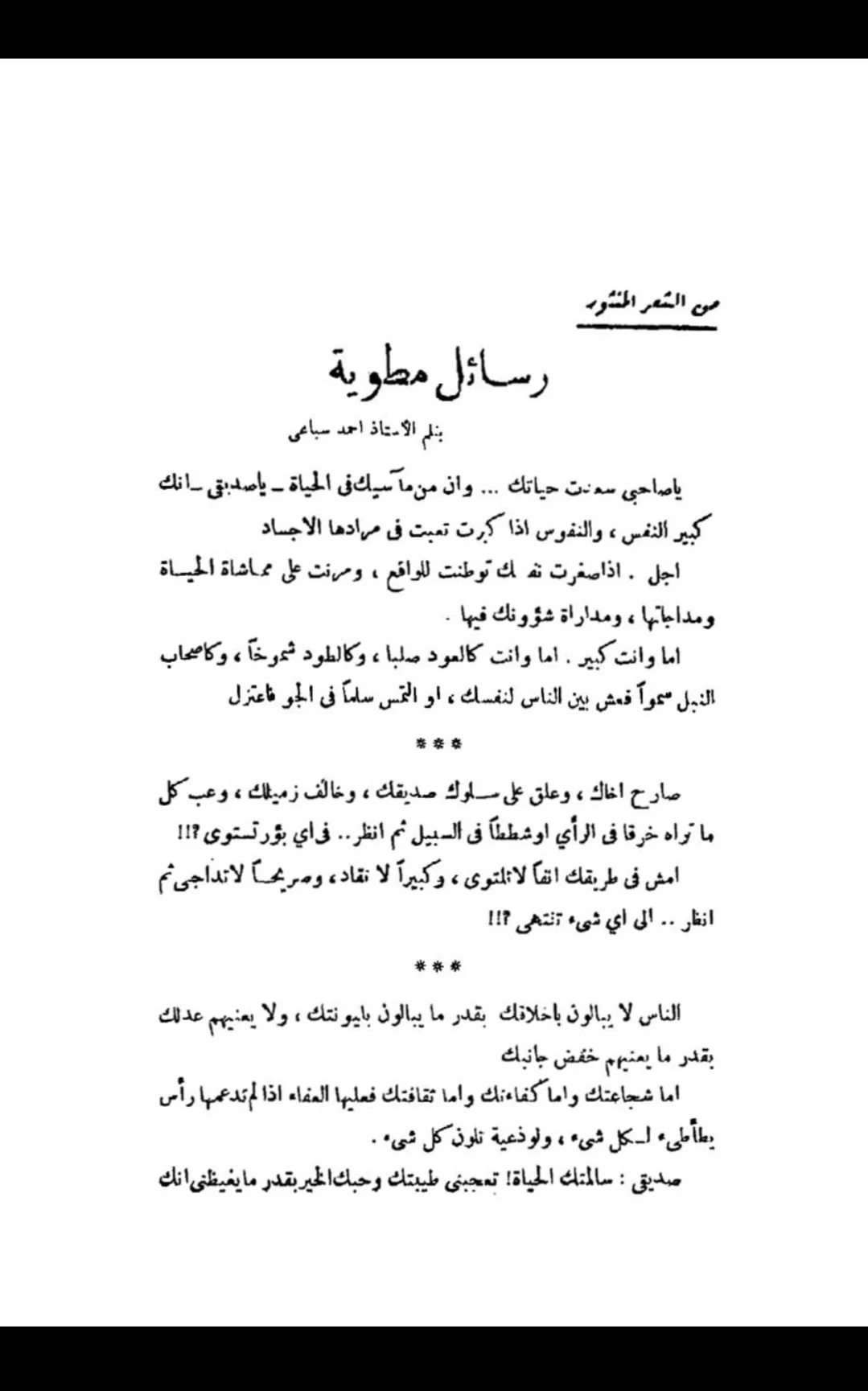
In Issue No. 10, published on 1 October 1946, another prose poem was published under the title “Folded Letters.”
Critical writings contained brief and passing references to his work in the art of prose poetry.
Ahmad Al-Sibai (1323–1404 AH) was a pioneering Saudi writer, historian, and journalist, regarded as one of the most prominent figures in intellectual and literary life in Makkah. His works covered a variety of fields, including history in History of Makkah, short stories in My Aunt Kadrjana, and autobiography in My Days, in addition to his pioneering contribution to educational curricula through The Ladder of Arabic Reading. His style was distinguished by social reform and a combination of realism and local Makkah identity.
Among his most prominent literary works are History of Makkah, the short-story collection My Aunt Kadrjana, Diary of a Madman, Abu Zamil, his autobiography My Days, Let Us Walk, An Idea, and Folk Proverbs in the Cities of the Hijaz.
He was also the first to establish a printing press for the magazine Quraysh, which he served as editor-in-chief. Through his writings, he sought to challenge social and cultural stagnation. He received the State Appreciation Award in its first edition in 1404 AH, in recognition of his literary and historical contributions.
Below are the beginnings of the three rare texts published by Al-Manhal Magazine. He begins his text:
“Whose Are These Ruins Along the Banks of Al-Aqiq?”
“Whose is the abandoned dwelling between Ranonah and Al-Jamāʾ?
Whose are these traces beneath the protection of Ayer, on the slopes of Al-Harar and the heights of Urwah?
Whose are these ruins along the banks of Al-Aqiq, lying in the embrace of the mountains between one age and another?
Whose are these visible remains along the edges of the silver-colored watercourse, appearing in their grandeur and pride as though they were some mighty giants of life, challenging the forces of life and mocking the ravages of time?”
The beginning of the text “To My Mad Friend” reads:
“My friend:
Was it your own decision to assume this madness, or was it the divine decree and choice of fate?
If you were the one who chose and fashioned it, then you are a master, and in your mastery you are a genius. You knew how to surpass people, you knew how to play and laugh, you knew how to mock and ridicule, you knew how to make fun of people's circumstances, and you knew how to free yourself from them.”
As for the beginning of the third text, “Folded Letters,” it reads:
“My friend: May your life be blessed.
One of your tragedies in life, my friend, is that you are great of spirit. If you were to make yourself small, you would become accustomed to reality, learn to go along with life and accommodate it, and manage your affairs within it.
But as you are great, as you are firm like a staff, lofty like a mountain, and noble like people of honor, then live among people for your own sake, or seek a ladder into the heavens and withdraw.”