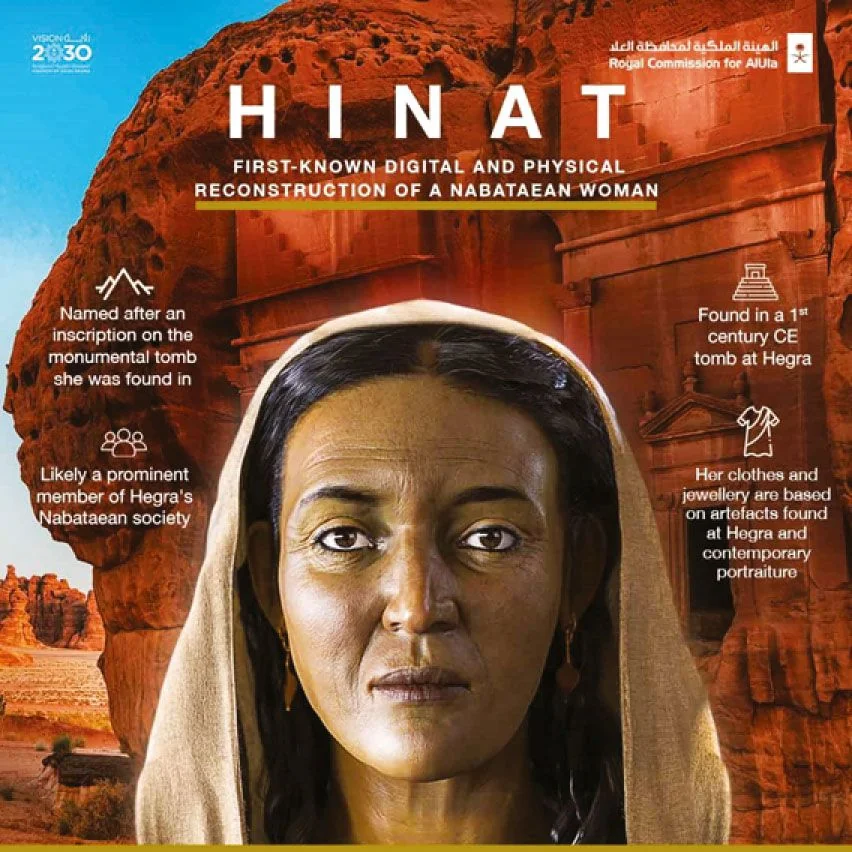
A cultural narrative in Al-Hajar and Mada'in Saleh... Hina bint Wahb is the first Nabataean woman to have her face reconstructed in the world
Conditions of Knowledge – Special
Today, she has become part of a civilizational narrative, and news outlets circulate echoes of her story as the first Nabataean woman in the world whose face has been reconstructed. She is Hinat bint Wahb, or (Hanat bint Wahbu), the most famous Nabataean woman today, whose fame has even surpassed that of the Nabataean queens. She is the first woman identified by name whose tomb, bearing a royal inscription, archaeologists and excavation specialists have been able to excavate, whose remains they have been able to discover, and whose image they have been able to contemplate. Artificial intelligence, together with anatomy and forensic medicine, successfully created a three-dimensional digital reconstruction of her based on what is believed to be her skeletal structure. The sculpted face has thus become a witness to a civilization said to be 7,000 years old, and a testament to a Nabataean woman who lived during the first century AD in a flourishing life within an advanced civilization. Today, she has become a historical icon representing one of the ancient Nabataean women who found eternal rest in the historic burial grounds of Al-Hijr.
Ornamented Discoveries:
Some sources and references, based on the findings of the French mission in AlUla, indicate that the number of women's tombs in Al-Hijr/Mada'in Salih (AlUla Governorate) that have been uncovered so far is seven tombs belonging entirely to women, and three others jointly owned by women and men. These are among 36 Nabataean tombs bearing 39 inscriptions, as some tombs contained two inscriptions, one external and one internal. Thirty-three of these date from between the first year BC and 74 AD. This number also includes three tombs dating to the post-Nabataean period, dated to 268 and 356 AD. These are part of approximately 109 tombs uncovered in Al-Hijr, including tombs with decorated and undecorated facades.
The tomb of Hinat bint Wahb (d. 60/61 AD) left an inscription specifying who her heirs were and who had the right to be buried in this tomb, forming part of the legal literature associated with the tombs of Al-Hijr. When it was excavated in 2008, it provided us with rich information about everything it represents in terms of history and society. It is the first and only tomb belonging to a woman to have been excavated to date. It is worth noting that these tombs, whose facades fill the Al-Hijr/Mada'in Salih area, are the product of Nabataean human creativity in the first century BC, an achievement in whose selection, creation, and ownership Nabataean women also participated.
The Nabataean civilization emerged before the advent of Islam, and its flourishing features appeared across the land of AlUla over a period of 7,000 years, as manifested in the carving of ancient rock symbols and the architectural shaping of mountains in a distinctive style. The kingdoms of Dadan and Lihyan flourished, and the thriving city of Dadan was established, rich with numerous archaeological remains that have yet to be discovered. Archaeological evidence indicates that AlUla attracted the attention of the Nabataeans around the first century BC, leading them to establish numerous cultural and civilizational monuments there.
Archaeological Landmarks:
The archaeological site of Al-Hijr in AlUla Governorate contains archaeological landmarks dating back to different periods. Among the most famous are the Nabataean tombs carved into the mountains in a unique architectural style, dating to the first century AD. They reflect the advancement of engineering and artistic knowledge and the ability of human beings to shape and manipulate rock.
According to the Royal Commission for AlUla, the site contains approximately 141 rock-cut tombs, 93 of which feature facades carved with intricate geometric decorations. They are distinguished by their decorated facades and inscriptions carrying religious and social meanings that document the prevailing ways of life at the time. This highlights the architectural and artistic status achieved by this civilization in rock carving and facade design.
Al-Hijr is the first Saudi site to be inscribed on the UNESCO World Heritage List, due to the clear archaeological evidence it provides of the history and civilization of the region.
The inscriptions on the entrances of the tombs reveal information about social and professional figures. Archaeologists discovered the remains of approximately 80 individuals in a single tomb. Among the most notable discoveries are the remains of Hinat bint Wahb in the Jabal Al-Ahmar group of tombs, providing a human dimension to the role of women in Nabataean society. Her facial features were reconstructed using modern techniques under the supervision of the Royal Commission for AlUla, through an international team that included archaeologists specializing in Nabataean civilization and several experts. This became the first facial reconstruction of a Nabataean woman in the world. It is believed that she was more than 45 years old at the time of her death. Meanwhile, the visitor center at Al-Hijr presents the story of Hinat through an educational experience highlighting the human dimension of the site's civilizational heritage.
In February 2023, a three-dimensional model appeared depicting what was said to be Hinat bint Wahb in her appearance and form, perhaps even with an approximation of her flesh and body, presenting an interpretation of her facial features, skin color, eyes, and hair. This was based on an analysis of information about the current inhabitants of AlUla and their range of skin tones in order to reach the most accurate possible approximation of her complexion.
National Geographic then presented it on its website under the title “Meeting Hinat”, along with an account of her story. It was later installed at the Al-Hijr Visitor Center. This project had been undertaken by the Royal Commission for AlUla since 2019 with a team of archaeologists and forensic scientists, within what is believed to be a genomic project studying ancient samples from the Arabian Peninsula, emerging from the Saudi Genome Project. The project tells a civilizational story that continues to be filled with remarkable archaeological treasures that history will preserve.
Footnotes:
· https://www.experiencealula.com/ar/forever-revitalising/history/powerful-women-of-ancient-arabia