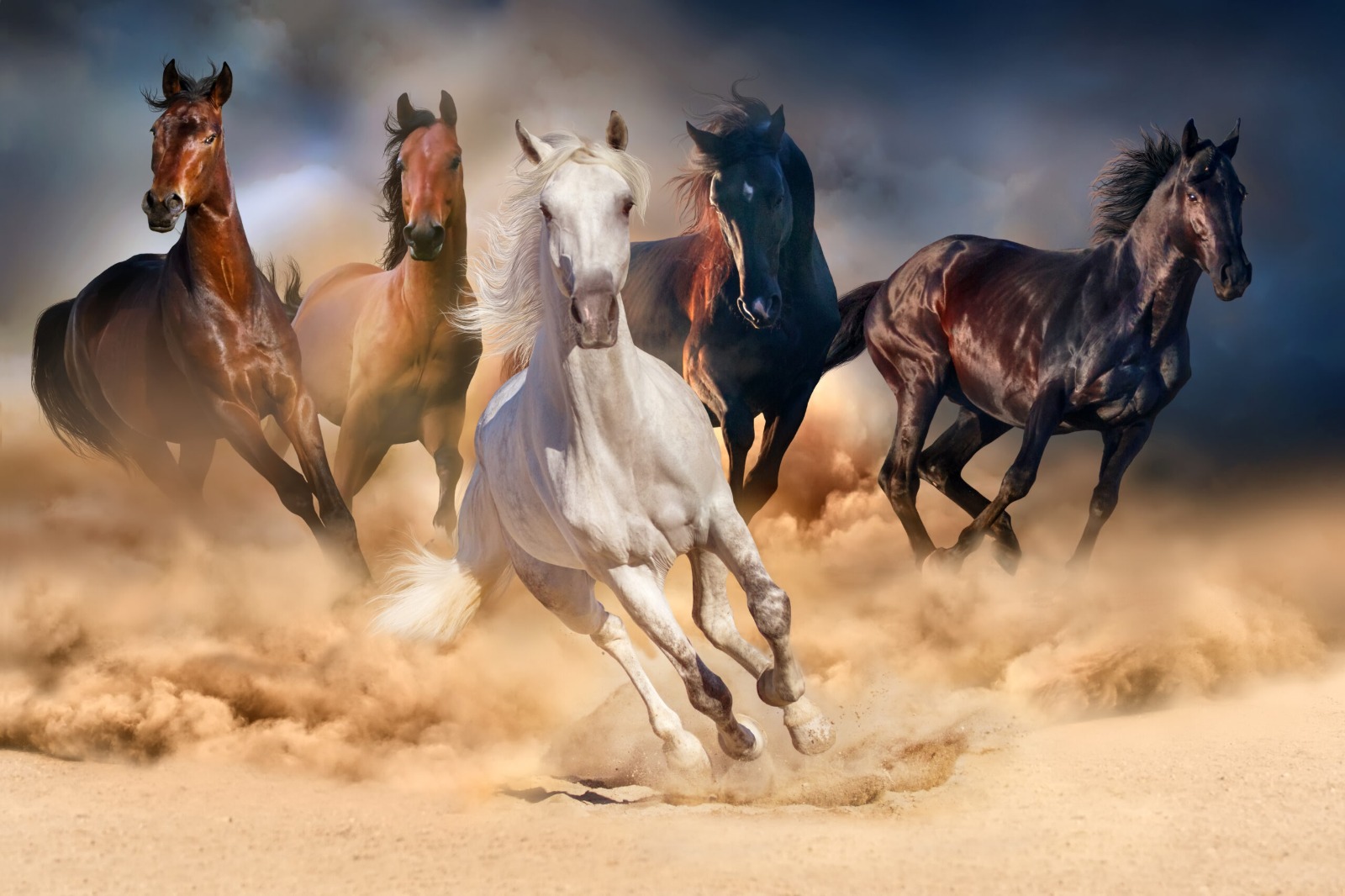
The Speeds of Arabian Horses in Heritage: Between Melodic Rhythm and Racing Gallop
Knowledge Affairs – Special Report
Among the most famous poetic verses describing Arabian horses and their various speeds and movements are those found in the Mu‘allaqa of the Arab poet Imru’ al-Qais, who said:
I set out at dawn while the birds remained in their nests,
On a lean, powerful horse that captures even the wild beasts.
Charging and retreating… advancing and withdrawing together,
Like a massive boulder hurled down from above by a torrent.
It has the flanks of a gazelle and the legs of an ostrich,
With the extended stride of a wolf and the swift approach of a fox.
Imru’ al-Qais described several rhythmic and melodious movements of his horse, harmoniously coordinated in a distinctive manner. These include charging, retreating, advancing, withdrawing, extending its stride, and moving closer. These movements have specific meanings in the world of Arabian horses, illustrating an ordered, rhythmic pattern of speed that alternates between charging and retreating. He also compared the horse’s speed to that of other animals, describing how it stretches its stride like a wolf or approaches its small prey quietly and unnoticed like a fox.
In contrast to Imru’ al-Qais, who describes the swift movements of his horse, some poets described slower movements. Among them was Antarah ibn Shaddad, who said:
He turned away from the impact of the spears against his chest,
And complained to me with a tear and a soft neigh.
Degrees of Horse Speed:
Arab poets excelled in describing the speeds and movements of horses, classifying them with remarkable precision to reflect a horse’s strength and skill in charging and retreating. Traditional poetry describes various degrees of horse speed, including taqrib, a fast, coordinated gait or light canter that flows like water; sabuh, a term used for a horse whose legs seem to swim through the air or across the surface of water because of their speed and lightness; and irqal and full-speed running, which describe an intense gallop in which the horse’s strides fly like an arrow or a massive boulder swept down by a torrent.
The natural gaits of horses are divided into four basic levels, progressing from the slowest to the fastest: walking (Walk), trotting (Trot), cantering (Canter), and galloping at full speed (Gallop).
They can be described as follows:
Walking (Walk): The horse’s slowest gait, consisting of a regular rhythm of four successive steps. At this pace, a horse covers approximately 6.4 kilometers per hour.
Trotting (Trot): A faster movement in which the horse’s hooves strike the ground in two regular beats. Its speed is approximately 13 kilometers per hour.
Cantering (Canter): A regular three-beat gait considered moderate to fast, ranging from 16 to 27 kilometers per hour.
Galloping (Gallop): The horse’s fastest movement, characterized by four rapid and powerful beats. Thoroughbred horses can reach speeds of more than 60 kilometers per hour over short distances.
Visual Comparisons:
Arab poets excelled at describing the speed and sudden bursts of horses, considering them symbols of strength, pride, and survival during battles and journeys. They used a variety of visual comparisons to portray equine speed, as reflected in Arabic poetry and prose throughout the Arab heritage. Poets compared fast horses to fierce winds because of their lightness and forceful momentum. They also described a horse’s movement as rapid swimming because of its smooth, flowing motion, and compared its speed to that of wild animals fleeing from hunters.
Among the most notable poets who used these comparisons were Imru’ al-Qais, Tufayl al-Ghanawi, and Malik ibn al-Rayb, particularly in their descriptions of the horse’s speed and extraordinary strength. Malik ibn al-Rayb composed a remarkable verse expressing his horse’s sorrow, saying:
And a well-built chestnut horse, dragging its reins,
Was led toward the water, though death had left it no one to give it a drink.
Abu al-Tayyib al-Mutanabbi also combined precise descriptions of movement with the horse’s tremendous speed in battle, portraying the rider and horse as a single entity:
With a keen-edged blade, I moved between the two armies,
Until I struck while the waves of the sea crashed against one another.
Its legs in the gallop become one leg, and its forelegs one hand,
And its actions fulfill whatever the hand and foot command.
Likewise, al-Buhturi immortalized the speed of horses on racecourses, illustrating how the powerful sound of their hooves seemed to let them outrun the wind.
Among the most famous books addressing horse lineages, breeds, characteristics, and speeds are Ancestries of Horses by Ibn al-Kalbi (d. 204 AH), Horses by Abu Ubaydah (d. 209 AH), The Book of Horses by al-Asma‘i (d. 215/216 AH), and The Names of Arab Horses and Their Riders by Ibn al-A‘rabi (d. 231 AH). These works form the foundational heritage of Arabian horse studies, documenting their types, colors, sizes, and most famous names in Arab and Islamic tradition. Horses have been closely connected to Arab life since pre-Islamic times and continue to hold this significance today.
The number of Arabic titles identified in specialized bibliographic studies—such as Horses and Horsemanship: A Bibliographic Study, published by the King Abdulaziz Public Library—is approximately 838 printed titles, out of a total of 2,262 Arabic and foreign-language titles covered by the study. Meanwhile, some recent exhibitions and research collections, such as the Origin of the Horse exhibition, have brought together and documented more than 200 books and manuscripts for specialized events. However, no comprehensive final count exists of all works published in Arabic throughout history.